Impending deadlines for compliance with the International Accounting Standards (IAS) will require hard work on the part of many accountants and R/3 specialists. The problem posed by IAS is that, in most cases, two or more sets of figures have to be managed because of the differences among IAS, US GAAP, and national fiscal reporting.
Impending deadlines for compliance with the International Accounting Standards (IAS) will require hard work on the part of many accountants and R/3 specialists. By 2005, all companies listed on a European Union (EU) stock exchange have to be in compliance with IAS.1 European companies also listed with an exchange in the United States have until 2007 at the latest. The requirements will affect U.S. subsidiaries of these companies. Non-listed companies should be alert as well. European banks already tend to require IAS compliance in loan applications. (See, "International Accounting Standards (IAS) Grows in Stature," below.)
The problem posed by IAS is that, in most cases, two or more sets of figures have to be managed because of the differences among IAS, US GAAP, and national fiscal reporting. (See, "Examples of Differences between IAS and US GAAP," below.) Time is running out, because in reality, changes have to be in place as early as 2004 to provide a comparable set of figures.
SAP has provided you with two options for complying with IAS requirements. (See, "Pros and Cons of Aligning Your System with IAS," below.) Both of the following methods could require a system overhaul, because prerequisites include a central chart of accounts and fewer controlling areas than many systems have:
- Special G/L accounts allowing different financial statements based on account selection. For example, a credit is automatically posted to two different G/L accounts, each with its own rate.
- One or more parallel ledgers in which the alternative values are stored. For example, a credit is automatically posted to ledgers with different accounting principles.
This article describes how both options for achieving IAS compliance work, using the example of foreign currency open items revaluation. (Table 1 compares the methods for foreign currency open items revaluation via manual processing, special G/L accounts, and parallel ledgers.)
Tip!
The same information is relevant for other valuation processes, such as depreciation and stock valuation.
| Manual adjustment |
- In manual adjustment, you calculate the final currency valuation adjustment per quarter and at year-end based on the foreign currency positions at month-end.
- At best, this will result in an estimate. You need to convince your accountant and/or the tax authorities that it is accurate enough.
- Not a good option for dealing with multiple currencies or a high volume of transactions.
|
| Special G/L accounts |
- Foreign currency valuation depends on the accounts selected in your financial statement version.
- Depending on the financial statement version, your report will contain the correct value according to US GAAP, IAS, or reporting to local tax requirements.
- Simple method that users generally can modify without further outside help, depending on the issues involved.
|
| Parallel ledgers |
- Foreign currency valuation differs between the financial and the special ledger. This allows for parallel ledgers according to different accounting principles (e.g., US GAAP and IAS).
- It is still possible to use special G/L accounts in the financial ledger to further differentiate reported values according to tax requirements.
- Good option when postings are too complex for one general ledger. Allows companies to keep traditional reporting formats.
|
|
|
|
| Table 1 |
Comparing methods for complying with IAS using the examples of foreign currency valuation |
Method 1: G/L Accounts
The simplest and most commonly used method of handling IAS is the use of special G/L accounts in which a single debit or credit is posted to two different G/L account numbers, each with a unique rate (i.e., parallel valuations). Reports use sets of accounts according to the accounting principle that is to be applied, resulting in financial statements according to different valuations.
In the following example, I’ll show you how to use this method to differentiate between IAS foreign currency open items valuation and the method required in Germany by tax legislation.
First, divide the G/L into three different sets of accounts: local accounts, IAS accounts, and common accounts. (See Figure 1.) IAS reporting is based on a selection of common and IAS accounts. All other reports combine common accounts with local accounts.
In this example, you need these accounts:
1. G/L accounts: open items (accounts receivable in the example)
2. G/L accounts according to IAS accounting principles: foreign currency correction open items; P&L account: foreign currency valuation gains; and P&L account: foreign currency valuation costs
3. G/L accounts according to German tax law (HGB): foreign currency correction open items; P&L account: foreign currency valuation gains; and P&L account: foreign currency valuation costs
To report according to IAS, select the accounts under examples 1 and 2. In the case of German tax law, the selection in your financial statement version will be examples 1 and 3.
Let’s look at the details:
Open items in foreign currencies are valuated according to the exchange rate at period-end closure. HGB adheres to a strict lowest-value principle. Using special sets of accounts, you can manage this difference by posting the valuation twice, once on HGB accounts (local) and once on IAS accounts.
In Figure 2, note the three open items that were posted with three different exchange rates. According to HGB, only item "b" needs revaluation because the exchange rate is higher than the period end rate of 2.32. The revaluation is posted as a revaluation cost. According to IAS, all items are revaluated against the month-end rate. This results in a cost of 18 for the item valued at an exchange rate of 2.50 and a gain of 32 for the item valued at 2.00.
As a last step, generate your reports:
- Reporting according to IAS is based on accounts in examples 1 and 2. The reported foreign currency valuation is a debit of 14 (32 minus 18).
- Reporting according to HGB is based on accounts in examples 1 and 3. The reported foreign currency valuation is a credit of 18.
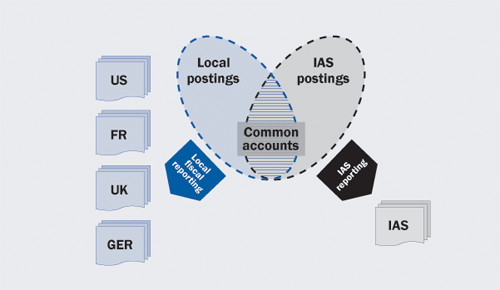
Figure 1
Sets of accounts in the G/L
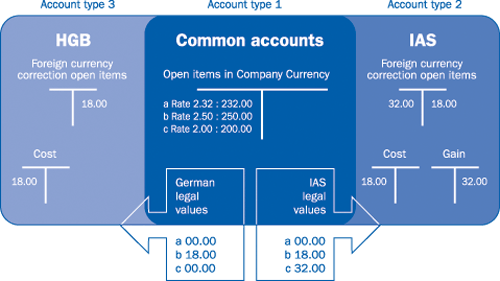
Figure 2
Dealing with different valuations within one system (exchange rate at month-end = 2.32)
International Accounting Standards (IAS) Grows In Stature
As long ago as 1973, accountancy bodies in Australia, Canada, France, Germany, Japan, Mexico, the Netherlands, the United Kingdom/Ireland, and the United States agreed to strive for common accounting standards. The aim was to create a more efficient capital market by establishing transparent and comparable figures.
Various international bodies were created, culminating in the independent IAS Board, which is headquartered in London. IAS is rapidly growing in international stature. The European Union, Hong Kong, Switzerland, the Russian Federation, Egypt, and South Africa have accepted its accounting principles.
The board took its cue from the uniform American practices embodied in US GAAP (Generally Accepted Accounting Practices). However, important differences between the two standards still exist. Despite a recent meeting between the governing bodies to discuss further convergence, those differences are expected to remain for some time. This means that many international companies with listings on stock exchanges in both the United States and in Europe will have to manage parallel accounts to deal with the diverse reporting requirements, which take effect starting in 2005.
The Web offers a number of downloadable publications that provide a general overview of IAS. Web resources include:
- IAS in your pocket, available from www.iasplus.com. This site offers a lot of interesting, up-to-date material.
- International Accounting Standards Similarities and Differences: PriceWaterhouseCoopers. Available from www.pwcglobal.com. Click on Publications, do a quick search for IAS, and then an advanced search for International Accounting Standards Similarities and Differences.
Method 2: Parallel Ledgers
The second option for tackling IAS compliance is the use of parallel ledgers. Until now, this has rarely been used to deal with IAS.2 The main reason seems to be its comparative complexity and required system knowledge.
Most companies seem happier with special accounts. It is something they can fully grasp, and the activities in the R/3 system are restricted and reasonably simple, such as creating new financial statement versions and obtaining parallel postings in the case of currency valuations, depreciation, and stock valuations. Furthermore, users can modify this process without further outside help once it is in place. However, a parallel ledger is a logical choice if modeling all the various postings within one general ledger becomes too complex.
The principle of a parallel ledger is that you can automate postings according to different accounting principles.
Going back to the example of IAS and HGB foreign currency valuation, you follow the same steps, but with parallel ledgers you have the following:
The FI module uses US GAAP accounting principles. To allow for national tax requirements, special accounts are used. The special ledger contains a copy of relevant financial postings according to IAS accounting principles. Figure 3 shows how this works.
Apart from allowing parallel reporting, the advantage of a special ledger is the ability to maintain known reporting formats (US GAAP) in the financial ledger. This gives management, which often reacts adversely to changes, consistent key performance indicators and traditional financial key figures.
The data flow for a special ledger is depicted in Figure 4.
You can select any transaction type to be transferred to the special ledger. This creates an automatic copy in which additional postings are possible.
Special ledgers are a standard R/3 functionality. To facilitate the IAS ledger, Enterprise has some additional special features. For example, the special ledger supports the posting of an alternative foreign currency valuation. All customizing transactions are bundled under one heading in the IMG.
IAS reports are in most cases generated automatically along with the usual finance reports according to US GAAP. In the example of foreign currency valuation, the IAS postings are transferred to the IAS ledger.
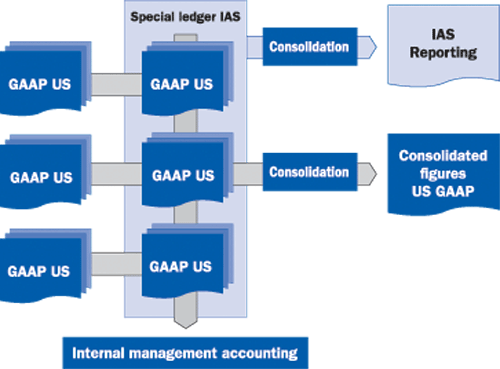
Figure 3
Using a special ledger to introduce two parallel accounting principles
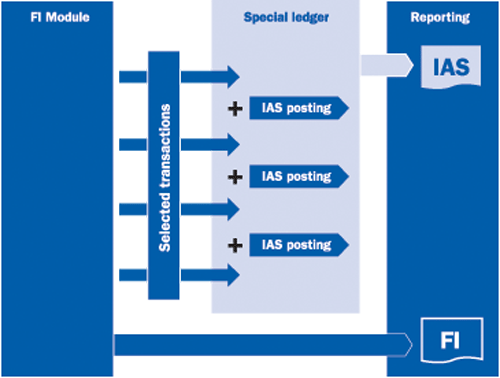
Figure 4
Data flow using special ledgers
Examples of Differences Between IAS and US GAAP
To get your system ready for IAS, you should first analyze the differences between your current practice and the new standard. These examples are based on publications of some of the major accounting firms. They are no more than an indication of the type of differences that might confront you.
- In IAS, a moving average price is preferred. In US GAAP, the normal approach is standard price.
- IAS often requires (re)valuation of assets according to fair value. US GAAP, in general, does not.
- Changes in “fair value” of investment assets must be recorded in IAS and should be taken into account in the income statement. US GAAP does not have this requirement.
- IAS contains basic rules for the structure of your balance sheet that might differ from your current reporting format.
- IAS allows for both cost of goods sold and categorical reporting. US GAAP only allows for cost of goods sold.
- As soon as land and property are not used in the business, they should be considered investment property under IAS. This is not the case in US GAAP.
- In IAS consolidation, the actual control involved in the relationship determines the ownership. In US GAAP, definitions relate to risk and rewards.
- The areas of pensions and financial instruments differ. Discussions on these points, however, have not been finalized.
Pros and Cons of Aligning Your System with IAS
A major decision you must make is whether to move to a system configuration based on IAS and/or US GAAP requirements, or to account for IAS with manual processing. Many companies with older systems have configurations based on company codes with their own charts of accounts. To use the special account or parallel ledger processes, your company needs a single chart of accounts. Given the impact of a restructuring approach, it would be logical to upgrade to the latest release at the same time. Companies will need specialized accountants for this assessment process, and it is questionable if there will be enough of them.
Moving to a single chart of accounts offers several advantages:
- Transparency of data, more control, and ease of introducing new accounting procedures.
- Greater ease of consolidation within your R/3 system and savings on license costs for additional business management software systems.
- Possibility of integrated cash management and treasury for the whole of your business to reduce costs related to cash flow.
- Improved benchmarking of internal figures.
- Unified controlling area increases the quality of your management accounting.
On the other hand, the move to a single chart of accounts has drawbacks:
- Loss of historical comparability.
- Different key figures that managers have to learn.
- Extensive training and change management in the F&A department and a major effort in training and change management for customers.
Tip!
All approaches within the financial realm involve some kind of double valuation, either through special accounts or through special ledgers. This "doubling" cannot be used in controlling. If, for example, both the IAS and the US GAAP currency valuation are posted into controlling, they are added together in product costing or automatic calculation of tariffs. Although you can do a lot through specially programmed ABAP routines, in general, it is wiser to use only one accounting approach to be copied in controlling to avoid these issues.
Dr. Stef G.M. Cornelissen
Dr. Stef G.M. Cornelissen, MBA, is an experienced international SAP business consultant from the Netherlands with certifications in FI, CO, and SD. He took part in important international projects involving the large Dutch multinationals. Before specializing in SAP, he worked as a management consultant and was a senior advisor to the Board of Directors of the University of Nijmegen. Stef's academic background is in business administration, economics, and organizational science. He is the owner of Bowstring BV and principal partner at Sperry Associates.
You may contact the author at info@bowstring.nl.
If you have comments about this article or publication, or would like to submit an article idea, please contact the editor.



 Premium