SAP SPM
What is SPM?
Service parts management (SPM) is a cross-component solution to support and manage the extended service parts network. It consists of two business areas: service parts planning and service parts execution. Organizations often deal with a high number of stock-keeping units (SKUs) for aftermarket service that can come from multiple locations. Lifecycle management is important due to the large volume of SKUs and warranty agreements; surplus and obsolescence issues are common. SPM covers the entire range of service parts management activities, planning, execution, fulfillment, collaboration, and analytics.
What is SPM?
Service parts management (SPM) is a cross-component solution to support and manage the extended service parts network. It consists of two business areas: service parts planning and service parts execution. Organizations often deal with a high number of stock-keeping units (SKUs) for aftermarket service that can come from multiple locations. Lifecycle management is important due to the large volume of SKUs and warranty agreements; surplus and obsolescence issues are common. SPM covers the entire range of service parts management activities, planning, execution, fulfillment, collaboration, and analytics.
Key Capabilities of SAP Service Parts Management (SAP SPM) are:
- Architecture and Communication: Communication methods to transfer data through the SAP landscape
- Extended Inbound Delivery Processing: Exchange of advanced shipping notice (ASN) IDOCs, SAP Extended Warehouse Management (SAP EWM), or third-party orders to ensure accuracy
- Contract Packager Inbound: A contracted third-party service provider supporting the inbound processes
- Third-Party Order Processing: Support for direct shipping from the vendor to a customer
- Outbound Processing: Support for transmission of data between originating systems
- Transfer and Inventory Management: Transfers of stock from connected systems to the SAP EWM
- Complaints and Returns: Returns management for unused or damaged parts from customers
- Quality Management: Ability to perform quality inspections
- Transportation Cross-Docking: Consolidation of deliveries from different warehouses into one shipment
- Foreign Trade: For a bonded warehouse, letter of credit, or creating an intrastate declaration
- Business Package for External Users: Collaboration with ability to perform functions in a SAP NetWeaver portal
SAP now offers SAP Service Parts Management ES Bundle. This extends the capabilities of the existing platform with a seamless business network for external service parts inventory planning and optimization application. Prior solutions for this were only available through custom integration efforts.
5 SPM Benefits are:
- Enhanced customer service
- Visibility to see where the need is and where the parts are going
- Ability to keep inventory low and to reduce carrying costs
- Improved coordination and collaboration control of the network
- Standardized processes
Vendor partners that can help with service part management are: Accenture, Capgemini, and Westernacher Consulting.
Key Resources for SAPinsiders:
- Consignment Process in Enterprise Asset Management Reduces Spare Parts Inventory. Gain insights on how to execute vendor consignment to reduce the inventory of spare parts.
- Squeezing Inventory into an Extract Value in an OEM Service Parts Environment. Learn how Barloworld Equipment in Southern Africa utilizes SAP Advanced Planning and Optimization to manage a massive amount of SKUs and plants.
- Track Multiple Manufacturer Part Numbers Effectively Using Manufacturer Part Number Management. Read about tips and tricks to set up manufacturer part numbers (MPNs) to manage multiple vendor part numbers effectively.
520 results
-

SAPinsider 2020 Announces Powerful and Diverse Keynote Lineup to Headline Virtual Conference Experience Aug. 18-21, 2020
BOSTON – August 5, 2020 – SAPinsider, the world’s largest and fastest-growing independent membership organization of SAP professionals, announced today the keynotes to headline their Four-Day Live Virtual Conference Experience, August 18-21. Keynote Speakers Include: Anthea Stratigos, CEO of Outsell (Panel Moderator) Alison Biggan, President Corporate Marketing, SAP Judith Williams, Head of People Sustainability and SVP,…
-

SAPinsider 2020 Virtual Conference Experience To Welcome Record Attendance August 18-21
BOSTON – August 18, 2020 – SAPinsider, the world’s largest and fastest-growing independent membership organization of SAP professionals, announced, the doors to its inaugural virtual conference will open at 10:00 AM ET today, to its largest audience ever. The Live event runs Tuesday August 18 through Friday August 21, 2020. A powerful line-up of keynote…
-

SAPinsider 2020 Virtual Conference Experience Draws Thousands, Provides New Immersive Experience
BOSTON – August 20, 2020 – SAPinsider, the world’s largest and fastest-growing independent membership organization of SAP professionals, continues to welcome members of the SAP ecosystem to its inaugural virtual conference, today and throughout the week. Live sessions started on Tuesday, August 18, and run through Friday August 21, 2020. More than 6,500 registrants have…
-
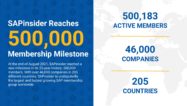
SAPinsider Reaches 500,000 Membership Milestone
BOSTON, MA – At the end of August 2021, SAPinsider reached a new milestone in its 25-year history: 500,000 members. With over 46,000 companies in 205 different countries, SAPinsider is undisputedly the largest and fastest growing SAP membership group worldwide. These record numbers amplify SAPinsider’s commitment to delivering cutting-edge content that helps the SAP user…
-

SAPinsider Announces Acquisition of MasteringSAP
Purchase Solidifies SAPinsider as the Largest Global SAP Member Community BOSTON, MA – October 22, 2021 – SAPinsider, the largest and fastest-growing SAP membership group worldwide, today announced the acquisition of Australia-based MasteringSAP. The combination brings together the two strongest brands in the SAP professional community. With more than 50,000 loyal members built over a…
-

Mastering SAP June 2023
We’re bringing the thriving Mastering SAP community together – 800+ people, 2 days, 90+ hours of brilliant content and a plethora of unrivalled networking opportunities – to celebrate the talent, innovation and ideas literally transforming the way we work. 7-8 June, Melbourne. Register today!
-
 Premium
How SAP Business AI and SAP Asset Performance Management are Closing the Loop between Maintenance Strategy and Execution
SAP Asset Performance Management (APM) helps asset owners, managers, plant managers, reliability engineers, and maintenance technicians to define, implement, execute and monitor the optimal asset maintenance. Mastering SAP Premium Access Membership Required You must be a Mastering SAP Premium Access member to access this content.Join NowAlready a member? Log in here
-

LRS Meets Pressing Printing Needs of Modern Digital Supply Chains
Reliable printing solutions, critical for efficient supply chain and asset management operations, are often overlooked despite their importance in ensuring timely production of essential documents like labels and picking slips, with LRS offering certified output management solutions to address these issues amidst the transition to cloud technologies.
-

AI Agents: Transforming SAP Integration with Innovation and Compliance
Boomi is enhancing its SAP integration solutions with AI Agents focused on automating tasks and ensuring compliance with data privacy regulations, while developing an ‘AI Agent Registry’ for responsible governance, amidst growing concerns over security and compliance in AI implementation.
-

SailPoint deployment with SAP GRC/ Access Control
SAP Access Control (also generally referred as SAP GRC or SAP GRC Access Control) is a solution from SAP that enables organizations to control access across various SAP systems, minimizing the time and cost of compliance. It is an add-on to SAP NetWeaver platform, and works with SAP applications such as SAP ECC 6.0, and…
Your request has been successfully sent