See how the Port of San Diego struggled with user adoption after the implementation of SAP CRM. Learn some of the expected (as well as unexpected) risks that an organization can encounter after introducing new software such as SAP CRM, and read about techniques to help end users embrace it.
Key Concept
End-user adoption refers to the moment when end users understand the value of a product (in this case, SAP CRM) and begin to fully use its functionality. It can also include the time after the adoption when end users find new and different ways to use SAP CRM in their business.
In the previous articles on the Port of San Diego’s SAP CRM implementation, I covered how my team and I selected SAP, implemented it, and considered an upgrade or reimplementation. Now I describe some of the project management challenges for SAP CRM user adoption, what we tried, and what worked for our organization — along with our efforts to continue overcoming some of these challenges.
Common Organizational Risks
Common risks go along with many projects, and considering these potential risks ahead of time is half the battle. No matter what kind of project, if a risk occurs, determining what to do next is always important and can make or break the success of your project.
As we progressed through our SAP CRM project, we found various risks — some anticipated and others unexpected. We realized halfway through the project that the business leaders were not as engaged as we anticipated they would be. This trickled down through the organization and there was a perceived message that the CRM program, including SAP CRM, may not have been as important as we thought. From the rank and file perspective, many employees feel that “if my boss isn’t asking, it must not be important.” It turned out that the business leaders did consider the CRM program, and SAP CRM, important. They felt it was a very good vehicle to track interactions with the Port’s varied customers. However, they thought that stating it once was enough. Communication with team and business leaders needs to occur over and over throughout the project life cycle. You need to help the business leaders better understand what they need to do and provide them with concrete ways in which they can help.
Next, we found that groups of the customer-facing staff felt there wasn’t enough communication with them, even though the project team and leadership thought there was. We were mostly dealing with perceptions; however, perceptions are often reality so it became important to pay attention to this. Structuring a communications plan that not only carries messages but also engages the team and staff and asks questions is important. You would do well to establish a feedback loop to ensure you’re receiving input for your project, from the project team, staff, and leadership — and back again.
Interruptions of day-to-day operations can slow a project. Build time into your project plan to accommodate these interruptions. Even if you have a dedicated project team, planning ahead for this time can ensure the overall success and acceptance of the project. Teams work best when they have solid deadlines and schedules.
However, if an understanding of the teams’ pressures and feelings are not addressed, morale and productivity can shift. New procedures and processes can leave many feeling unprepared and confused. Training helps, but it’s often more important than showing someone how to click here and fill in a field there. Some form of connection to the new system has to be shown. With SAP CRM, as an end user collects complaints and questions, it may be harder for the end user to find the “what’s in it for me” factor. For the most part, these may be the people doing the perceived extra work by entering the transactions but not necessarily seeing the results of the interactions (and any potential changes that result from the information collected via the interactions). Try to find a connection with them, as they can have the most effect — both positively and negatively.
Next, you may have to deal with competing interests. What’s the likelihood that your project is the only project underway at your company? Organizations are often pulled in many directions, and it’s often unclear which direction is going to have the most pull. How do you get people to participate fully when they don’t always have control of their time? Continued communication and the ability to be flexible can be your salvation.
Lastly, it’s important to understand that many will feel that the old way is the best way. If it’s worked for years, why change now? It can make team members feel as though something was wrong with the way their work was done before. Most people feel attachment and pride regarding their work, so simply stating that a new way is better can make them feel as though their work thus far was wrong. Take a step-by-step approach and assure them that the old way wasn’t wrong. Make it clear that the organization is interested and committed to providing the best service possible for its customers, so finding new ways can be helpful for everyone.
In some ways and to varying degrees, the Port of San Diego experienced each of the risks I described. For each of these risks, a proper communications plan was a significant help. Of all the possible risks, the ones that can cause the most problems are the ones that have real people and staff involved. There are several ways to make sure this doesn’t happen to your company. Looking for small victories can be your biggest route to the top.
Training is extremely important, but the follow-up to the training is more important. According to my observations, trainees take away only about 30% at best from a training session. Following up to determine what learning took place can help make or break your project team and its direction. If your staff doesn’t connect all the aspects of what to do and doesn’t follow through, the project is destined to hit speed bumps. If something doesn’t work the way you think it should, people are more apt to put the blame on the inanimate object — the software, in this case. It’s rare that people realize that they might be the culprits or at least part of the challenge. Therefore, following up with all of the trainees can produce favorable results. First, you might see increased levels of skills. You can catch any bad habits early or give advice quickly on how to best use SAP CRM. You might also catch the misinformed before a less-than-positive opinion is formed. Second, and almost more important, is good will: You want your team members to know that they matter and you care about their progress. Both of those aspects can buy a lot of improvement.
More on this can be seen in what is referred to as the Hype Cycle (Figure 1). Gartner provides an example of what an organization often experiences over time with emerging technology. When the trigger is pulled to begin the new project, everyone is excited about the possibilities. Expectations start to build so much that you hit the peak of expectations. Next comes implementation, and reality begins to set in. You have a new system that was sold as a miracle cure, and it won’t do something you need it to do. The organization quickly slides into the so-called trough of disillusionment. With time, the organization learns and tries to do new tasks, and perhaps someone in that department shows you something you didn’t remember you could do. You start to think that maybe this isn’t that bad and decide to give it another look before completely dismissing the software and working around it. This is where the slope of enlightenment begins. It’s the “aha” moment when you see and remember what you liked about the system in the first place. Lastly, you hit the plateau of productivity. You realize that technology is not perfect, but you can work with it for your benefit. Where the plateau stops in Figure 1 means the cycle starts all over again, because it’s time to upgrade.
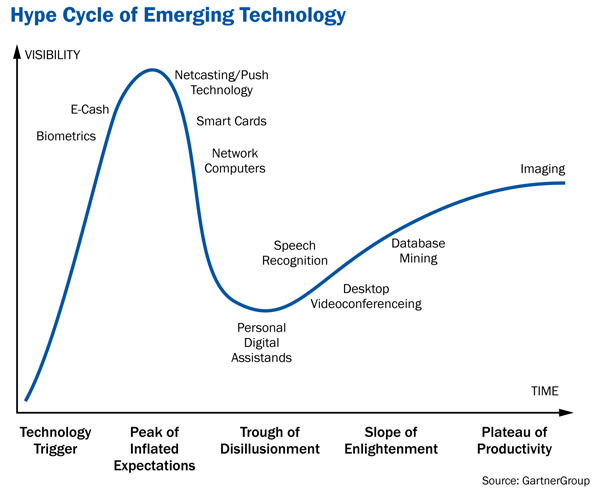
Figure 1
The Hype Cycle
So how do you know where you’re really at in the cycle? You can listen to what your group is saying, for one. Most importantly, look at trends. Running simple reports on volumes, who creates a transaction, where they come from, and more can all help determine what your trend is. When I began to write this article, I had been working in SAP CRM for almost six years. I looked at the data often but realized I hadn’t really reviewed what happened over the full life of the software. When I ran a simple report or two, what I found surprised me. I found that over the first two years, our incoming volume of communication to the Port of San Diego remained relatively static. The number of transactions created as compared to the incoming contact was on the decline. Was this our “trough of disillusionment”? Next, I looked at the next two years and found a slight uptick in transactions.
The next piece was the eye-opener: our system was set so that the majority of incoming transactions were created at the call center, which in turn meant that most transactions were created by that staff. Our communication over the years stated that we wanted more staff (in addition to the call center) to create transactions. We knew calls were being made and conversations were held with customers that deemed follow-up in SAP CRM. It didn’t seem as though we gained a foothold. However, when I ran a report to see who had been creating transactions over four years, I found a sharp rise in transactions created outside of the call center. This meant that those conversations and email were, in fact, entered. We were going to start seeing a clearer picture of what was going on with our customers.
Where We Still Struggle
We learned quite a bit along our journey. Even though we planned and hoped that we covered as much as we could think of and tried to keep the momentum going, we still struggle. Users across the Port have not fully embraced the technology and the program. One of the largest challenges is trying to find the right or best way to connect the dots. We know conversations and actions take place on a day-to-day basis with customers. Sticky notes, email, and the telephone are all used to convey the necessary information. However, often both managers and end users aren’t connecting that they can use the information as part of SAP CRM. We’re still trying to figure this out.
Some have embraced the program and understand it. They see the value and now want more, such as the Case Management functionality, which helps them when interactions are longer in their particular life cycle. Many of our transactions are so-called one-and-done or question-and-answer transactions that quickly pass to the next person. Case Management can help when multiple staff members need to interact and document the steps taken before a final resolution is prepared. Our Park Permitting group is also interested in being able to incorporate their transactions. Their time needs are greater but they also require a calendar to show locations that are available, booked, and reserved. Case Management is one possibility, but we’re open to finding other new and innovative solutions that could potentially work.
We are contemplating bringing in an expert to strategize exactly what we want and need. Gathering the requirements in this case is probably best suited for an outsider, as we’ve used up our entire bag of tricks trying to get the information. We’re also in the midst of redeveloping a communications strategy that is Port-wide. This, too, will affect the requirements of an SAP CRM program.
Identifying and Fixing the Trouble Spots
Despite the fact that you need to drive a program and a timeline, start addressing the risks early. Take time to find out what the root causes of your people-related risks are. Why are you receiving pushback? If you can answer this question, you have a better chance to overcome it. Next, try to assign accountability to key leaders. If they’ve agreed to be committed and support the effort, hold them to it and monitor their progress often. Silence from the masses is not always a good thing, because it doesn’t always mean consensus. In addition, don’t forget to check in with the middle levels of the organization. They can delay initiatives and progress by not supporting the efforts of their staff.
To keep things moving best, give your stakeholders an explanation. It’s the four Ws (what, why, when, and who) that they expect answered. They need assurances about what will happen and what you need them to do. They also want to know that their efforts and the program will make improvements and a difference. Ensure you have the right people on board (i.e., the right people on the right teams). How do you know who they are? Ask those who appear to support the program and then ask them who they feel are best suited.
Assuring that your stakeholders are heard should be at the top of your to-do list. It’s important to make sure they don’t think, “Nobody asked me.” Never miss an opportunity to get in front of key people and let them know where the project is and how it is doing. Developing a 30-second elevator speech helps because any time you have someone in front of you, you can use this short speech. Continue to ask them what they think and how they like what they see so far.
Take time to notice and highlight the successes. For the Port, we found out quickly that our park permitting function was in need of an overhaul. SAP CRM put a spotlight on the function to show that it was not working well. A team was deployed to revamp the whole system. It served as an impetus for the review and improvement of other processes.
We also noticed that many of the passengers for our cruise business preferred hard copy information instead of information via the Internet. We approached our marketing group to ask if a hard copy folder could be prepared for this reason. Although the marketing group initially preferred that we direct people to the Web, we were able to provide data from SAP CRM to help plead our case for hard copy information. They were able to prepare information about frequently asked questions immediately, and everyone was satisfied.
Ongoing Change Management
To ensure that our staff was responding appropriately to our customers and stakeholders, we run what’s called an open management report once a month. The report, given to all members of management, contains all open transactions that are past their prescribed closure time. It also lists the department where it was last handled.
What we found was that most departments wanted to make sure they weren’t on the list. Many began running reports ahead of time and making sure their transactions were appropriately addressed and closed whenever possible. It appeared that slight peer pressure is enough to ensure continuous movement.
Never stop identifying trouble spots and working out issues. If you don’t take this step, you could find the project derailed or set back. Continue to get agreement from leaders that you’re headed in the direction that they want. Also, leverage your supporters. Have them speak out on the advantages of the program. People are more likely to take the testimonial of their colleagues over those who are directly behind the change. The more you can keep SAP CRM in the spotlight, the better. If it’s not far from everyone’s mind, it’s easier to have the continued movement.
How We Handled Some of the Changes
If we learned anything along the way, it was to balance communication in the form of information. Once you have informed people, do it again and again. However, I believe it is possible to over-communicate, so it’s important to walk a fine line between just enough and too much. Always let everyone know what’s coming and, more importantly, why. If they understand this and feel part of the communication loop, they can gain confidence and work towards success.
A few major initiatives that helped bring staff towards adoption of a CRM program (including the use of SAP CRM) was customer service week. Every year in October, the nation recognizes and applauds customer service. We thought we would start with a simple recognition, but it grew into something much bigger. We put a board up in our main lobby and let anyone nominate a fellow employee for providing good customer service. We ran out of room on the board quickly. A committee of volunteers delivered treats to each of the nominees along with the write-up of what got them nominated. At the end, we put all of the nominations in a bowl and pulled out several to award prizes. Now this annual week-long celebration is a tradition and produces many happy and proud participants.
We also created an SAP CRM puzzle pack. The SAP CRM staff developed a crossword puzzle, word scrabbles, and fill-in-the-blanks that required players to go into SAP CRM to find the answers (including our Solution Database). The games had to start at the same time and be time-stamped for receipt. This involved the deployment of multiple groups of people to hand off the puzzle packs at precise times. It was amazing to see the turnout. The competition between departments became intense, even among those who hadn’t seen adoption of the program. Because they were able to delve into SAP CRM, they saw what it involved and how they might be able to use it in their business. They could see transaction types, how items could be categorized, and how many areas SAP CRM covers. These are the types of wins you hope to find because ultimately, it creates a greater connection to an SAP CRM program and gives a personal tie to using it. You can find one of the sections of the puzzle pack, a word scramble, in the Downloads section at the end of this article.
Summarizing What Could Work
To recap some of the items we tried or thought through that might be good to keep in mind:
- Focus on your organization’s culture. If you don’t, it can come back to you later when you least expect it and can’t afford it. Understand what the culture is and how to work within it.
- Identify and address the people risks. This ties in closely with the organizational culture. The two together are important aspects.
- Find the quick wins and small successes. Try new ideas like customer service week or SAP CRM-related puzzles and games.
- Leverage and drive agreement among the leaders of the organization. Let them know what you need to make the program work for all. They’re likely willing to help but need to know what you need.
- Take the pulse of the organization and take it often. Make sure you know where you and the program stand along the way. You can ward off many issues by watching and checking.
Jerine Rosato
Jerine Rosato has worked for the Port since 2001 and is responsible for the continued development and operations of the Port’s CRM program. She also works closely with the ongoing development and implementation of the Port’s COMPASS strategic plan, as well as the development of new strategic programs for the Port. Prior to her work at the Port, Jerine was involved in developing start-up organizations for more than 20 years, including experience in research and development, strategic planning, process engineering/re-engineering, and technical writing. Jerine has published two articles on the strategic planning process for trade publications and presented to many organizations on CRM in the public sector. Jerine holds a bachelor of science degree in organizational behavior.
You may contact the author at jrosato@portofsandiego.org.
If you have comments about this article or publication, or would like to submit an article idea, please contact the editor.




 Premium