An integrated financial consolidation system is crucial to facilitate the month-end closing process. Weigh the functionalities of two SAP consolidation tools, EC-CS and Business Information Warehouse (BW)-based SEM-BCS.
Key Concept
Companies have a choice for consolidating their financial data between the R/3 EC-CS and BW-based SEM-BCS consolidation tools. The benefits of using SAP's consolidation instruments lie in the integration between the financial transaction processor in R/3 (FI-G/L/EC-PCA) and the SAP consolidation tool. This integration can streamline the accounting consolidation function and increase process integrity and transparency.
In today's business environment, financial statement closing cycle and consolidation processes must occur quickly while still emphasizing accuracy and data transparency. Though this challenges most accounting groups, software applications can help bring continuity, consistency, and prioritization to the processes. For accounting groups, however, the lack of integration between the G/L and the consolidation system causes problems every time a new account, company, or currency is added to the G/L. This slows the process while the consolidation system is updated.
The two most common SAP consolidation products today are the R/3 Enterprise Controlling Consolidation Solution (EC-CS R/3 Enterprise release) and the newer Strategic Enterprise Management Business Consolidation Solution (SEM- BCS Release 4.0). Both EC-CS and SEM-BCS consolidate financial data for both internal and external reporting purposes. More advanced functionality is available in SEM-BCS because of the technical architecture of that system, but many more differences exist. We will examine the differences between SAP's EC-CS and SEM-BCS by comparing their architecture, functionality, process monitors, reporting, licensing, and ongoing maintenance.
Many SAP customers are using EC-CS, and the adoption rate of BW-based SEM-BCS is increasing significantly. Since January 2003, the number of US customer installations of BW-based SEM-BCS has increased from 10 to more than 60 installations. The product roadmap that SAP has published identifies SEM-BCS as the product it will continue to enhance and support.
As a result, companies are advised to review their choices between R/3 EC-CS and BW-based SEM-BCS. As a general rule, companies starting a consolidation project in 2005 should strongly consider the latest release of SEM-BCS unless their requirements can only be met with R/3-based EC-CS. By choosing SEM-BCS today, you avoid an inevitable upgrade from EC-CS in the future. This should reduce the total cost of ownership and enhance the ROI for the implementation cost.
If you find that EC-CS is constraining you in the way you report or process your financial data, we advise that you evaluate the use of SEM-BCS to see if these constraints are removed in the newer software. If you are just starting an SAP implementation project and want to use a consolidation tool, evaluate the choice provided by SEM-BCS because it can lead to lower total cost of ownership and a faster ROI for the project. See Table 1 for a summary of consolidation requirements and options.
Requirement
|
BW-based SEM-BCS or R/3 EC-CS?
|
Why?
|
Consolidating accounting data from many accounting systems, both SAP and non-SAP
|
BW-based SEM-BCS
|
SEM-BCS can take advantage of the Extraction, Transformation, and Loading (ETL) toolset in BW to gather and standardize the base accounting data
|
Standardized enterprise-wide reporting tool
|
BW-based SEM-BCS
|
Use of the BW reporting toolset can be deployed across the enterprise, for both SAP and non-SAP data sources and across all application areas
|
Enhanced reporting attributes associated with the consolidated financial statements
|
BW-based SEM-BCS
|
Virtually unlimited number of reporting attributes can be assigned to the data model of SEM-BCS
|
Significant number of companies/units that need to be proportionately consolidated
|
R/3-based EC-CS
|
Proportionate consolidation process is standard in EC-CS
|
Consolidate planned financial statement data based on the same rules as actual data
|
BW-based SEM-BCS
|
Integration with the SEM- BPS (Business Planning Solution)
|
Monitor and report financial performance measures on the Balanced Scorecard or Executive Dashboards
|
BW-based SEM-BCS
|
Integration with SEM-CPM (Corporate Performance Monitor)
|
Table 1Note
SEM-BCS is available in two versions. For the purpose of this article we will address the BW-based SEM-BCS version.
Architecture
The architecture of the BW-based BCS allows for easier integration of non-SAP source data, R/3-based data, as well as other SAP products such as Strategic Enterprise Management Business Planning and Simulation (SEM-BPS), Supply Chain Management (SCM), Product Lifecycle Management (PLM), and Customer Relationship Management (CRM).
SEM-BCS is fully integrated with the SAP BW, which means that standard Extraction, Transformation, and Loading (ETL) processes can easily bring data from any source system into the data warehouse.
The data is subsequently recognized by SEM-BCS for consolidation purposes. In addition, you can consolidate the plan data that was developed using SEM Business Planning and Simulation (BPS) or use the consolidated actual values from BCS as a starting point for your business plans in BPS. You can also communicate the results of consolidated financial key performance indicators to your corporate dashboard (SEM-PM) or scorecard (SEM-SM).
The BW-based SEM-BCS consolidates actual and planned data while adhering to all aspects of legal and management consolidations and related reporting. Data among the SEM components and R/3 is integrated because all these components data are linked via BW. SEM-BCS gives you the option to integrate SEM-BPS and SEM-CPM for centralized planning, dynamic simulation, collection of unstructured data, and performance monitoring.
The BW-based SEM-BCS system allows users to bring the original source data into an Operational Data Store (ODS) and then transform it based on consistent accounting rules and data practices as it is transferred to the BCS staging InfoCube. This allows end users to report from the consolidated statement and work their way back to a copy of the original source data in the ODS for non-SAP system data and to R/3 for SAP financial data.
Also in SEM-BCS, you can set up the underlying data model to reflect the unique characteristics of the company that is implementing it. See Figure 1 (on the next page) for an example. This flexibility in the data model can benefit accounting groups that want to consolidate and report more than just financial data. For instance, the BW- based BCS could consolidate or report on sales and cost characteristics from R/3 Profitability Analysis (CO-PA).
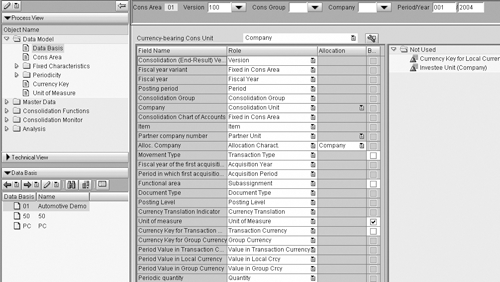
Figure 1
SEM-BCS Release 3.5 Data Basis configuration screen
Let's examine how R/3-based EC-CS functions in terms of non-R/3 data and the underlying data model. EC-CS can upload data from non-SAP systems using a flexible file upload. However, the manipulation of the incoming characteristic values must occur at the source before it is uploaded to EC-CS. Therefore, the transformation of the incoming accounting record is not transparent to the EC-CS end user. This also limits the capabilities of EC-CS for reporting back to a copy of the original source system data.
The EC-CS data model is predefined by SAP and cannot be directly manipulated during the configuration process. The structure links to the characteristics in the Financial and Enterprise Controlling applications in R/3. EC-CS provides for up to five additional user-defined reporting characteristics. This is helpful for increasing the reporting flexibility of EC-CS; however, if an enterprise has more than five reporting characteristics, it needs to choose which ones to include.
Note
An SAP-defined data model is delivered in SEM-BCS that can be used without modification if this model fits a company's reporting requirements.
Functionality
Both EC-CS and the BW-based SEM-BCS allow for legal and management consolidation, generally accepted accounting principles (GAAP) adjustments, currency translation, inter-unit eliminations, and consolidation of investments. The newer 3.5 and 4.0 versions of SEM-BCS support both the purchase and equity methods in the consolidation of investments process. The areas of functionality differences we'll examine here are the setup of the data model, integration with other SAP applications, elimination process, currency translation, and reporting.
The SEM-BCS application is built on the BW multi-dimensional data model and the Data Basis of this model defines which characteristics and key figures are available for consolidation purposes. In the development of this data model, you have the ability to assign consolidation roles to the characteristics and key figures. Each characteristic and key figure in the Data Basis can only have one role assigned to it.
Characteristics in the SEM-BCS Data Basis can have the role of consolidation unit, partner unit, version, group currency key, financial statement item, document-type posting level, time characteristics, etc. This allows you to have more than one consolidation unit and related partner unit for the purpose of generating elimination entries. It also enables you to create a matrix-organization to consolidate data, for company code and profit center combinations, for example.
EC-CS has a single consolidation unit and related partner unit within a dimension. This limits you to consolidating only profit centers or companies within a dimension. In both SEM-BCS and EC-CS, the consolidation unit can be freely defined at whatever level (company, division, business unit, profit center, etc.) is necessary for consolidated enterprise reporting. For both solutions, however, the consolidation units and partner units are limited by the level of detail and processes in the financial system's source data.
Additionally, in SEM-BCS, customers can have as many additional reporting fields or attributes as they feel are required to meet their reporting needs, because companies define the data model. In EC-CS you have up to five user-defined fields that can be used as reporting attributes for the consolidated financial data. This enables users to have additional information and views of the consolidated financial data in EC-CS. You can report EC-CS data from the point of view of categories such as material code, cost center, or sales organization. With SEM-BCS, you are not limited to five of these fields, but rather can use a virtually unlimited number of user-defined characteristics for this purpose.
Validation of financial statement accuracy has become more of a focal point amid Sarbanes-Oxley Act concerns. An enhanced feature of SEM-BCS that EC-ES does not have is the availability of user-friendly, graphical functions for defining customer-specific validation rules. These validations are useful for reconciling balance sheet and income statement items with statistical data or for reconciling different dimensions for external and internal accounting.
SEM-BCS can react to inconsistent data via straightforward messages (warnings, errors), automatic adjustment entries, or customer-defined workflows. These validation processes can easily be configured and can prove invaluable for identifying data errors and having those errors dealt with shortly after they occur instead of dealing with them during the month-end closing process.
You can call up the SEM-BCS validation process in the process monitor at any point during the consolidation process. This provides an interactive analysis as problems occur, which reduces the analysis time and speeds up the overall process. The SAP document concept is also present within SEM-BCS. This is a concept carried over from EC-CS that enables the ability to audit data at all points along its journey to a consolidated financial statement. A document is created for each transaction that is posted to EC-CS or SEM-BCS, enabling an audit trail of results from the original input through the various adjustments and eliminations to the final consolidated result.
One area where EC-CS has more functionality than SEM-BCS is EC-CS's ability to proportionately consolidate units and eliminate profit/loss in the transfer of assets between units. At this time, if these functions are necessary in SEM-BCS, a custom elimination process needs to be considered. For example, the proportionately consolidated units can be brought into SEM-BCS already properly proportioned and then can be treated as 100 percent owned units. For the profit in transferred assets, you can process a manual elimination based on information stored either statistically in SEM-BCS or in a spreadsheet external to the system.
A major difference between the SEM-BCS releases 3.5 and 4.0 is that SEM-BCS 4.0 has enhanced integration with R/3's Financial and Profit Center Accounting modules and increased data integration with SEM-BPS.
SEM-BCS Release 3.5 could only acquire financial data using two methods, flexible file upload and manual data entry forms. Some consulting options exist to automate the flexible file upload process; however, as delivered out of the box, these were the only two methods to get financial data (R/3 and other source systems) into SEM-BCS 3.5. This process ensured data integrity because before the financial data was deposited in a BW InfoCube, it passed through the configured SEM-BCS validation rules.
In Release 4.0, SEM-BCS can source financial data directly from a BW InfoCube (assuming it has the proper data characteristics). As the data is transferred from the original BW InfoCube to the BCS InfoCube, validation checks ensure that only valid source data is posted to the BCS InfoCube. This allows R/3 data from FI or PCA to flow into a BW InfoCube where BCS reads the data and imports it for consolidation purposes.
Process Monitors
The tasks for both SAP consolidation tools have the same basic steps and processes. The difference is in the way they are configured and presented to the end user. The process by which the end user interacts with the consolidation software differs between EC-CS and SEM-BCS.
BW-based SEM-BCS has a single monitor (Figure 2). This Consolidation Monitor supervises and executes all steps starting with the initial acquisition of data from the individual consolidation units to the availability of standardized financial statement data that has been validated, translated, and adjusted to meet the group's accounting rules. The end user sees various icons to easily and quickly determine if the process has been run and what the results are. Here are some examples of steps that the SEM-BCS Consolidation Monitor manages:
- Balance carry forward
- Data entry
- Manual standardizing entries
- Automatic reclassification
- Currency translation
- Corporate allocations
- Data integrity validations — local and group currency
- Assignment of balance sheet accounts to other consolidation units
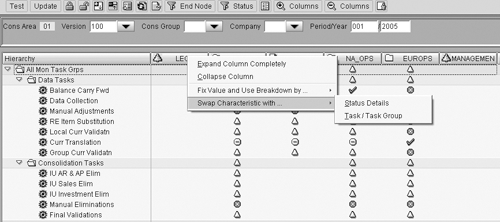
Figure 2
SEM-BCS Release 3.5 Consolidation Monitor
The SEM-BCS Consolidation Monitor observes and carries out all inter-unit eliminations and consolidation tasks at any level within the consolidation group hierarchy. You can execute these tasks in groups through the SEM-BCS Consolidation Monitor's task group functionality. Tasks available in the SEM-BCS are:
- Elimination of inter-unit (IU) payables and receivables
- Elimination of IU revenue and cost of goods sold (Figure 3)
- Elimination of investment income
- Other IU eliminations
- Elimination of IU profit/loss in inventory
- Consolidation of investments
- Manual consolidation entries
- Reclassification
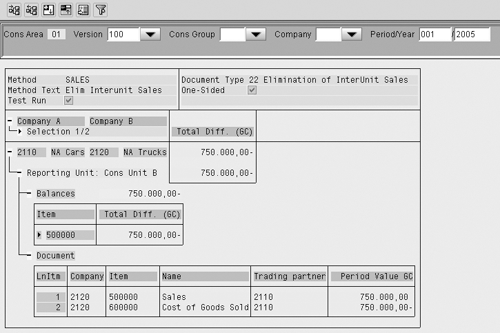
Figure 3
SEM-BCS Release 3.5 Elimination Process Report
EC-CS offers the end user two process monitors. The first monitor, the data monitor, obtains the source data, validates its accuracy, translates it into a group currency, and makes any necessary corporate adjustments. This monitor shows the consolidation units and groups.
The second monitor, the consolidation monitor, enables the user to interact with the consolidation process. It identifies which consolidation groups need to have elimination entries generated for them, along with any manual elimination entries and the consolidation of investment process. The consolidation monitor works only with the consolidation groups. Both monitors have easy-to-read icons to let the user know what processes have run and their current status. This facilitates monitoring the process during the short period of time available to the accounting group to close and consolidate the books.
Reporting
Business intelligence is a driver in the development of SAP's BW and SEM product suite. From a business intelligence aspect, you can use the functions of SAP SEM to help develop business plans, consolidate data, and monitor performance. BW helps to analyze your financial statement data and develop reporting content that crosses normal financial and operational boundaries.
With the online analytical processing (OLAP) advantages of the BW-based product, SEM-BCS is better suited to the reporting needs of customers than EC-CS. This is because of the ability and flexibility of combining financial and non-financial data from within BW and reporting both areas in a single report. In contrast, R/3 financial reporting generally reports data on a single-application basis. SEM-BCS is especially necessary when there are multiple and diverse data sources supplying the individual financial statements and is also crucial when bringing together non-financial and financial data to develop a complete picture of your enterprise.
EC-CS reporting involves standard R/3 tools such as drill-down reporting and Report Painter/Writer. You can also report on master data, additional financial data, and the control parameters using standard reports. EC-CS also has Interactive Excel for reporting, linking the EC-CS database and the end user using Microsoft Excel. A lot of EC-CS customers found this tool very attractive for extracting the data from EC-CS and using that as a source for their reports in MS Excel. This feature is not available in SEM-BCS.
BW-based SEM-BCS does, however, offer many reporting capabilities. The Extensible Business Reporting Language (XBRL) Interface is a reporting enhancement available only in the BW-based SEM-BCS. XBRL is an Extensible Markup Language (XML)-based tagging standard for publishing financial information in a way that can be interpreted by another system without human interaction. By reporting financial information through the XBRL standard, investors, regulators, analysts, and companies can benefit from increased transparency and usability of the information, as well as reducing the cost of obtaining and consuming that data.
Reporting using the BW reporting tools in SEM-BCS allows you to use time-sensitive consolidation group hierarchies. Companies with complicated corporate structures that often change can use this BW feature to report current data against a previous structure to see how it would have looked. It can also restate historical data using today's corporate structure, making the year-over-year comparison of data across different corporate structures easier.
Licensing Issues
You need to consider a number of issues when it comes to licensing of SEM-BCS. You should discuss individual circumstances with your SAP account executive; however, SEM-BCS and EC-CS licensing arrangements differ in a few general ways. EC-CS is licensed as part of R/3. Therefore, if you have licensed R/3, you generally have access to the EC-CS software.
For SEM-BCS, the licensing is more complicated. It is always separate from the R/3 license but in some cases, the SEM license is separate from the BW license, depending if you licensed BW or SEM first. As a result, having a BW license does not always mean you have access to SEM. If you have an SEM license, you have access to BW, at least for the use and support of all SEM applications.
This complexity increases with the advent of the BPS planning engine migrating to BW in Release 3.5. Each of the application areas (FI, PLM, CRM, Supplier Relationship Management [SRM], and SCM) is now responsible for content development and delivery using the BPS planning engine.
As there have been many licensing arrangements devised by SAP over the years (mySAP.com, solution-oriented pricing, etc.) it is best to discuss your situation with your SAP account executive to determine if you have access to SEM- BCS. New licenses will incur additional costs; however, if you focus the consolidation project on the consolidation accountants, the cost should not be overwhelming because of the small target audience.
Ongoing Maintenance/Conversion
SAP will continue providing mainstream maintenance for those companies currently using EC-CS. There is an end in sight, however: EC-CS Release 4.6C mainstream maintenance will end sometime in 2006. The mainstream maintenance for EC-CS as part of the R/3 Enterprise core will end in 2009. This means that future developments and enhancements of EC-CS will be negligible. Instead, SAP will focus on increasing the functionality of SEM-BCS.
Currently, no automatic program (similar to the conversion of FI-LC to EC-CS) is available to migrate from EC-CS to the BW-based SEM-BCS. There are some delivered methods for transferring master data, customizing data, and extracting data from EC-CS to SEM-BCS. The migration requires manual effort in most SEM-BCS configuration areas, but not nearly as much as when EC-CS was first implemented because most business decisions that drove the configuration choices in EC-CS do not need to be revisited in SEM-BCS. Therefore, it is only a matter of learning some new configuration steps and then configuring and testing the software based on these prior business decisions.
The one area where conversion may be more time consuming is reporting. Because of the BW platform, the R/3 EC-CS reporting must be replaced with BW reporting technology. If you are already using BW for your EC-CS reports, work is still required to convert those existing BW reports to the new SEM-BCS reporting InfoCube. If you are currently sourcing all your consolidation reports from R/3, these reports must be manually recreated using BW reporting tools. The amount of time this part of the conversion takes depends upon the level of consolidation reporting that currently occurs in EC-CS and if you plan to revisit the consolidated reporting content based on the additional options that the BW platform presents.
Alan Hildebrandt
Alan Hildebrandt is the managing director of Business Information Solutions (BIS) Canada. Prior to joining BIS Canada, Alan was BI Market Development Manager for SAP Canada and he was a founding member of the SEM Solution Rollout team for SAP America. Alan received his Certified Management Accountant (CMA) designation from the Society of Management Accountants of Canada in 1989.
You may contact the author at alan.hildebrandt@biscanada.ca.
If you have comments about this article or publication, or would like to submit an article idea, please contact the editor.
Paul Halley
Paul Halley is director of Strategic Enterprise Management (SEM) for Business Information Solutions, LLC (BIS). Prior to joining BIS, Paul was SAP America's and SAP Public Sector's leading expert on SEM. As the SEM product manager and lead solutions engineer, Paul was responsible for some of the first US SEM implementations and the subsequent rollout of SEM throughout North and South America. He has a BA degree in economics from Illinois Wesleyan University and an MBA from the Owen School of Management at Vanderbilt University.
You may contact the author at paul.halley@bisamerica.com.
If you have comments about this article or publication, or would like to submit an article idea, please contact the editor.


 Premium