Learn how SAP Enterprise Controlling and Consolidation (EC-CS) and SAP Strategic Enterprise Management-Business Consolidation System (SEM-BCS) reporting uses consolidations logic to dynamically report consolidated results.
Key Concept
The consolidation logic programmed into the reporting for SAP Strategic Enterprise Management-Business Consolidation System (SEM-BCS) and SAP Enterprise Controlling-Consolidation (EC-CS) takes into consideration for each period: posting levels; accounting techniques; the structure of the time-dependent hierarchy of consolidation groups or units; dates of first consolidation; and divestiture accounting. This logic dynamically determines, at the time the report is executed, what records to include or exclude to get true consolidated results for the consolidation group being reported and not just aggregation of the database records.
SAP Strategic Enterprise Management-Business Consolidation System (SEM-BCS) and SAP Enterprise Controlling-Consolidation (EC-CS) have consolidations logic programmed into the reporting. In many cases, this logic allows you to obtain consolidated results dynamically for almost any consolidation group.
Note
For more information on consolidation of investments, see my article “A Simplified Approach for Consolidation of Investments,” which shows how to automate consolidation of investments without a full-blown implementation of the consolidation of investments component.
Figure 1 shows the consolidation logic for reporting on consolidation of investments with SEM-BCS and SAP EC-CS. Although SEM-BCS is illustrated in Figure 1 with SAP NetWeaver BW InfoCubes, the logic applies to EC-CS as well.
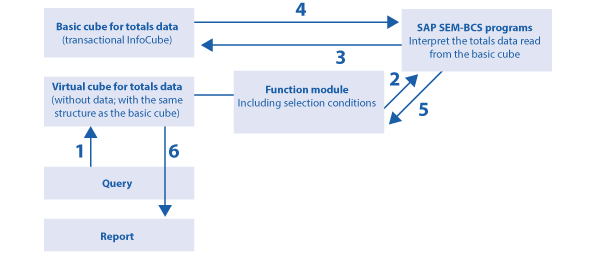
Figure 1
SEM-BCS SAP NetWeaver BW reporting with SEM-BCS virtual InfoCube’s consolidation logic
Here is a further explanation of the information presented in Figure 1:
- A query is executed for the consolidated results of a specific consolidation group for a certain period of time. (A consolidation group is a related group of consolidation units for determining and reporting the consolidation results, and consolidation units are individual entities within the consolidation hierarchy and typically represent a legal company, profit center, segment, or business area.)
- By reading the time-dependent consolidation group hierarchy, the system uses this logic to determine which consolidation units are included in the consolidation group for the period of time being queried.
- Data is retrieved from the totals database for the consolidation units determined in step 2.
- Eliminations (posting level 20) data is included only if both the consolidation unit and partner unit are included in the consolidation group being queried.
- Additional logic reads the consolidation group master data and excludes the data for any consolidation units divested prior to the period of time being reported. The logic also reads the accounting technique and further excludes data for consolidation units assigned the accounting technique of equity.
- The remaining totals records are included in the query output.
Note
Posting levels classify journal entries in the consolidation system. Here is a list of the posting levels:
- Posting level 00 is the reported data loaded from the source general ledger systems.
- Posting level 01 is for adjustments to the reported data and is merged with posting level 00 as part of the annual balance carryforward.
- Posting level 10 is for standardizing entries or preconsolidation entries made in the consolidation system.
- Posting level 20 is for interunit eliminations.
- Posting level 30 is for consolidation group level entries.
- Posting levels 02, 12, and 22 are for changes to consolidation groups.
A consolidated group is not stored in the totals records, except for posting levels 02, 12, 22, and 30 entries. The fact that the consolidation group is not stored in most records is important for better understanding the dynamics of the reporting logic and that records with posting levels 02, 12, 22, and 30 may pose limitations to such reporting. The remaining data to be included in the report is thus determined dynamically.
The consolidation logic that allows the consolidation group to be determined dynamically provides flexibility, particularly related to restatement. Restatement in this case is when the historically reported results are revised because the consolidation group hierarchy was changed. In such restatement cases, the consolidation processes do not necessarily have to be re-executed, and it may be possible to simply re-execute the reports after the consolidation group hierarchy changes are made for the restated results.
Consider this example. You select consolidation group A (CG-A) in a given report for the actual data period 002/2010. From the consolidation configuration, the system consolidation logic determines which units make up the group as of 002/2010. The consolidation logic checks the period of the first consolidation or divestiture and determines that units A, B, and C make up the group at that point in time (Figure 2). All these units are accounted for on the purchase method. Therefore, the consolidation logic selects base data (i.e., posting level 00, 01, and 10 records) for these units.
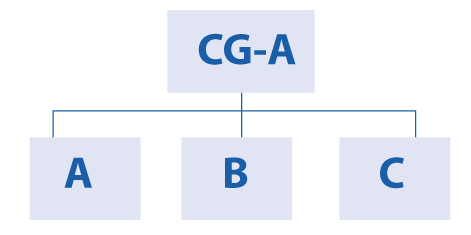
Figure 2
An example of a consolidation group hierarchy
The group should include eliminations only among the three units making up the group, so the consolidation logic automatically selects elimination records only if both the unit and the partner unit are parts of the group (A, B, or C). A partner unit is a second consolidation unit that has a business relationship with a given consolidation unit. The reporting logic then automatically selects consolidation group records (posting level 30) specific to group consolidation group A. The results are automatically accumulated and reported.
Dan Sullivan
Dan Sullivan is a consultant with more than 28 years of experience in accounting and systems design. He has been an accounting manager for a Fortune 200 global enterprise, where he first implemented global ERP systems. He has worked in numerous industries implementing global enterprise solutions with a focus on SAP. These industries include retail, manufacturing, and utilities.
You may contact the author at Dan.Sullivan@focusSAP.com.
If you have comments about this article or publication, or would like to submit an article idea, please contact the editor.


 Premium