As part of its positioning for the corporate boardroom set of enterprise performance management applications, SAP BusinessObjects Supply Chain Performance Management enables full visibility of the value chain using metrics and indicators. Learn how to reduce risks in material and intellectual property flow in your supply chain and create a more effective organization using the features available in SAP BusinessObjects Supply Chain Performance Management.
Key Concept
SAP BusinessObjects Supply Chain Performance Management, as part of the enterprise performance management (EPM) solutions suite, allows you to quickly determine real-time changes to the flow of ideas, material, and products within your value chain, ensuring strategic alignment of enterprise operations based on a holistic and risk-based approach.
As a result of the financial crisis, operations managers around the world have reexamined their operating models and suppliers that participate in their business to achieve higher levels of cost and time efficiency. This reexamination, combined with an overall decrease in risk appetite, is difficult on many fronts as it calls into question old trading partner relationships and the habits that come with those relationships over many years.
Conventional management suggests reexamination built on the current business model to discover ways to make the business more efficient. In the post-crisis world, however, yesterday’s business model may not suit the forward direction of the organization. A fundamental discussion around effectiveness versus efficiency based on new realities is in order.
Unfortunately, for executives and management teams, it makes absolutely no difference if a company with poor operations is efficient. In fact, it can have catastrophic results when a company is simply executing a bad process more quickly or focusing on improvements in areas with little or no relevance to financial return. Figure 1 shows an example using manufacturers, retailers, and distributors in the grocery business. Important upside could exist for particular initiatives (such as perceived value in technology improvements) in one area of the value chain but to a lesser degree in others. Looking at broad, holistic improvements in the overall supply chain to drive effectiveness gains must address these disparate points of view across participating supply chain members.
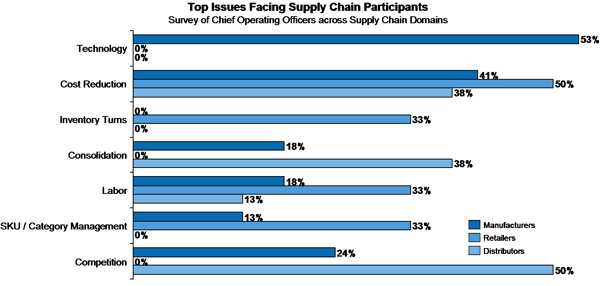
Figure 1
Top issues facing supply chain participants in the food and grocery segment
Aligning a fragmented supply chain such as this can produce financial gains and eliminate unwarranted risks. When internal to the organization, supply chain optimization considers holistic gains to the organization across all key processes from source through delivery, as well as elements of the SCOR model advocated by the Supply-Chain Council (Figure 2). Efficiency gains in the make stage of operations (e.g., new fabrication technologies desired to increase the value content of a new product) may yield efficiency losses in the source stage of the operation if a supplier is not readily available to deliver new tooling. External increases in the sourcing of materials to overseas operations may have a downstream negative impact on delivery time of the final product to customers.
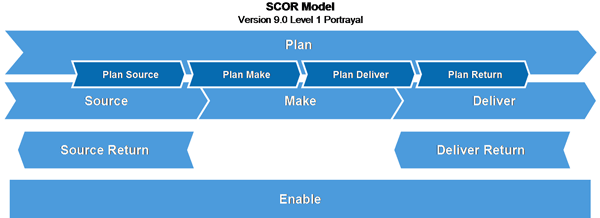
Figure 2
The SCOR operations model, level 1 portrayal (Supply-Chain Council)
SAP provides SAP BusinessObjects Supply Chain Performance Management to enable a broader view of effectiveness. I’ll introduce you to this product so you can benefit from full-visibility operational effectiveness across your organization. I’ll use an example of an operations manager of a semiconductor company to show you the ways you can improve the performance of your supply chain.
Note
William’s forthcoming SAP PRESS book
Understanding SAP BusinessObjects Enterprise Performance Management, to be released in mid-2010, covers this and other topics. For more information, visit
www.sap-press.com.
SAP BusinessObjects Supply Chain Performance Management is part of the overall SAP BusinessObjects enterprise performance management (EPM) solutions suite. For more information about SAP BusinessObjects EPM solutions, see William’s article
“Create and Monitor a Risk-Adjusted Strategy for the Post-Crisis Economy.” Optimizing the Supply Chain Using SAP BusinessObjects Supply Chain Performance Management
SAP BusinessObjects Supply Chain Performance Management provides a quick and flexible analytical environment to assess savings potential and supply chain processes. SAP BusinessObjects Supply Chain Performance Management provides several functional processes and knowledge databases:
- KPI Database: More than 350 key performance indicators (KPIs) based on SAP best practices and the SCOR model developed across multiple industry segments
- Linkage to SAP Spend Analytics: Based on the availability of certain key defined categories and SKUs, financial information already known to the organization and defined in business intelligence environments (e.g., SAP NetWeaver BW) may be leveraged to make cursory cost trade-off decisions
- Linkage to strategy and risk positions: Based on strategic KPIs and key risk indicators (KRIs) known to the organization, you can align operations across the value chain to address strategic enterprise objectives, as well as plant-level optimization. Additionally, you can take advantage of third-party benchmark information to provide a basis for performance across industry average.
- Integration to SAP Advanced Planning & Optimization (SAP APO): With information contained in the SAP APO environment and demand planning models, you can analyze logistics and transportation performance
SAP BusinessObjects Supply Chain Performance Management is based on a flex-designed dashboard environment with an initial role-based cockpit (Figure 3). (Flex is a presentation environment used with Adobe Flash and other browser plug-ins.) An initial view of the scorecard feature illustrates several of the company’s strategic goals, including financial, order fulfillment, demand and supply planning, and compliance. For example, a semiconductor company operations executive could quickly review the state of the strategic objectives and the underlying KPIs by the color and trend direction of the indicator dials shown on the screen.
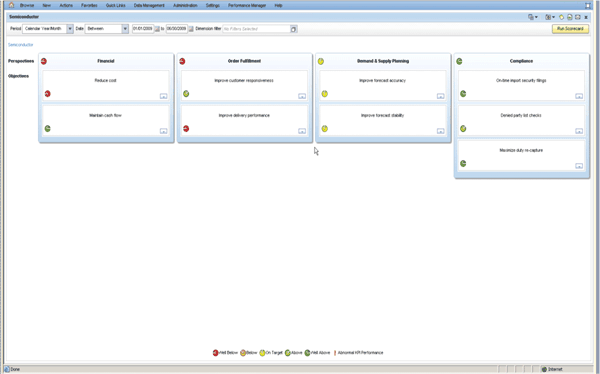
Figure 3
SAP BusinessObjects Supply Chain Performance Management company scorecard
Note
At the time of this writing, SAP BusinessObjects Supply Chain Performance Management 1.0 has been released as part of the current SAP BusinessObjects EPM 7.5 solution suite of generally available (GA) software.
Looking at the screen, the operations manager notices a poor indicator and trend with the Improve Delivery Performance KPI. This is a critical component of meeting the overall strategic goal of Order Fulfillment. SAP BusinessObjects Supply Chain Performance Management allows the user to investigate through drill downs of a particular indicator. A closer inspection of the status of Improve Delivery Performance shows that there are two contributing indicators: Product Quality and Perfect Order Fulfillment, referring to the on-time delivery and sign-off to the customer (Figure 4). Quality appears to be trending well, so the operations manager once again takes a closer look through the drill down into the delivery statistics of the final product.
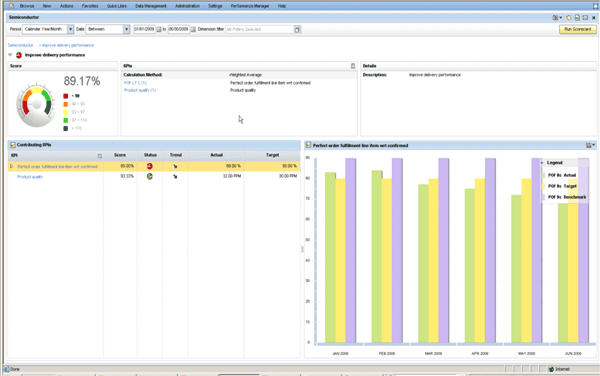
Figure 4
The dashboard enables quick graphical depictions and drill downs
SAP BusinessObjects Supply Chain Performance Management allows for the graphical use of time-based indicators, goals, and metrics. For example, the left column bar on the histogram illustrates actual company performance, while the middle column bar illustrates the company target goal, and the right column illustrates industry benchmark information that you can adjust for seasonal patterns of the business. In this way, management can review not only the performance to date based on a transparent view of operations, but also as a reference to the overall strategic expectations of the entire enterprise and industry best practices.
Drilling down even further, the operations manager can see the decomposition of on-time delivery metrics in its own view (Figure 5). In this view he can expand the histogram to show more clearly where the performance disturbance trend for on-time delivery occurred and pinpoint any risk events. It is clear to the operations manager that the delivery date target is well below both the target and industry benchmark trend, with a particular degradation in performance in the last month of the six-month look back.
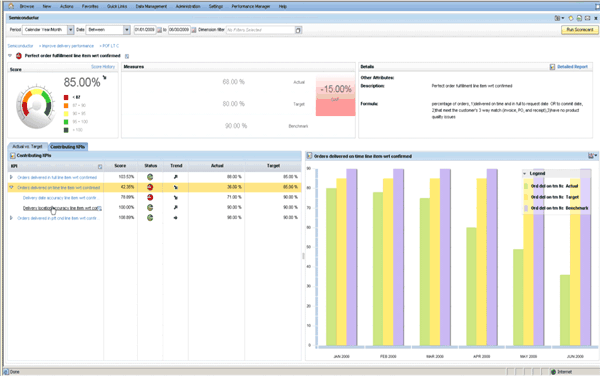
Figure 5
Level two and three drill downs illustrate performance degradation trends and allow the user to isolate metrics contributing to the problem
To best understand the nature of the on-time delivery problem, the operations manager selects the KPI composition view and finds that the overall measure of on-time delivery consists of four metrics: transit damages, production schedule achievement, capacity utilization, and transit cycle time (Figure 6). The indicators show that an issue exists with item damage during transit and the production schedule. These issues may also be consistent with key risk indicators (KRIs) defined in SAP BusinessObjects Risk Management.
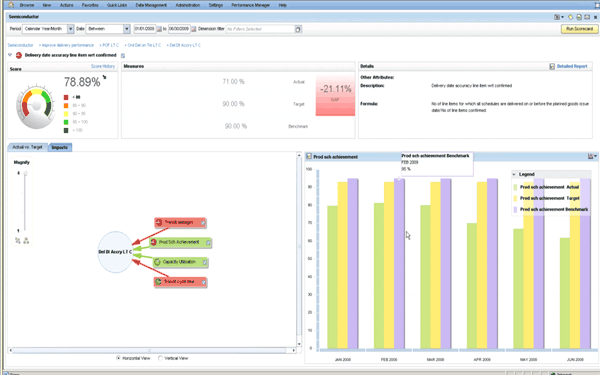
Figure 6
KPI composition view provides an indication of metrics inside and outside of acceptable tolerances
The operations manager wants to explore the issue of costs around the production schedule. One of the tabs on the application panel is a saved report on outbound transportation costs (OBTC) as shown in Figure 7. The operations manager selects this tab view and can quickly see the effects of missing the planned production schedule and the cost associated with leveraging more freight transport using both express and air shipments. These negative effects confirm the problem meeting the normal production schedule, with an additional confirmation of the cost impact of shipping products outside of the normal shipping cost envelop.
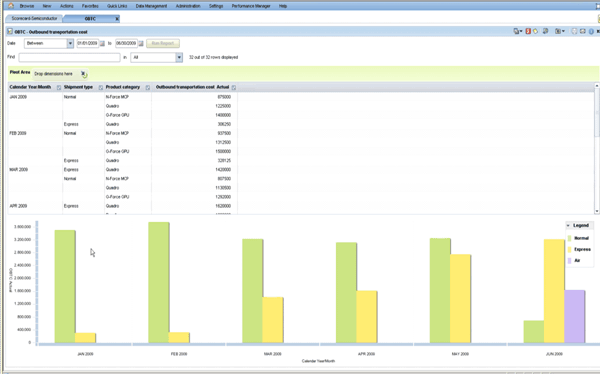
Figure 7
Limited cost analysis illustrates where changes in performance trends occur and why
SAP BusinessObjects Supply Chain Performance Management can also integrate with SAP BusinessObjects Spend Performance Management to provide greater details about multiple supply chain spend patterns, price point analysis, and category management. In addition to direct integration to SAP APO, SAP BusinessObjects Supply Chain Performance Management also interacts with SAP BusinessObjects solutions, Xcelsius, Crystal Reports, and SAP BusinessObjects Explorer dashboarding, reporting, and analytic tools.

William Newman
William Newman, MBA, CMC is managing principal of Newport Consulting Group, LLC, an SAP partner focused on EPM and GRC solutions. He has over 25 years of experience in the development and management of strategy, process, and technology solutions spanning Fortune 1000, public-sector, midsized and not-for-profit organizations. He is a Certified Management Consultant (CMC) since 1995, qualified trainer by the American Society of Quality (ASQ) since 2000, and a trained Social Fingerprint consultant in social accountability since 2012. William is a recognized ASUG BusinessObjects influencer and a member of SAP’s Influencer Relations program. He holds a BS degree in aerospace engineering from the Henry Samueli School of Engineering and Applied Science at UCLA and an MBA in management and international business from the Conrad L. Hilton School of Management at Loyola Marymount University. He is a member of the adjunct faculty at both Northwood University and the University of Oregon with a focus on management studies and sustainability, respectively.
If you have comments about this article or BI Expert, or would like to submit an article idea, please contact the editor.
You may contact the author at wnewman@newportconsgroup.com.
If you have comments about this article or publication, or would like to submit an article idea, please contact the editor.