Management
As the economy faltered in late 2008 and early 2009, it became clear that the companies with the best chance of success were those that could adapt quickly and find new ways to improve operational efficiency. At Bayer MaterialScience, surviving the downturn would require improving several processes along its supply chain.
Bayer MaterialScience (BMS) had begun a large supply chain transformation project built around SAP systems about a year before the recession hit. Near the end of that project, however, it became apparent that further process improvements were necessary. User adoption was critical to the success of the transformation, so BMS set out to revolutionize the way it trains and motivates employees working within the supply chain.
The solution was to create a Supply Chain Certification Program that focused on bringing users across the supply chain up to speed on the new system. The program requires users to pass one-on-one exams administered by subject matter experts to gain certification.
“We wanted to make sure we trained our people adequately on the new processes, and to certify them so they can demonstrate that they understand how to do their job and that the system works,” says Tom Balzer, sr. vice president, head of Supply Chain Center – NAFTA.
The certification program itself is an International Organization for Standardization (ISO)-certified process. This means all procedures within the program must be reviewed and approved every year, and that the company is subject to an audit to demonstrate it is following those procedures. This ensures that the certification program is kept up to date and sustainable.
The project team in charge of the program first rolled it out to users in the planning and scheduling department using SAP ERP or SAP Advanced Planning and Optimization (SAP APO). Ensuring that employees followed proper procedures was especially important after the company automated several planning-related processes and reduced the headcount of the department.
“After right-sizing that whole part of the organization, it was now more efficient. At the same time, that opened us up to a lot of risk, because if the employees regress after six months and start using spreadsheets again, you could end up in worse shape because there are not as many people around to help manage the process,” Balzer says. “This is an insurance policy to help ensure that the change would have a high chance of being sustainable.”
Five Keys to a Solid Certification Program
Creating a program that will reinforce knowledge of key processes and set the bar for process mastery is not a task that should be taken lightly, Balzer says. The team responsible for the certification program enacted its plan carefully and deliberately, dividing the process into five key activities.
1. Communication and Change Management
The first step for the BMS team was to secure the support of upper management. Because the certification program is so important to the company’s change management process, it was critical that the program was backed by top executives. To secure support, the project team drew an analogy between end-user certification and certifications for machine operators at the plant level.
“We drew that analogy because this is just as critical. The functioning of the plant and the functioning in the operations in the office place is just as important,” says Balzer. “This was a good opportunity to raise the bar with everything that we implemented.”
The program was designed to support the ground-breaking (and very well-supported) supply chain automation program the company was implementing, in which half of all customer orders are never touched by any human, from receiving the order to matching inventory to the customer to scheduling delivery.
“That all happens automatically and no one touches it, which means your planning has to be pristine. And we use the no-touch order metric to really gauge the health of the supply chain,” says Balzer.
Once the team had secured buy-in from top-level executives, it worked with lower-level management to convert the principles of the program into tactical initiatives and guidelines. The team was careful to craft a message that would resonate with all employees who would be required to pass certification exams. A cornerstone of that message was that the tests could be used for career advancement — those wishing to become planners or regional product managers could gain certification as a step toward those positions.
“If that’s your career path, obviously when there was an opening you would have the inside track because you were already certified,” says Balzer.
2. Training Material and Test Development
The team used documentation from the supply chain transformation project as the basis for training materials to help employees understand and perform their new responsibilities. The resulting manuals covered everything from step-by-step transaction guides to troubleshooting. While the manuals are based on SAP training materials, they are heavily customized to suit specific BMS processes.
These manuals were then used as guides to develop the tests employees would be required to take. The team ensured that all test questions could be linked to specific guidelines in the manuals, in part to reassure users that the exams covered only the information they needed to know.
“We wanted to give them some comfort that if you study this material and prepare well, there are no trick questions. The questions and answers are all found in this book,” says Balzer.
3. Employee Preparation and Training
Before implementing the tests, the team held a number of review sessions that offered employees a chance to review the training materials and ask questions. Sample test questions helped employees get a sense of the types of questions they’d face on the exam. “They were nervous about what the test was going to be like. Once we gave them a feel for the questions, I think they got a lot more comfortable,” says Balzer.
As a side benefit, the certification program inspired far more engagement during those sessions than typical user training would. Employees aggressively sought clarification on training topics and many scheduled one-on-one follow-ups for greater understanding. The net result was a more efficient learning process. “We spend a lot of money training people who might absorb 10 percent or 20 percent of it. With this approach the absorption rate was a lot higher,” says Balzer.
4. Testing
The tests themselves ranged from 12 to over 90 questions, depending on the type of certification, and were administered in one-on-one sessions with a subject matter expert. A shorter test could take only 15 minutes, whereas the longer tests could last more than an hour. Some questions were straightforward, such as demonstrating the ability to complete a particular transaction (Figure 1). Others were more open-ended, such as asking the employee to troubleshoot a particular situation. Depending on their role, employees were required to complete one to five exams in order to achieve certification.
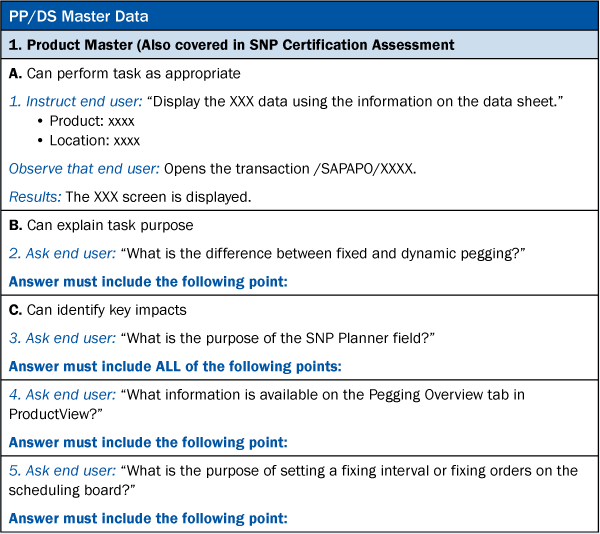
Figure 1
A sample test scenario
Employees were given three opportunities to pass their exams, with 71 percent passing on the first try (94 percent passed after the second round). Only questions missed during the first exam were asked in the second or third try. Failing twice would earn employees a “below average” rating in the company’s tracking system and would trigger a performance improvement plan managed by their supervisor. Failing three times would result in removal from their current position. In some cases, trainers conducted one-on-one sessions with struggling employees to address critical knowledge gaps. Eventually, all employees in the first round of testing (about 35) were able to achieve certification.
5. Process Feedback
Once an employee passes a certification exam, he or she receives a congratulatory note and certificate from his or her manager. Shortly after the first round of testing, employees were pinning their certifications on the walls of their workspaces — clearly proud of achieving certification.
The team gathered feedback from employees and tracked test results carefully. This gave the team a clear picture of where employees were struggling to grasp concepts. “We got a lot of feedback that the training sessions were good and that they learned a lot. We also identified where they struggled,” says Balzer.
For example, the graph in Figure 2 illustrates the pass rate for employees by module. This data helped the team adjust its test preparation materials to focus on needed areas.
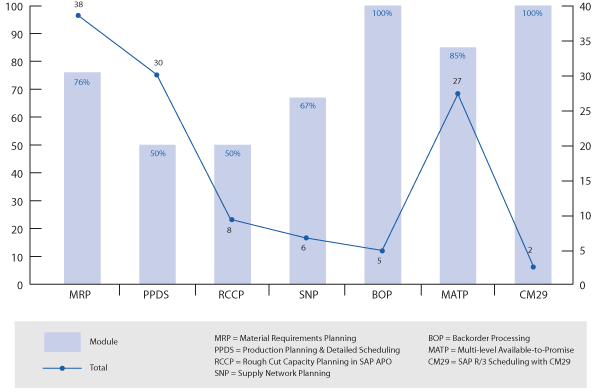
Figure 2
Employee pass rates by module
Continuing Progress
The testing phase of the certification program was by no means the finish line for the project team. The training and testing materials need to be constantly augmented to accommodate system or process changes, and the company still has to deal with traditional change management and user adoption issues.
“There was a little bit of a lag where we weren’t seeing our automation climb the way we expected,” says Balzer. By using KPIs and continuous monitoring, the team was able to reap the benefits of the certification program in a few short months.
“We’ve seen a pretty big change in the past two months. The planning processes are really becoming very robust,” says Balzer.
The next challenge for the project team is to roll out the certification program to new hires, as a way of evaluating their existing abilities and in-house training programs. New hires to the planning department will be required to achieve certification within a prescribed period (for example, six months).
The reusable nature of the ISO-certified process will allow BMS to roll it out to other parts of the business. The program is currently being rolled out to all of the company’s demand-to-supply workstream employees — including customer service, demand planning, inventory management, and other departments — and will later be rolled out to other SAP-specific roles. Eventually the tests will be given online as well as in one-on-one sessions with subject matter experts, in order to reduce the administrative burden.
Lessons Learned
The project team learned several valuable lessons throughout the creation and implementation of the certification program. Those include:
- Involve HR and legal teams early in the process
Because the certification can have an impact on the current or future employment status of an employee, it is important to ensure that the program does not violate any policies or employment laws. Bringing on representatives from the human resources and legal departments ensures that the program does not overstep its bounds.
- Approach communications carefully
When you’re rolling out a certification program that will be required for all or some employees, it is critical to craft the right message. It is imperative that the project team begin at the top — by selling the value of the program and describing how employee skills will help in that effort.
“The analogy we used over and over again was this: If you are hired to work in the plant, you have 90 days to learn your job and get certified,” Balzer says. “It’s really the same thing with the supply chain. When you have a system to assist you in making decisions and driving automation, you can’t underestimate the impact on the overall supply chain when processes are not followed and correct system usage is not adhered to.”
- Don’t underestimate the commitment
While there are several ways companies can build certification programs, Balzer makes one thing very clear — customization is critical to your success. Only by building the program completely from scratch can you meet your goals and deliver a successful outcome.
“If you try to take a shortcut by buying off-the-shelf tests or certifications, you will get diminished results. It really has to be custom made to your processes. It was a lot of work: The questions were evaluated, we had pilot test takers to make sure each question was understandable, and threw it out or reworked it if was not clearly understandable. It is a huge commitment,” says Balzer.
Setting the Bar
The rollout of a mandatory certification program is worth the effort, according to Balzer. Not only are the planning processes at BMS improving rapidly, but the company also has a clear standard for employee performance.
“In terms of talent management, we’ve established a bar for what we mean by performance. Going forward, it will reduce stress for all involved because they know where the bar stands and what is expected of them in each role. We are so heavily invested in our system that we can only function effectively if we are as automated as possible,” says Balzer.
Davin Wilfrid
Davin Wilfrid was a writer and editor for SAPinsider and SAP Experts. He contributed case studies and research projects aimed at helping the SAP ecosystem get the most out of their existing technology investments.
If you have comments about this article or publication, or would like to submit an article idea, please contact the editor.