Discover how to administer and use smart grid, advanced metering infrastructure, and smart meters to improve consumer experience and optimize associated energy and operational costs. Gain an understanding of the fundamentals, application, and impact of these emerging technologies and how the SAP Business Suite helps deploy and leverage the value they provide.
Key Concept
Smart grid, advanced metering infrastructure (AMI), and smart meters are technologies that can provide improvements in consumer-managed energy consumption, increase a utility organization’s portfolio of energy products and services, and improve production and distribution.
Together, smart meter, advanced metering infrastructure (AMI), and smart grid telemetry provide the basis for new products that can change consumer behavior and create opportunities to improve effective-use electric energy. These technologies provide new dimensions of meter data integration, data analysis, demand response, peak and trough prediction, outage management, and device and information security.
In addition, they can interface with other technologies, ranging from distributed generation to renewable energy and electric vehicles. Reaping the benefits offered by these technologies requires the integration of many factors: energy consumption data capture, data analysis, triggers, consumer consumption profiling, weather and geospatial data, real-time consumer communication, self-service, and customer service, together with more traditional and often complex back-office and financial applications.
SAP solutions are vital tools for harnessing these technologies. SAP provides relevant applications in SAP CRM 7.0, sponsors the SAP AMI Lighthouse Council, introduced SAP HANA, and has a rapid deployment strategy for Demand Side Management (DSM). In this article, we will cover all this and more.
Challenges Faced by Utility Companies
The utility industry, especially the electricity industry, is beset with several intrinsic challenges that stem from the fact that a utility cannot store its commodities—and its commodities need to be used instantaneously. The electricity sector is unique in that the volume of consumption is difficult to predict, but companies must still generate a sufficient quantity to comply with the established norms of grid reliability and energy efficiency. Additionally, the industry is seeing a growing gap between potential demand and available capacity, especially with the retirement of generation units and mandatory upgrades to meet new EPA compliance standards.
There is an impetus to reduce the consumption growth rate, shape the consumption away from peak loads, and to share capacity to increase reliability. The North American Electric Reliability Corporation defines reliability as “a measure of the ability of the system to continue operation while some lines or generators are out of service.” This requires companies to set up and manage elaborate grids and controls. For example, in New York City, the grid supports reliability to ensure service even if two circuits or generation sources are down.
Figure 1 shows the components of a smart grid mapped to the value chain of generation, transmission and distribution, and retail. You can see the key solutions required for enabling a smart grid are spread across the entire value chain within the electricity industry. Both regulated and deregulated industries require solutions mapped to their capabilities.

Figure 1
The various components of a smart grid mapped to the value chain of the electricity industry
Utility commissions worldwide are striving to reduce the rising cost of commodities by encouraging competition and creativity. This is achieved by restructuring and deregulating non-shared infrastructure (e.g., generation and sales) and by providing an exchange for transferring energy between service providers using shared transmission and distribution grids. Implementation requires transmission grid interconnectivity with appropriate metering and controls (smart grid), a framework and infrastructure to meter and monetize the shared usage (AMI), and a premise-based electronic and communication meter (smart meter).
Figure 2 shows how enabling smart grid links the industry in a composite, end-to-end value chain with a balance between generation and consumption. Smart grid senses increases in consumption across the entire grid from each individual smart meter, along with the home area network (HAN) if present, and responds to increased demand.
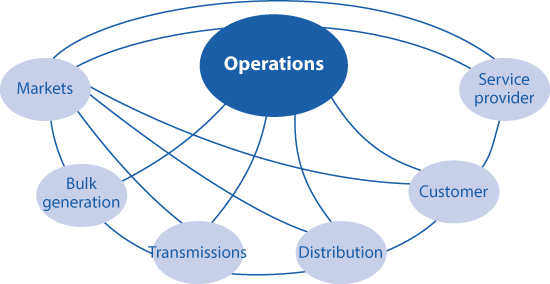
Figure 2
A consolidated model enabled by smart grid, where generation, transmission, distribution, and retail are linked to reciprocate increased consumption and maintain reliability
Challenges in the Electricity Industry
In a 2012 electric sector Gartner energy research study, it was found that smart grid was among the highest concerns at energy companies, along with aging assets, security, reliability, and rising energy prices. The ideal path forward for the industry is to consolidate the revenue stream, increase customer service and participation, optimize asset and electric generation and consumption, and focus on sustainability. (For some guidance on how to create a successful organization, see the sidebar “Critical Questions to Ask Before Jumping In.”)
Critical Questions to Ask Before Jumping In
To create a successful energy organization, some critical questions that should be asked—and answered —are:
- Revenue: Will improving the revenue cycle and decreasing the working capital ease the pressure on the revenue? How can we reduce the current meter-to-cash cycle from 90 days? Can advanced collection make the difference? Will consumers and regulatory commissions embrace such approaches?
- Customer participation: Will consumers change their consumption patterns? Which incentives and pricing will encourage desired behavior? Will involving the consumer in their energy consumption decisions, as well as flexible pricing and payment models, improve customer satisfaction?
- Asset and commodity optimization: Will optimizing generation help reduce costs while supporting desired margins? Are there new technologies that can improve the effectiveness and efficiency of energy generation and delivery, specifically predicting, modulating, diverting, or re-channelizing electricity where it is most required? When should these technologies be applied?
- Sustainability: Are there sufficient resources to support growing energy needs? What impact will electric vehicles, renewable energy sources, and green energy have? How do we predict the generation of electricity, and how do we integrate newer models, such as alternative energy, without compromising our existing investment in generation?
Smart Grid
Smart grid provides sophisticated electric capacity management and distribution capabilities through an interconnected network of power lines and controls—including consumption, sharing, and capacity knobs. It provides a backbone for monitoring consumption from power plants to energy consumers by not only carrying electricity, but also providing a communication network to enable communications with the smart meter and devices behind the meter (e.g., the HAN). It helps a utility company optimize assets, anticipate and respond to load and system disturbances, and adjust the system in response to emergencies. Smart grid is evolving, but it currently focuses on:
- Sensing and monitoring technology, such as remote power management of equipment, including remote detection of outages and connection or disconnection
- Bidirectional, two-way communication of data and information over the power wire
- Enabling consumer participation and enhancing the quality of customer service
- Grid security
- Supporting widespread, distributed energy by integrating and assimilating energy efficiency options
- Smart customer enablement, such as the management of energy use through improved insight
AMI and Automated Meter Reading
AMI is a metering system that records customer consumption and other parameters hourly or even more frequently. It provides daily (or more frequent) transmission of measurements over a communication network to a central collection point. AMI consists of metering technologies and protocols that enable the monetizing and control required to share generation capacity and offer deregulated services, and it ties the entire spectrum of the energy management value chain together by enabling end-to-end integration and the simultaneous two-way flow of information from power plants to consumers.
In 2010, the Federal Energy Regulatory Commission (FERC) redefined AMI as a mix of diverse technologies configured to create an infrastructure that integrates existing and emerging utility processes and applications—specifically, meters that measure and record usage data at hourly intervals or more and provide usage data to both consumers and energy companies at least once daily. The data is then used for billing and planning purposes. Advanced meters include basic hourly interval meters, meters with one-way communication, and real-time meters with two-way instantaneous communication and the ability to store interval data for future transmissions and planning.
As we’ll cover later in this article, a robust ERP system is a critical enabler for integrating these different technologies, and SAP Industry Specific Solution – Utilities (SAP IS-U) provides an ideal platform for this. Before diving into how SAP can help utility and energy service providers use these end-to-end opportunities, you should understand a bit more about the fundamental aspects of these technologies and their architecture. Together, smart grid and AMI have implications across the value chain of generation, transmission and distribution, and retail. They provide a mix of technology and applications, and the emerging challenges in the utility industry make it necessary to adopt solutions that link the entire chain, from generation through retail. The implementation and installation of smart meters significantly influences consumer sentiments, so we will start with the retail side of the meters.
Smart Meters
The smart meter provides the ability to monitor real-time and near-time consumption of electricity, natural gas, or water. It is the lynchpin for enabling consumer participation in load management and consumption efficiency. The less apparent benefit is that it can also communicate over the smart grid and provide two-way communication to the consumer, and it enables communication to a plethora of energy consumption and control devices inside the consumer’s location.
Smart meters can measure consumption on a real-time basis and during predefined intervals, collate the data, and communicate this data at regular times or on demand. They can provide a local or remote consumer display to read, monitor, and manage consumption. This is a major advance over Automated Meter Reading (AMR), which measured meter data at regular intervals but not in real time. With AMR, meters communicate monthly or daily consumption using technologies such as radio signals, satellites, or power lines—much like smart meters—to a central station, also eliminating the need for a visit to the premise to read.
A smart meter can store large amounts of usage data, and its real-time bidirectional communication helps with peak shaving, load management, and time-based pricing. It also provides net metering, outage detection monitoring, tamper detection, theft protection, remote connection and disconnection, load limiting for “bad pay” or demand-response purposes (e.g., voluntary interruptible power program, direct load control, and other pricing programs), energy pre-payment, power quality monitoring, and communication with other devices in the home.
Smart meters are one of the key enablers of the smart grid and an essential component of the AMI. They are essentially a computer with one or more radios that acts as a sensor, captures data at an interval, and stores and communicates this data along with a router to support background or behind-the-meter devices (e.g., the HAN) and equipment consuming significant electricity inside the home. For more about the history of the electric meter, see the sidebar “The Evolution of the Electric Meter.
Note
HAN is the preferred technology for wireless technologies such as Zigbee or Bluetooth.
The Evolution of the Electric Meter
The evolution of the electric meter followed two very different paths. Initially, the electromechanical meter or induction meter measured consumption, but not the time of consumption. It also did not provide any data on the quality of the electricity. However, the commercial market required a meter that could measure consumption data in intervals throughout the day, paving the way for the Interval Data Recorder (IDR) meter. IDR meters captured data on consumption at an interval (usually 15 minutes) and communicated it to a central location called the data aggregator. However, this meter data read was not on a real-time basis, and the device only supported one-way communications. The data was captured and relayed but could not be communicated back to the meter.
Applying SAP Solutions
SAP offers a front-end and back-end capability that allows a utility or retail service provider to support complex operations composed of both business processes and infrastructure. SAP CRM 7.0 offers capabilities for integration with SAP IS-U, as well as with third-party solutions and bolt-ons.
SAP CRM, especially when used for utilities, has a distinctly different flavor compared to the retail or manufacturing industries. Generally, there are two classes of implementations: SAP CRM for the residential market and SAP CRM for the commercial industrial market.
Often, the residential market offers most baseline functionalities (e.g., account and contract management, opportunity and lead management, marketing) and groupware integration. Functionalities such as Transaction Launcher allow access to back-end functionalities (e.g., analytics and SAP HANA) for the front office. This seamless integration allows the front office to practically use analytics in their sales pitch. This has opened a new opportunity for energy retailers because now analytics can be sold as a commodity. Earlier versions of SAP CRM required you to access this information through separate log-ins.
In the commercial and industrial market, quote-to-contract processes are central to businesses, and it is important to emphasize how they integrate SAP CRM (the front end) with SAP IS-U (the back end). Quote-to-contract processes within this market are highly complex and competitive. An account may have several contracts, and each contract may have different master agreements and business agreements, which in turn can hold several ESSIDs (i.e., unique identification for electrical meters). Processes around both master and business agreements affect the success of commercial and industrial customers, as well as an organization’s revenue. The quote-to-contract process needs to accommodate customizations and requires a flexible pricing and billing engine. An organization can bill value-added services (e.g., energy-saving products) using CRM Billing, a critical end piece for selling additional goods or services.
SAP also offers the Plant Maintenance and Enterprise Asset Management (EAM) solutions as part of SAP ERP Central Component (ECC), which integrates third-party solutions with the back end. These third-party solutions and technologies, such as Supervisory Control and Data Acquisition (SCADA), Global Information System )GIS), Network Management System (NMS), and Outage Management System (OMS), are critical for a successful smart grid.
Thus, the SAP Business Suite provides an ideal platform offering integration with smart grid, AMI, and smart meter. The major components include:
- Improved revenue cycle management and pre-payment through integration of pre-pay solutions in SAP CRM and SAP IS-U
- Meter Data Unification and Synchronization (MDUS) and the SAP AMI Light Council
- SAP Energy Data Management (SAP EDM)
- Meter master data management and SAP HANA
- Load monitoring, outage management, GIS, and SCADA with integration through SAP NetWeaver Process Integration
- Demand response, pricing response, and the Dynamic Pricing Engine, which are versatile solutions in Internet Pricing and Configurator (IPC) for third-party integrations
- HAN allows you to manage home electric energy and customer care support, such as outage management, connection and disconnection, and consumption profiles
Figure 3 shows the various solutions that we discuss next.
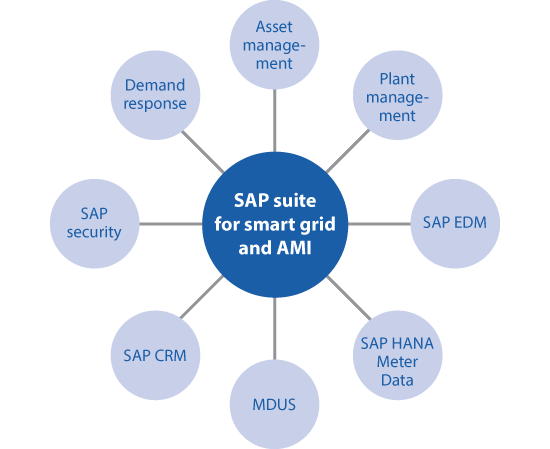
Figure 3
SAP solutions for smart grid and AMI needs
Note
Although SAP security is shown in Figure 3, we do not cover it because it is beyond the scope of this article.
MDUS and the SAP AMI Lighthouse Council [subhead 2]
Integrating SAP IS-U and SAP CRM Customer Service to the AMI infrastructure is a challenge because of the different architecture, designs, and standards for the communication and format of data. These differences are compounded by country-specific variations in communication standards. Because meter interaction technologies must interact with other front-end and back-end applications, they must conform to certain communication and data exchange standards.
The concept of MDUS originated from this, as did the launch of the SAP AMI Lighthouse Council. AMI integrates with MDUS, which makes data captured in a vendor-specific MDUS compatible with other downstream SAP applications. The Council, organized by SAP, defines and develops industry-wide standards and processes to address AMI integration with the aim of formulating best practices for smart meter integration. Council members include OSISoft, Siemens, and leading utility companies.
Meter Data Management and SAP HANA
Smart meters give rise to massive quantities of data and intelligence, in turn demanding a lot of attention. For comparison, while electromechanical meters have a single read per month, smart meters can have as many as 2,880 intervals stored for a single meter per month (i.e., 30 days x 24 hours x four, presuming the data is collected every 15 minutes). This number only includes reads, not other operational information these meters gather and report, such as outages.
If a utility company chooses to keep all this data for each meter for billing and analytics, the amount of data and the time needed to compute it becomes extensive. What was initially one gigabyte of raw data per customer could become several gigabytes of data. Millions of such data points are likely generated after the deployment of a smart meter. This detailed information is useful for timely billing data collection, anticipating consumption, alerting the consumer of unusual usage, characterizing consumers, and disaggregation (i.e., showing the usage components). In addition, when these customer consumption patterns are analyzed against particular customer segments, the utility company can use the results to devise strategies for identifying usage issues, such as demand load, that would reduce stress on the system. This data has the potential for insight, and if the analysis is based on real time, an added potential for action.
Strategies to transmit, store, and access this data and ensuring privacy are among the key challenges for companies. For example, a utility may get insight on consumption patterns such as time, day, and quantity, along with seasonal variations and other patterns that help build consumer profiles and attributes. Three concerns arise immediately for such information: First, what information is helpful and important; second, where to use this information; and third, the privacy concerns associated with this data. Segmentation of this data helps in its downstream use.
Current data analytics programs are constrained when it comes to dealing with this magnitude of interval data. The business need is to provide near-time and even real-time insights on usage, which demands analysis, characterization, profiling, and the detection of anomalies in a timely manner. In particular, commercial and residential clients should be alerted to consumption anomalies, inefficient air conditioner units, and unusual energy consumption, because catching these issues helps the consumer quickly remedy the problem and receive a smaller bill. This demands near-time and real-time triggers.
An analytic tool such as SAP HANA has the potential to become a major differentiator in the commercial industrial energy market, as a significant amount of per capita energy is consumed in this market compared to the residential market. A small change in consumption patterns can lead to massive savings for customers. SAP HANA offers a solution for evaluating and strategizing based on complex data analytics, providing in-memory analytics and the ability to analyze real-time data using proprietary SAP software that synchronizes the database and hardware to synthesize results. It also allows a utility or retailer to analyze data and trigger an appropriate action while continually tuning consumers’ profiles. SAP HANA offers insight from consumption patterns and benchmarking, and its in-memory computing capabilities are fundamental for dealing with smart meter data and providing dynamic information to consumers.
Demand Response
Demand response and pricing response are two ways a utility can perform load management to shave peak energy costs and pass along the savings to their participating subscribers. The concept is simple: if, during a peak consumption period, some consumers reduce their consumption, the retailer or utility could reduce the amount of high-priced energy they need to support the peak. The savings are in turn shared with consumers by offering reduced energy costs. Demand response is used to avoid blackouts when generation capacity is exceeded or when the cost of energy is very high due to demand.
Several demand response programs are in use within the mass residential market and the wholesale commercial and industrial market, and these programs can be mandated or voluntary. The voluntary programs are tied with pricing to model customer behavior and reinforce the changed behavior. A 2010 FERC survey reported that the wholesale market responds well to emergency response, interruptible load, and load as capacity resource, whereas the mass market responds better to direct load control.
Usually, these programs are tied with pricing, and several pricing options are selected. The most common are fixed pricing, time of use pricing, critical peak pricing, real time pricing, and peak time rebate.
Prepayment and Revenue Cycle
Prepayment and revenue are among the core challenges in SAP IS-U. Pre-pay products provide the option to pay for electricity before consumption, unlike traditional payment based on notional consumption. They help the provider reduce bad debts, shorten the Day Sales Outstanding (DSO) cycle, which reduces working capital and increases liquidit,; and enable the consumer to turn on energy without a deposit and increase competition in deregulated markets.
Out of all the business advantages of pre-pay, one stands out: the collection cycle is advanced rather than initiated after a fixed-duration post-selling of the electricity. For consumers, there are several benefits to this—there is no credit check, no security deposit, no sharing of financial or bank details, electricity rates are locked at predetermined rates, and consumers can switch at will.
However, consumer advocacy groups and the state utility commissions have cautioned against the use of pre-pay solutions due to concerns about disconnection to homes that fail to recharge their pre-pay cards. Utilities that do not fall within the sphere of the commissions, such as municipalities and cooperatives, are rolling out the pre-pay option, while most independent for-profit utility companies have not enthusiastically introduced it. Despite high consumer support for the pre-pay solution, there is always a chance that those affected by the concerns expressed by the commissions may not be happy with the solution. That said, pre-pay is increasingly common in North America, and in the U.K., Ireland, and South Africa, the use of pre-pay is high and adoption has reached a plateau. As more smart meters are launched, the deployment of the pre-pay solution will be easier. Although pre-pay is a spin-off of smart meter, a smart meter is not required for pre-pay.
Outage and Workforce Management
Outages are a frequent occurrence and ideally managed in a methodical fashion. The first challenge is to identify where the outage is. GIS can help pinpoint the outage area by indicating the positioning of the outage. The outage area is identified and isolated, contingency restoration is done, repairs are initiated, and restoration occurs. Isolations and restorations were a manual process before the advent of smart grid. Now, with smart grid, isolation and contingency restoration can be performed automatically.
Outage management in SAP is a functionality that requires SCADA, network connectivity management, and GIS. It can analyze isolated outages (e.g., a single customer) or multiple locations on the grid to determine central failures, such as a transformer malfunction. Real-time data is fed by SCADA and any interruption to the pattern is noted, while GIS technology helps locate where the interruption originated. SCADA is also used to create a ticket when a customer calls to report an outage and a task list or work order is created.
Note
Though considered part of the smart grid offering, GIS has a technological and application component. Companies such as Autodesk, Bentley, GE Energy, and Intergraph collaborate with application development companies such as Gatekeeper Systems, Enspiria, and Telvent to form a hybrid techno-application platform that offers a complete solution.
SAP EDM
SAP EDM collects all energy data (e.g., consumption data from individual meters), load shapes, and profiles from interval data and sends it to settlement workbench within SAP EDM. It has the functionality to support consumption calculation based on factors that influence energy loss (e.g., dissipation), and it offers an open interface that different AMR and smart meter vendors can use. Various formats are supported, and collected data is uploaded through the Intermediate Document (IDoc) format to the back end (i.e., SAP IS-U).
Settlement workbench supports time, period mode, and units of settlement. You have the option to choose a settlement procedure or to create your own. Scheduling management, also found in SAP EDM, allows you to schedule the final data generated from settlement workbench and forwards it to the settlement coordinator. In this way, SAP EDM supports the entire process, from collecting consumption values to settlement.
Plant Maintenance and Asset Management
Macroeconomic factors, price volatility (energy price varies based on various commodity future indexes), unpredictable demand, and inadequate visibility regarding alternative sources of generation can all offset the saving benefits offered by hedging and add to the vulnerability of operations revenue. (To overcome the risk associated with energy price volatility, energy companies perform future buying, a process called hedging.) A sound energy data management solution that captures these processes and offers insight and analysis is critical to operation in the competitive utilities market.
The ideal strategy is to lower the total cost of ownership (TCO) investment and improve returns on investment (ROI). Tightening asset management helps to not only maximize assets, but also decrease the cost of asset maintenance, leading to increased operational and financial efficiency. In turn, the benefits from a reduced TCO are passed to the consumers and provide an advantage in a competitive market.
Additionally, asset management helps synchronize and realign assets for better customer service and schedule maintenance. An up-to-date SCADA, GIS, and mobile technology are foundational for delivering the benefits of asset management. A distinct advantage of SAP’s Asset Management functionality is its ability to manage individual elements of the bill of material (BOM) and its subcomponents. It can also integrate with existing legacy systems. Usually, asset information is stored in silos and disparate systems; Asset Management helps consolidate this information into a single landscape. Other benefits include asset procurement (integrated with Materials Management), maintenance (integrated with the Service Management functionality and Project System), asset inspection (integrated with the QA system), and finance (integrated with fixed assets). Finally, analytics in Asset Management provides insight for faster and more strategic decision making.
Taken together, smart grid, AMI, and smart meters are an evolution in continuity. Given the competitive market, macroeconomic instability, aging infrastructure, and deregulatory challenges facing the utility industry, a robust and consolidated ERP system has a strong influence on the tangible and intangible aspects of short-term and long-term operations. SAP supports all the dimensions of the energy business, from domain expertise to daily operations, with the solutions you need in a single platform.
Note
Resources for further reading include:
Note
The authors are thankful to Kurt Ziegler for peer reviewing this article. Kurt is an enterprise and solutions architect, software developer, innovator, change agent, entrepreneur, and mentor. A cloud computing pioneer with multiple books and papers on managing technology, he has been a guest speaker and panelist on managing technology, cloud computing, security, application performance, grid, parallel computing, network management, and service delivery. He received his MSMT in management of technology from American University and a BSc in electronics from Arizona State University.

Ash (Shashank) Heda
Ash Heda is working as a Principal for Managing Consulting Services within the SAP energy (utilities), communication, and services (SAP ECS) practice for Infosys Ltd. He has been responsible for managing portfolio for different initiatives within the generation, transmission, and distribution for the utilities market. As an SAP consultant, Ash has worked within the SAP IS-U/CREB and SAP CRM for utilities, retail, and other verticals for more than 15 years. He has worked on implementing several utilities projects (regulated and deregulated) from design to implementation and support. He has significant understanding of the SDLC cycle, application lifecycle management and ITIL framework. He has keen insight on the challenges within the utility industry and deep hands-on experience in implementing a seamlessly integrated meter-to-cash customized solution. Ash has worked extensively on integrating prospect-to-cash processes for various verticals such as consumer products, fast-moving consumer goods, pharmaceuticals, and healthcare. Additionally, he is a thought leader contributing to smart meter, demand response management, pricing signal, and realigning and modeling processes. His LinkedIn profile can be viewed here: LinkedIn.
You may contact the author at ash1201@gmail.com.
If you have comments about this article or publication, or would like to submit an article idea, please contact the editor.

Shailesh Sinha
Shailesh Sinha is a senior SAP Application consultant specializing in SAP CRM, CRM billing, CRM-IS-UT, and SD and LE (ECC) and its integration with modules such as materials management, production planning, and plant maintenance, for over14 years. Having worked end to end on several implementations, roll-outs and upgrades, Shailesh is keenly aware of the critical success factors. As a subject-matter expert within the commercial industrial market for the regulated and deregulated utilities, Shailesh has designed end-to-end solutions encompassing CRM and IS-U/CRB. He has also worked in various verticals such as utilities, steel, real estate, hi-tech, and processing. As an architect, he has extensive hands-on experience in technical integration across various SAP modules and also third-party software. He is well versed in scoping, blueprinting, realization, cut-over, and go-live. Having worked end to end on implementations and production support, Shailesh has developed an innate ability to capture clients’ pain points and convert them into successful configuration. His understanding of the SDLC methodology and ITIL framework offers him a unique methodical and procedural perspective.
You may contact the author at sinhashailesh08@gmail.com.
If you have comments about this article or publication, or would like to submit an article idea, please contact the editor.


 Premium