If you’re using costing based on production or process orders, consider the advantages of implementing product cost collectors instead. You can implement them with these guidelines.
Key Concept
Product cost collectors are available since SAP R/3 Release 4.5 for use with production orders, as well as in repetitive manufacturing. A product cost collector is a cost object that collects actual costs during the production of a material. Product cost collectors become the main cost object, instead of production orders, when linked. With product cost collectors, the system calculates what the value of work in process (WIP) should be based on the preliminary cost estimate, and the calculated value is posted as WIP at period- end. Any difference between calculated and actual WIP is posted as a production variance. Product cost collectors are relatively easy to implement, even if you are currently using production/process orders. When you value WIP at target based on preliminary cost estimates using the WIP valuation variant, you reduce WIP messages and production variances.
The use of product cost collectors with production orders as well as in repetitive manufacturing provides some advantages over costing based on production orders. Product cost collectors include easier reconciliation with financial accounting and more useful variance analysis based on product instead of production orders.
The method of calculating work in process (WIP) and variances for product cost collectors is different than for production orders. I’ll illustrate the differences by discussing WIP at actual based on production orders and WIP at target collected by cost collectors in detail, followed with a list of advantages of WIP at target. I’ll provide the configuration steps and give an example of the use of a WIP valuation variant to reduce error messages and postings to production variances.
Production Orders — WIP at Actual
Many people are familiar with the method of calculating WIP for production orders, known as WIP at actual. At month-end, the actual balance of incomplete production orders not fully delivered to inventory is temporarily moved to WIP G/L accounts. The calculation is based on production order status:
- REL: released (calculate WIP)
- DLV: fully delivered (cancel WIP)
- TECO: technically complete (cancel WIP)
During settlement, calculated WIP is posted to a WIP balance sheet account and an offsetting profit and loss account. The main advantage of WIP at actual is that it is relatively easy to understand how and when WIP and variance are calculated. WIP is calculated until the production order is fully delivered or technically complete. Then WIP is canceled and the variance calculated.
One disadvantage of WIP at actual occurs if production orders stay open for several months. Variance in Controlling (CO) is calculated and posted several months after payment for the external cost of variance occurred in financial accounting (FI). This can make reconciliation between CO and FI difficult.
Another disadvantage of WIP at actual is that production variance analysis is focused on the production order. It is often more useful to analyze variances based on a material or product line. Determining the variance and production costs of a material allows easy comparison between materials, in turn allowing easier comparison of profitability between materials. This can affect marketing, capital investment, and buy/make decisions.
Product Cost Collectors — WIP at Target
WIP at target is used by product cost collectors in repetitive manufacturing. You can also assign production orders to product cost collectors with all SAP versions beginning with R/3 Release 4.5. Assignment to a product cost collector occurs automatically when a production order is created. At month-end, the system temporarily moves target costs (plan costs adjusted for confirmed yield not yet delivered to inventory) from product cost collectors to WIP financial accounts. Variance is also calculated and posted at the same time.
WIP at target advantages include:
- If production orders remain open for multiple periods, variance reconciliation is easier using WIP at target. For example, say the price of natural gas used in drying kilns increases unexpectedly one month. If the production order is finally delivered three months later, the production order variances in CO are posted in a later month compared with when the primary expenses occurred in FI. This makes reconciliation between CO and FI accounting difficult during any one period. With product cost collectors, WIP and variance are posted together during the month they both occur.
- Variance analysis is based on a material or product, which is usually a key reporting requirement. Comparison of production variances among different products allows an analysis of which is made more efficiently, affecting profitability per product. This analysis is usually more beneficial at a management level than analyzing production variance per production order.
- There is no change to the manufacturing process. The only difference is costs are collected on product cost collectors instead of production orders. After you create a product cost collector, the system links new production orders automatically. You can achieve the benefits of analyzing variances per product without affecting the production process.
- WIP valuation variant allows a choice of cost estimates to valuate WIP. Prior to Release 4.5, you could use only the standard cost estimate to valuate WIP. If the structure of a routing changed after a costing run, WIP could not be valuated, resulting in an error message. The system then posted all cost collector costs as variances. The error message could only be eliminated by creating another standard cost estimate — possibly not company policy in between main costing runs. WIP at target allows the product cost collector preliminary cost estimate to valuate WIP, even if the routing structure is changed.
If you’re interested in the advantages of WIP at target and are presently collecting costs on production or process orders, it is possible to change over to product cost collectors. You can introduce this change on an individual material basis. Before introducing the postings and reporting on a plant- wide basis, you could try it on one or two materials to examine the postings and reporting before you introduce them on a plant-wide basis.
How to Configure Product Cost Collectors
If you want to test product cost collectors on a small number of materials initially, you may need to create a new order type via transaction OPJH or menu path IMG>Production>Shop Floor Control>Master Data>Order>Define Order Types (Figure 1).
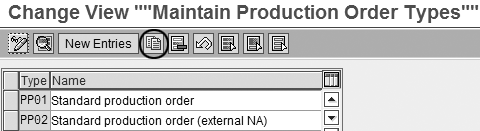
Figure 1
Maintain production order types
Select the existing order type, and click on the highlighted copy as icon to display the screen shown in Figure 2.
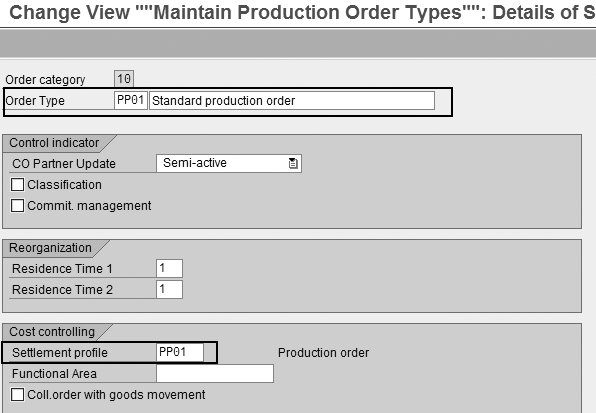
Figure 2
Specify the new order type
Specify the new Order Type and save. It may be sufficient to use the same settlement profile, although you should test this. The Settlement profile determines key settlement parameters, such as valid settlement receivers and whether values settle to Profitability Analysis.
Next, define the order type dependent parameters via transaction OPL8 or menu path Production>Shop Floor Control>Master Data>Order>Define order type-dependent parameters (Figure 3).
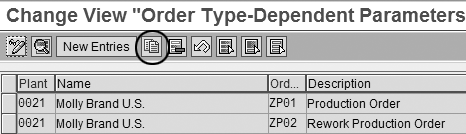
Figure 3
Maintain order type dependent parameters
Select the existing plant order type combination, and click on the copy as icon to display the screen shown in Figure 4.
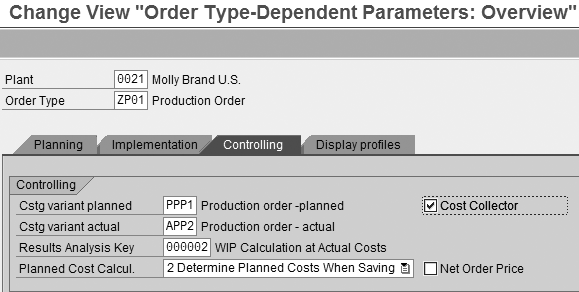
Figure 4
Enter the new order type
Enter the new Order Type, click on the Controlling tab, and select the Cost Collector indicator to specify that costs are to be collected on cost collectors. Production orders created for the new order type are automatically connected to the cost collector. All production costs flow directly to the product cost collector, while no actual costs appear on production orders.
Note that other plant-dependent configuration settings may be necessary for a new production order type, such as scheduling parameters (transaction code OPU3), availability checking (OPJK), and order confirmation parameters (OPK4). Also, WIP at target configuration settings may be necessary if you did not already set them up, such as OKGD (define valuation method) and SPRO (define valuation variant for WIP and scrap).
Create cost collectors using individual transaction KKF6N, collective transaction KKF6M, or menu path Logistics>Production>Repetitive Manufacturing>Master Data>Product Cost Collector.
WIP at Target Valuation Variant
The valuation variant for WIP and scrap allows the choice of which cost estimate to value WIP for product cost collectors. Access the setting via menu path IMG>Controlling>Product Cost Controlling>Cost Object Controlling>Product Cost by Period>Period-End Closing>Work in Process>Define Valuation Variant for WIP and Scrap (Target Costs). You see the screen in Figure 5.
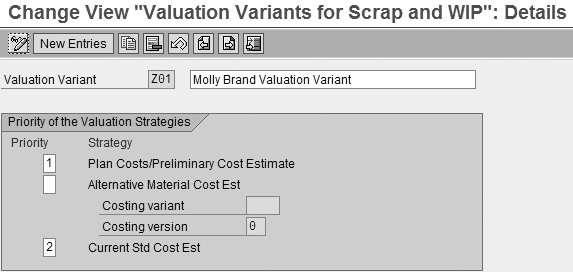
Figure 5
Valuation variant allows choice of cost estimate to valuate WIP
Previous to SAP R/3 Release 4.5, you could use only the standard cost estimate to valuate WIP at target. If you made a change to the structure of a routing after the standard cost estimate was created, WIP could not be valuated. The setting in Figure 5 allows WIP to be valuated with the preliminary cost estimate. If a routing is changed, you can create a new preliminary cost estimate and valuate WIP. This avoids creating another standard cost estimate and revaluing inventory just because a routing changed.
Tip!
Even though WIP at target can be calculated based on the preliminary cost estimate, the credit when received into inventory is based on the standard cost estimate. Any difference due to a change in the routing will be posted as a variance when WIP is canceled at the time of goods receipt into inventory
Let’s follow an example illustrating the benefits of using the preliminary cost estimate to valuate WIP at target. The structure of a routing is changed since the standard cost estimate was created and released. Figure 6 shows the results of the WIP calculation based on the standard cost estimate.
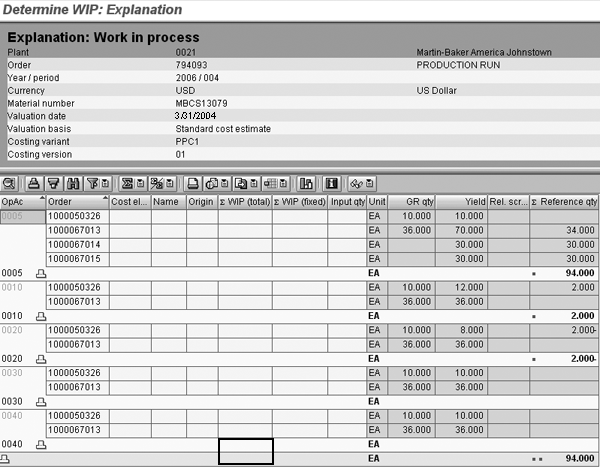
Figure 6
WIP cannot be calculated based on standard cost estimate as shown by the empty field in the box
Cumulative WIP cannot be valuated even though partly completed assemblies are on the production floor. Now let’s analyze the corresponding variance calculation. Variance calculation based on the standard cost estimate shows a variance of $37,837.48, as shown in Figure 7.
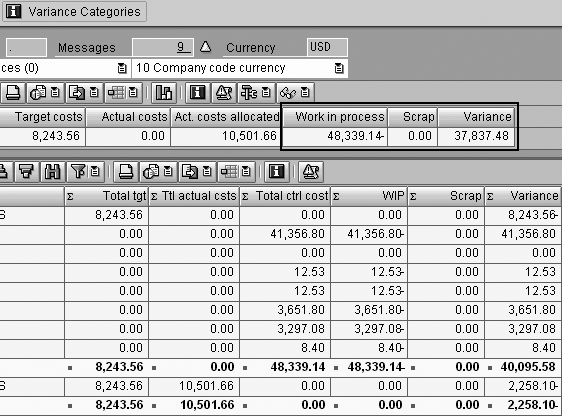
Figure 7
Large variance based on standard cost estimate
The posting of $48,339.14- change in WIP highlighted in Figure 7 cancels existing cumulative WIP, which is now zero, as shown by the highlighted blank total field in Figure 6. Now let’s see the result of WIP calculation based on the preliminary cost estimate, as shown in Figure 8.
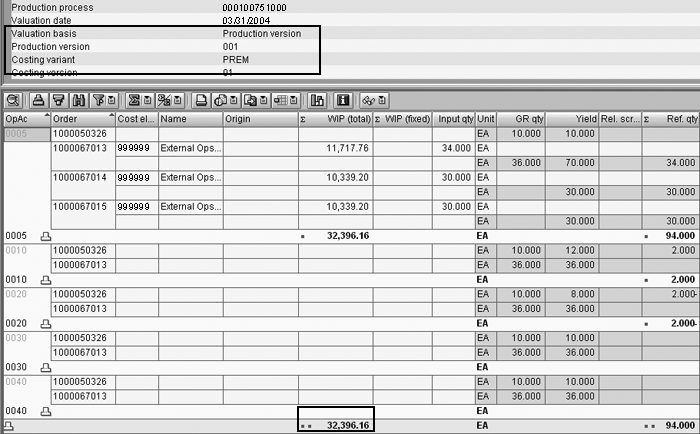
Figure 8
WIP can now be calculated based on preliminary cost estimate
You can valuate cumulative WIP using the preliminary cost estimate, as shown in the highlighted total field at the bottom of Figure 8. The preliminary cost estimate is based on Production version 001, a unique combination of bill of materials (BOM) and routing (list of operations) used to manufacture a product. The preliminary cost estimate is based on costing variant PREM. You can create it individually with transaction KKF6N or collectively with transaction MF30. Variance is reduced if the WIP calculation is based on a preliminary cost estimate, as shown in Figure 9.
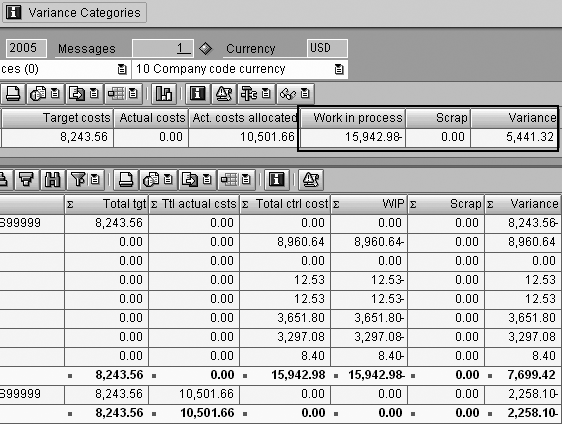
Figure 9
Reduced variance based on preliminary cost estimate
The reduction in variance in Figure 9 occurs since cumulative WIP of $32,396.16 can now be calculated in Figure 8. The previous cumulative WIP was $48,339.14, since this was completely canceled with the change in WIP posting shown in Figure 7. The change in WIP posting $15,942.98-, highlighted in Figure 9, reduces previous cumulative WIP $48,339.14 to new cumulative WIP $32,396.16. These changes occurred since WIP could be valuated using the preliminary cost estimate, and could not be calculated using the standard cost estimate.
Notice the reduction in variance using the preliminary cost estimate in Figure 9 compared with the use of the standard cost estimate in Figure 7. The variance is reduced by $32,396.16 or the amount of WIP calculated using the preliminary cost estimate.
John Jordan
John Jordan is a freelance consultant specializing in product costing and assisting companies gain transparency of production costs resulting in increased efficiency and profitability. John has authored bestselling SAP PRESS books Product Cost Controlling with SAP and Production Variance Analysis in SAP Controlling.
You may contact the author at jjordan@erpcorp.com.
If you have comments about this article or publication, or would like to submit an article idea, please contact the editor.



 Premium