Management
Cirque du Soleil has thousands of cast members in dozens of shows performing in cities all over the world. While performers are executing astonishing acts on stage, costume designers behind the scenes are carrying out impressive feats of their own by suiting up that incredible number of performers. See how the company moved from manual processes for ordering and managing costumes to SAP solutions to gain insight into costume demand and improve capacity requirements planning.
Cirque du Soleil thrills audiences throughout the world with imaginative performances that blend equal parts of circus-act excitement and flamboyant street theater. It’s a winning combination that has helped the organization grow to almost 4,500 employees and become a fixture in entertainment hotspots like Las Vegas, Orlando, Tokyo, and Macao.
But the real heart-stopping action often takes place behind the scenes, where thousands of backstage employees work feverishly to create the 20,000 custom costumes used by the troupe’s 1,300 performers. Working with an annual budget of more than $25 million, the wardrobe staff carefully creates custom-fitted costumes (Figure 1). The process includes more than 150 physical measurements of each performer and uses high-tech three-dimensional scanners to produce a precise a composite reproduction of each artist’s head to make sure hats and wigs fit perfectly. All that upfront work means there is typically a three-month lead time from the creation of the purchase requisition until the costume is delivered — and that’s not including the time required to develop new costume concepts.

Figure 1
Costume production is an involved process that includes costume design, custom fittings, and individual creation for each performer
“We operate an engineering business, but instead of making boats we make costumes,” says Olivier Gariepy, senior business analyst with Cirque du Soleil.
Design and production complexities aren’t the only things that resemble a large-scale engineering operation. Equally challenging is forecasting the annual requirements and managing the inventory of all the specialized fabrics, sequins, and other specialized materials that go into the costumes.
For years, Cirque du Soleil relied on a collection of manual processes for ordering and managing costumes (Figure 2). The company had an effective implementation of SAP ERP in place, but the firm’s reliance on a collection of related proprietary applications meant it didn’t have all the elements in place to run a full materials requirement planning (MRP) system. This impaired visibility into key areas, such as projected costs of costume components and the projected demand for materials over a 12-month window into the future. The result was late deliveries of new costumes to performing troupes.
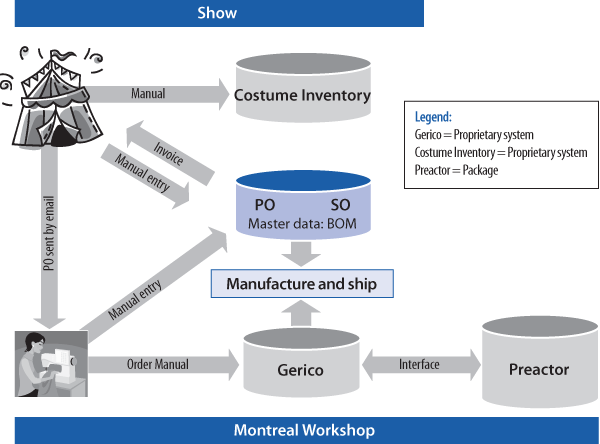
Figure 2
Cirque du Soleil’s legacy costume procurement process
“We had to start working on an order when the order actually came in instead of having greater visibility offered with MRP to better plan our operations,” Gariepy says.
In 2007, Cirque du Soleil began to change course. The organization launched an extensive IT project designed to give it the forecasting tools needed to gain insights into costume demand, with the ultimate goal of better materials and capacity requirements planning.
To do this, the company designed a new solution with some real-world realities in mind.
Happy with the performance of its ERP system, Cirque du Soleil used SAP as the foundation for its new plans. The company added two new applications within SAP Production Planning: Material Requirements Planning (MRP) and Capacity Requirements Planning (CRP). It considered swapping out its proprietary applications for other solutions in the SAP portfolio, but the proprietary applications were too closely linked to other proprietary applications for managing casting, contracts, and other activities. Eventually the company decided on a hybrid environment despite the implementation challenges. The biggest challenge was writing sophisticated interfaces to bridge the SAP and proprietary platforms. But after completing the process and seeing the results, Gariepy is convinced the project team made the right decision.
“If you look at this project from afar, it’s easy to say ‘You could just manage inventory in SAP.’ But the decision always depends on the individual business and each company’s situation,” Gariepy says. “We were confident that SAP was the proper tool for us to process all of our information, but we feel the solution we put in place to actually do the transactions is a lot easier for our users.”
Ongoing Challenges
With Cirque du Soleil’s old system, SAP handled purchasing and inventory management, with a collection of manual, commercial, and proprietary solutions for controlling work orders, the shop floor, and other areas.
The production process began when the costume workshop in Montreal would receive a purchase order from the troupes whenever a new costume needed to be created. The workshop then manually generated a work order and used Preactor, a commercial planning and scheduling program, to determine capacity planning requirements. Then Gerico, one of the proprietary applications Cirque du Soleil uses, took over shop floor management duties, such as printing production orders and status reports. Once costume makers received these work orders, costume creation began. Additional manual operations would then confirm when a finished costume was shipped and eventually received by the performer.
The manual processes were error-prone and nothing in the old system provided the forecasting capabilities Cirque du Soleil needed to accurately manage costume planning and production.
In 2007, the costume department began to lobby for new processes. Senior managers had already voiced a desire to put systems in place to improve forecasts and streamline the ordering process, so Gariepy presented an architectural proposal that would meet these objectives.
He sought help in the planning process from the CGI Group, an IT outsourcing-services company. In addition, CGI called in intelligence group, a consultant specializing in SAP supply chain solutions.
The team members spent the next four months nailing down the project’s architectural requirements. Gariepy describes these talks as “war room sessions” that included business staff members, business analysts, SAP architects, and technical staff members in charge of non-SAP technologies. They probed a range of nuts and bolts architectural questions, including the most fundamental one of all: should Cirque du Soleil replace its proprietary systems and do everything with SAP applications or go with a mix of solutions?
“One thing was for sure, we knew that SAP would be at the center of the solution. But we weren’t sure how these systems would manage our artist-specific BOMs [bills of material],” Gariepy says. “We needed to find a way to have these items configured specifically for artists. We didn’t want the heads of wardrobe to have to think about what color a sleeve on a particular costume should be. We wanted to make it so they could say, ‘I want this costume for this artist’ and the rest would be automatic.”
A Fresh Approach
To provide that automation, Cirque du Soleil uses a materials variant approach (Figure 3) that manages and stocks materials that undergo custom configurations. Thus, the head of wardrobe specifies a costume and the artist who will be wearing it and the system will determine the necessary components.
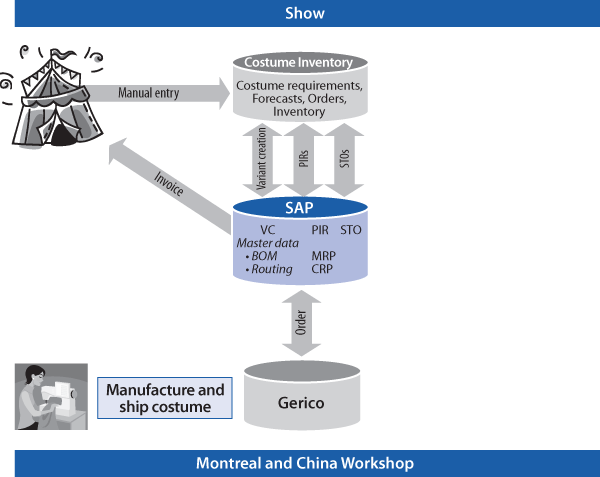
Figure 3
Cirque du Soleil’s new, streamlined costume procurement process
But to do this, the company had to develop an interface that automatically creates material variants as soon as a new artist is hired for a show. The interface bridges a proprietary costume inventory system with the SAP platform to help create the purchase requisition that eventually gets converted into an STO (stock transfer order).
The head of wardrobe sees a screen for entering forecasts of costume requirements, which look 15 months into the future, within the same cost of inventory system. The inventory system only allows forecast generation for combinations of costumes and artists found in the costume requirements records. This guarantees that the SAP material variant for which the Planned Independent Requirement (PIR) will be created already exists in SAP.
Whenever a new artist comes to the show, the head of wardrobe enters the name of the costume the artist will normally wear into the costume inventory system. From then on whenever a costume is added into the system for that artist, his or her physical specifications are automatically sent to the SAP applications. Thus, through that single interface, Cirque du Soleil can configure a materials variant and assign it to the BOM.
“This interface will create the material variant and configure the variant for the one characteristic that is common to all variants: The artist ID. It will also link the variant to the configurable material BOM and create the routing and production version, also based on the configurable material. The other characteristics, such as color, vary from one material to the next. These characteristics need to be manually configured in the material master record of the variant based on what the artist will do on the show. Once the variant is completely configured, orders can go through and SAP will know which components to use,” says Gariepy.
For example, if the company needed to create a purchase requisition within SAP, the request would first go through costume inventory and then to SAP, which would create a purchase requisition. If any master data is missing in SAP, an alert message would go back to the proprietary system, which would send an e-mail message to the owner of the master data to request updated information.
Cirque du Soleil also created interfaces between its Gerico shop floor control system and the SAP platform to manage production orders. “This allows us to generate an automated confirmation of the operation and have SAP calculate start and end dates based on available capacity,” Gariepy explains.
Early Benefits
The new solution went live in January 2009 and the costume department management team is now in the process of gathering metrics to quantify the impact on delivery times and forecasting accuracy, as well as other key elements of the program. But anecdotally he says the solution is already delivering value for Cirque du Soleil. “The solution helps the whole workshop have better control of its operations. Work that used to take a lot of effort and a lot of time now runs more smoothly because everything is centralized within our master data system,” he says.
Because of the unique structure of Cirque du Soleil and its dozens of touring companies throughout the world, it’s not enough to see improvements in Montreal. “It’s easier to manage change here in Montreal because we are near the people using the system. But many of our people are traveling all the time, which makes it harder to stay in touch with them to get their feedback,” Gariepy says. “So we wanted to make sure that they weren’t being stuck with systems that they would not be able to use.”
Fortunately, the feedback he’s getting from the road is equally positive as from home base. “They are really happy with the way the system works and training them on the new features is much easier now because the systems that they are using are simpler to use,” Gariepy says.
Lessons Learned
As with any complex and large-scale IT project, Cirque du Soleil learned some key lessons about how the planning and implementation phases could have been improved. “If I had to do something differently, I would have put more effort into making sure that all the proper processes were in place to keep information up to date,” he says. “We put a lot of effort into making sure that all the data was good on day one. But we didn’t put enough effort into processes.”
The forecasting process is one example. Looking back, Gariepy wishes that more would have been done earlier to assure accurate forecasts. “We needed to analyze the results better to compare the forecast to the actual order and find incentives for our shows to provide the best forecast as possible,” he explains. “The whole purpose of the project is to have everything in place when you need it based on that forecast.”
Another example is master data processes, which Gariepy says weren’t initially precise enough. “With MRP, in order for the signals to be reliable, you need to have your BOMs, routings and material master records updated and correct and have your inventory up to date,” he says. “But there were a lot of questions about who should do what when the changes came through.”
Cirque du Soleil also devised some best practices during the course of the project that will help the company with any future IT modernizations.
Make Master Data Management a Priority
When the project started, Cirque du Soleil knew some of its master data would need to be updated, while in other areas it would need to build storehouses for data that had not previously existed. For example, the company had not been collecting master data associated with BOMs or for the routing of semi-finished products. “That information was all in the heads of the people who were in involved with the processes,” he says. So Cirque du Soleil spent about 18 months formalizing the previously undocumented information to eliminate the risk that key pieces of BOM or routing data wouldn’t be forgotten or leave the company because of personnel changes.
Give Super Users Full-Time Status
During the months of architectural deliberations, Gariepy identified several “super users” who understood the new technologies and could champion their adoption in the costume creation and design process. “We integrated them into the project right from the start and that helped us greatly when it was time for the go-live because these people had a lot of influence on other people in the company,” Gariepy recalls.
But the job of being a champion was in addition to their regular duties — one as a master planner and another from customer service. It became difficult for super users to find time for both responsibilities. Understanding the importance of the champions, Cirque du Soleil hired replacements that made it possible for super users to perform their new roles full time on the project during its roll-out phases.
“Without this support you might launch the projects and three or four months down the road your main planner says, ‘I have too many operational issues. I don’t have time for your project any more.’ And then your whole project stalls,” Gariepy says. “Having these people work full time for a whole year helped greatly.”
Alan Joch
If you have comments about this article or publication, or would like to submit an article idea, please contact the editor.