Understand how SAP solutions for enterprise information management (EIM) cover all types of information. This includes data that is structured, semi-structured, or unstructured, as well as many content forms such as documents, emails, and PDFs. It also supports business processing and analytical applications, and evolves into information governance to ensure data and information are managed as an asset. Key capabilities of EIM include data integration and quality management, complex event processing, content management, and master data management.
Key Concept
Enterprise information management (EIM) solutions serve a crucial role in ensuring the right information is available for various business and analytical applications. Information can take on many forms, such as trusted data used in a business process or decision to documents that provide context. EIM solutions perform many functions, including extracting, transforming, loading, and converting data; managing and governing data; managing unstructured content; and correlating data for key business intelligence events.
SAP is probably best known for business processing and applications such as the SAP Business Suite. However, over the past several years SAP’s portfolio offering has extended beyond the Business Suite. One important extension includes the business of managing data and information, referred to as enterprise information management (EIM). We’ll provide insight into EIM including what it is, why it’s important to business, and how it fits into SAP’s strategy.
We’ll start by explaining what EIM is and then move into some example use cases to help you understand how it applies to different industries and situations.
What Is Enterprise Information Management?
Simply stated, EIM is the management and governance of data and information from its creation through its active use and eventual retirement. This could be information or data that is used within a single application or leveraged across an organization. SAP solutions for EIM cover all types of information:
- Structured data
- Semi-structured data
- Unstructured data
- Documents
- Emails
- PDFs
- Audio
- Video
The management of information with the understanding of its life cycle yields the best results for use and cost.
As illustrated in Figure 1, there is an associated cost in bringing information into an organization, using the information, and hopefully retiring the information once it is no longer producing value. The idea that organizations really just do three things with information — on-board, actively use, and then off-board — is powerful when thinking about EIM solutions.
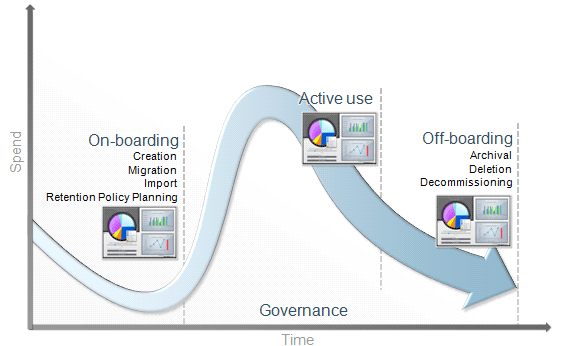
Figure 1
Cost of bringing information into an organization (source: SAP)
SAP solutions for EIM allow for trusted information to be brought into an organization, whether initially created, imported, or migrated from another information source. Once information is brought into your organization, it is desired for many uses beyond its original purpose. Hence, it is advantageous to prepare it for these manifold uses. That way, the effort to repurpose information during the active-use phase is greatly reduced. Once information is no longer required, it should be off-boarded or retired in a manner that meets your specific organization’s legal and business requirements. The truth is most organizations do not proactively consider off-boarding information, which ends up costing millions in IT resources due to maintaining systems that are no longer used. SAP solutions for EIM are designed to manage information through its natural life cycle.
Major Use Cases of EIM
There are many use cases for SAP solutions for EIM. Three of the primary scenarios are:
- Preparing and delivering trusted information for analytics and analytical applications: Analytical applications (also referred to as business intelligence [BI] solutions) are geared to support better business decision making to optimize performance. These applications can include drill-down reports, slice-and-dice data reports, predictive analysis, and supply chain optimization. All analytical applications require data and information management capabilities to ensure the information is trusted, cleansed, and able to aid sound decision making.
- Trusted data to drive operational business processes: Business applications, such as SAP Business Suite, automate crucial processes such as order to cash, payroll processing, or accounts payable. Business process applications require EIM for information on-boarding, conversion, facilitating the flow of information across business functions inside and outside the boundaries of the organization, improving the quality of data, management of master data, and strategy for structured and unstructured information in a cohesive manner that supports and drives the business process.
- Management and governance of information as a strategic asset: Once a company benefits from data management for business processing and analytical processing, the evolution is to an overall data management strategy that sees information as a critical asset and manages it holistically as intellectual property.
For the purpose of this article, we will focus on the usage scenario of EIM for business process applications, focused on SAP Business Suite.
Examples of EIM for SAP Business Suite
Figure 2 illustrates how EIM can be used in the context of SAP Business Suite.

Figure 2
EIM and SAP Business Suite (source: SAP)
Information management includes the following six sections, correlated to the numbers in Figure 2:
1. Structured Data
This includes the familiar data used within an application system (e.g., customers, products, and sales orders). SAP recommends this three-step process for handling structured data:
- Migrate structured data into an application system (e.g., SAP ERP Central Component [SAP ECC] 6.0 or SAP Customer Relationship Management [SAP CRM] 7.0)
- When creating a new business partner or product, enforce data quality rules upon data entry. This can include a duplicate check (i.e., customer, lead, business, partner, or material already exists based on the criteria you supplied) or enrichment of data (i.e., validating the address with the local postal authority).
- Governance is required on all major data structures, including the governance and control of master data
2. Office Documents
These include Microsoft Word, Microsoft Excel, and other desktop word processing applications. This data is stored across the enterprise on shared drives and laptops, much of it not controlled at an enterprise level. This content may be critical to the application data, so you need to manage this content with the same importance as the structured data in the database. Examples include:
- Purchasing documents (e.g., invoices) may need to be scanned and associated with the invoice inside SAP ERP
- Legal contracts, grants, and other unstructured to semi-structured data must support the business process
3. Pictures, Scanned Documents, and Other Images
These could be scanned invoices, pictures of products that are sold in a catalog, and drawings of products that are being designed and built. These become part of the content that needs to be managed and related to the structured data when required. Managing content associated with a core business process is becoming increasingly important to process efficiency and regulatory compliance. For example:
- Companies often need to keep detailed records of their asset maintenance, so they need a systematic approach to manage items such as routine maintenance records, failure case analysis, photographs and video of assets, and all relevant correspondence between employees, customers, and contractors
- Organizations also find significant productivity gains as they move away from paper. The process most dramatically improved by digitization is accounts payable. Companies can see 80 to 90 percent efficiency gains by automating the process of scanning invoices and handling all approvals and exceptions in the context of financial accounting (FI) in SAP ERP.
4. XML Files
Information that is available in XML format, such as RSS feeds, blogs, and other semi-structured information that is important to the enterprise. Examples include:
- A company has a large trade show and is interested in the blogs and posts regarding the show. Those comments should be associated with the show and also be related to structured customer data.
- Emails associated with purchasing documents, design plans, and contracts should be linked with the structured objects in the SAP application
5. Sentiment Analysis
It might be hard to read in Figure 2, but number 5 reads “The car should self-drive on the highway.” This piece of information may come from a survey, it might be a comment on a Web site, and by itself it might not be important. However, if you are looking at car design over the next five years and 60 percent of the comments you receive have something about self-driving, this comment warrants further investigation. So, EIM also includes looking into text you receive and doing some analysis to determine sentiment, feedback, input, or action that should be taken based on comments.
- For example, a truck manufacturer releases a new truck targeted to monster truck fans. The manufacturer is interested in comments and postings placed on specific Web sites. Additionally, all customers were sent an online survey after three months of ownership to receive feedback. All comments should be synthesized and analyzed to provide overall feedback for the product design and development teams.
6. Transient Data
Number 6 in Figure 2 is a list of flights that have landed or are about to land at the Frankfurt airport. This is meant to represent transient data, which means it is short lived, or is important as it is correlated to other data or information. Examples include:
- If returns in a certain week are up and quality numbers are low over the past three weeks, you might think those two are related. You can track both and notify the responsible person if you see a trend that requires investigation. In the flight example, you might want to look at trends in flights departing on time with security-level monitoring so you can determine when the security is at a certain level flights can be delayed by a certain percentage of time.
- Purchasing documents should be correlated to the receipt of goods. If there is a trend of discrepancy in what was ordered versus what was received, the purchasing agent should be alerted.
As you can see, SAP solutions for EIM include the combination of traditional structured data and non-structured information. Our scope is from the moment of creation through retirement. The retirement of data and information has the same value as creation. Once information is no longer needed, it becomes a liability. That could be a legal liability, a cost liability, or other liability. The entire lifespan of the data and information is covered within information management. As you manage all this information, it is critical to have some governance surrounding the management of your data and information. This is referred to as information governance and as you can see in Figure 2 it has a role with all the types of information from creation to retirement.
Business Examples of EIM’s Importance
SAP solutions for EIM provide trusted data to drive and deliver best business processes. This value includes the ability to holistically manage data within business processes, ensuring the quality and ability to reuse the data. Business examples of why EIM is important include:
- Compliance and regulations in the financial industry:
- Industry requirement for risk-related data analysis. All data must meet quality levels and industry standards.
- Ensure all associated content (e.g., documents and invoices) is always linked to financial contracts
- True cost assessment of manufacturing goods in the manufacturing industry
- Analyze total costs for making and delivering products. Crossing multiple business domains, data must be cleansed, duplicates removed, and correlations created to ensure analysis provides accurate information.
- Real-time data analysis to reduce fuel costs in the transportation industry
- Analysis of weather, speed, weight, to ensure the best route for fuel savings
- Data management of key master data, such as well management in the oil and gas industry
- Oil and gas companies have thousands of wells, with well information stored in many different types of systems. The overall production versus cost of the well is only known through the synthesis and linking of the data across the enterprise.
- Suspect tracking in the public security industry
- Federal, local, and state agencies must share information on criminal activity and suspect tracking. Data management ensures each new suspect is compared to others to ensure it is a unique suspect. Data quality rules can ensure the most up-to-date information is available for suspect tracking.
- Data management, conversion, and migration due to mergers, acquisitions, and global implementations across all industries
- High risk for business and application disruption during mergers, acquisitions, and new application implementations
- Reduce spend with harmonized master data across industries
How EIM Affects SAP’s Strategy and Software Portfolio
EIM falls into the SAP Business Analytics area at SAP. Strategically, SAP solutions for EIM have the role of orchestrating, cleansing, and providing data, information, and content management. This includes data residing and moving among on premise, on device, and on demand. The EIM capabilities drive the data layer of the SAP Business Analytics offerings as well as the operational data management requirements from SAP Business Suite. Figure 3 shows the Business Analytics offerings. EIM is the layer between data and information sources and the application that requires the data according to the application’s business and data quality rules.

Figure 3
SAP Business Analytics offerings (source: SAP)
The EIM offerings are broad and deep in functionality, including capabilities to support data management, information governance, master data management, enterprise content management, intelligence-driven complex event processing, and system decommissioning.
Data Management
Data management covers comprehensive breadth and depth of capabilities for the management of data. This includes a single platform for assessing your data to determine its quality level, enforcement of data quality, from cleansing and pattern matching to duplication detection. Additional capabilities are offered related to the transformation of data from disparate source systems, including textual data such as survey text (or text from Web sites or user reviews), data validation, data migration, and data conversion.
Information Governance
Information governance ensures success through value-driven management of your information, models, and policies. Information governance broadens data governance to include some more ambiguous aspects of governance, including the life cycle of information, accountability, monitoring of the governance process, and managing the information’s return on investment (ROI).
Information governance enables a repeatable, governed process to manage key data and information. An example would be the evaluation of data quality rules during data integration. In Figure 4 is an example of governance when data quality rules have failed. In this simple example, the evaluation of the failure could require an update in the data, or an adjustment to the data quality rules. (In reality, both could be required, but for this example assume one or the other is required.) The data steward approves the change and the changes are made.
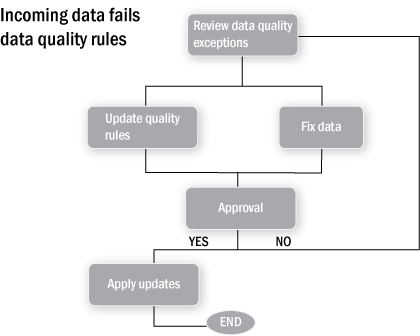
Figure 4
Failure of data quality rules
Depending on the complexity of the scenario, the governance around data management could be simple or more complex. As an organization views data as a strategic asset for running the business, then information governance requirements increase and there could be a few key processes that ensure data and information is governed and retains a high quality.
Master Data Management
Master data management is probably the most well known of the processes that SAP solutions for EIM address. Managing master data is required to support a myriad of business concerns such as mergers and acquisitions, regulatory compliance, and service-oriented architecture (SOA). Master data management is an enterprise strategy that treats master data as a corporate asset with enormous top-line and bottom-line impact. It facilitates data consistency across multiple systems for streamlined business processes and enterprise reporting while ensuring end-to-end data stewardship and master data governance.
Enterprise Content Management
One growing challenge with core business process management is that there is frequently unstructured content associated with the process that is not stored with the core transaction data. This type of content can include scanned images, invoices, documents, contracts, pictures, and emails. SAP’s Enterprise Content Management solutions enable organizations to capture, create, collaborate, store, and publish content related to business processes. These solutions integrate with SAP Business Suite — for example, invoices scanned and passed through an optical character recognition (OCR) engine can trigger an automated invoice approval process. Another example might be the creation of personalized billing statements that combine SAP data with unstructured content and appropriate marketing offers.
Intelligence-Driven Complex Event Processing
SAP solutions for EIM include a complex event-drive processing application that can help you understand the impact of events to your operations in real time. It can unite business events to provide insight into what is happening to your business at any moment. The goal is to determine what you need to know that you don’t know today (e.g., correlation of complaints in the last day with returns and quality issues in the last month). You can receive immediate alerts when a region’s sales for the day drop below an expected threshold, for example.
System Decommissioning
Once new applications have been implemented, the old applications often remain. Sometimes it is to support ongoing integration, other times the applications are left as insurance or until users are comfortable with the new applications. Then, as time passes, these applications become a liability. They are costing money and are not used daily. Once the cost of keeping these applications running exceeds the benefit, then applications need to be decommissioned, keeping what is required for tax and legal reasons and taking the application offline. EIM includes the retirement of data and processes within an application, as well as system and application decommissioning.
How to Get Started with EIM
As you can see from this introduction, SAP solutions for EIM have breadth and depth to cover data needs, from creation through retirement. So, how do you include these tools in the everyday requirement of doing business and how can you get more information?
The easiest way to include data management tools in your current processing would be to:
- Start with data migration. The next time you need to migrate new data into your existing SAP system, or if you are implementing a new SAP application, use the data migration capabilities provided by SAP solutions for EIM.
- Consider data quality inside SAP ERP, so that when a new business partner is entered the addresses are cleansed and duplicates are checked
- Start by looking at your customer data. Do you have sales people who fix data instead of selling? Do you have shipments delayed due to incorrect customer data? The customer domain normally provides immediate business process improvement with the investment of governed customer data.
- Involve data management capabilities on your next migration project. Don’t just move the data; cleanse and validate it, and then reuse the same tools to keep it clean after the migration.
- Integrate content such as scanned images, documents, and emails with the data objects in the SAP application system.
- Look at the integration of data into your applications today and pick the top three areas where data management and cleansing could save real dollars and processing time.
Note
If you are interested in learning more about SAP solutions for EIM and how it fits in with SAP Business Analytics go to
the SAP Business Analytics page. For further technical details on Enterprise Information Management use
this SCN link.
Mike Keilen
Mike Keilen is a senior director of solution management for SAP solutions for EIM. He has been with SAP BusinessObjects since 1991. Mike has provided leadership across EIM and enterprise content management (ECM) topics in various engineering, product, solution, and partner management roles. He is currently responsible for SAP’s information governance, migration, cloud/SaaS, and enterprise content management solutions. You can follow him on Twitter @MikeKeilen.
You may contact the author at mike.keilen@sap.com.
If you have comments about this article or publication, or would like to submit an article idea, please contact the editor.
Ginger Gatling
Ginger Gatling works in solution management covering information management topics, focused on data migration. Prior to this, she covered business process management topics (including SAP Business Workflow, Universal Worklist, and SAP NetWeaver Business Process Management), integration topics (SAP NetWeaver Process Integration), and other SAP NetWeaver topics. She coauthored the second edition of Practical Workflow for SAP and has delivered a series of workshops on workflow for SAPinsider.
You may contact the author at ginger.gatling@sap.com.
If you have comments about this article or publication, or would like to submit an article idea, please contact the editor.

 Premium