/HANA
The SAP CO-PA Accelerator is the marquee example and use case of an SAP HANA-based solution that accelerates existing SAP ERP-based business processes — in this case profitability management. See how using the SAP HANA-based CO-PA Accelerator to access and process nonaggregated data instantly can change your approach to profitability management.
Key Concept
SAP HANA is SAP’s in-memory appliance that orchestrates the latest hardware and software technological innovations to help you analyze real-time information on large volumes of nonaggregated data at unprecedented speeds. With many businesses focusing on after-the-fact analysis today, the SAP HANA-based CO-PA Accelerator allows SAP customers to use CO-PA as a much more proactive and opportunistic profitability management tool. Access to SAP HANA-based profitability data becomes instant, and users can access all the CO-PA data ever posted on a line-item level.
The SAP HANA-based CO-PA Accelerator brings current profitability data — in real time — to business users. This data is ready for ad hoc analysis in a self-service fashion, rendering hundreds of millions of line items in subseconds. With the processing power of SAP HANA and its real-time capabilities, managing profitability shifts from period-end reviews to business-in-the-moment actions.
The SAP CO-PA Accelerator uses SAP HANA as a secondary database. Revenue and cost data are gathered within CO-PA in SAP ERP as before. Subsequently, the CO-PA line items — scheduled as an extract, transform, and load (ETL) process or via real-time replication — are copied onto HANA. Existing SAP ERP processes such as allocations and drill-down reporting are redirected to read data from SAP HANA instead of the traditional database, dramatically improving the performance of those processes. In addition, flexible, business user-driven analytics can be set up as well directly on top of SAP HANA with SAP BusinessObjects Business Intelligence (BI) 4.0 front ends such as SAP BusinessObjects Explorer (Figure 1).
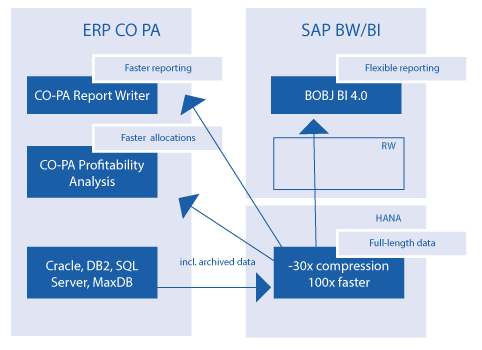
Figure 1
Architecture of the SAP CO-PA Accelerator
A virtual information provider that works specifically for CO-PA (in development) will soon allow you to directly access profitability data in SAP HANA from within SAP NetWeaver Business Warehouse (BW) queries to accelerate BW-based reporting as well.
CO-PA has been a core component of the SAP suite of business applications since the early days of ERP. Long before the arrival of industry-strength business warehouse concepts and solutions, SAP provided the capability within ERP to bring together revenue, cost data, and mechanisms for the accurate calculation and multidimensional analysis of profitability within the respective lines of businesses and market segments.
A key challenge has been dealing with the large data volumes originating from the SAP sales and distribution (SD), product costing (CO-PC), SAP General Ledger (GL), and managerial accounting (CO) modules or external data sources. In addition, all those transactions are stored as records (online transaction processing) and need to be analyzed across all the dimensions that require a more analytical view; that is, online analytical processing (Figure 2).
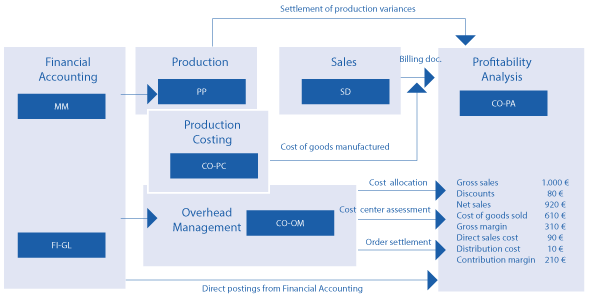
Figure 2
Data flow between Financial Accounting and Profitability Analysis
The performance of reporting is critical; also critical are month-end allocations from CO to CO-PA and top-down within CO-PA. Month-end closes need to be conducted within the allotted time window. Users need to have instant access to the decision-relevant sales, prices, revenue deductions, and cost information and insight to achieve the set profitability targets.
The following topics are key to helping you understand the underlying concepts of the SAP CO-PA Accelerator with SAP HANA:
- Solving CO-PA performance issues
- Boosting business users’ productivity
- Transforming your business to business in the moment
Performance Issues
Performance issues might not be obvious or visible as IT departments have been busy in the past 20 years putting creative workarounds in place, such as early data archiving, preloaded data aggregations, and dimensional limitations in reporting. Consequently, IT dependency — and even more often, IT bottlenecks — has become a performance challenge to the business user community.
Allocation and Reporting Process Performance
The good news is that many of the workarounds IT put in place are obsolete and are no longer required with the SAP CO-PA Accelerator. Archiving no longer needs to be performed to keep the size of the CO-PA tables low as the complete picture is available in SAP HANA after replication, but can be done when no longer required in SAP ERP for allocations or revaluations (as the complete picture is available in SAP HANA after replication).
Reporting
Aggregation levels to support better reporting response times no longer need to be created or maintained. Once the checkmark in the configuration for the SAP CO-PA Accelerator is set to active, reports automatically access the line-item data replicated to SAP HANA. SAP HANA is so fast that the data can be processed now without any data aggregations. Existing reports do not to be changed at all.
Dimensional restrictions to manage performance also are no longer required. New reports can include all dimensions, and you need to create new reports only if a different reporting layout is required or desired. You can also include additional dimensions in existing reports.
CO-PA reports perform faster and can provide complete information (not limited by archiving or dimensional restrictions) and allow for instant response times — to execute reports as well as for every drill-down included within reports.
Allocations
Allocations, the association of expenses and cost a business incurs, are captured mostly on an organizational (departmental) level. They also benefit from the enhanced SAP HANA speed. That is the case where allocation rules are based on reference (driver) data included in CO-PA – for example, when marketing costs that are incurred for a product group (dedicated event or conference) are allocated to the individual products within the product group based on revenue generated. The SAP CO-PA Accelerator works equally well for top-down allocations.
Note
Up to 50 percent of the overall allocation runtime can be saved by speeding up the read portion. Allocations are still executed in ERP, so the calculation and write portion of the process are not accelerated by the SAP CO-PA accelerator. Faster processing of the allocation cycles also provides business users with a window to introduce deeper, more detailed allocations.
Improved allocation performance reduces the processing time for the month-end closing cycles and increases the accuracy of the profitability and management information provided.
Business Users’ Productivity
Effective management of profitability requires an efficient, quick review of data in only one report with minimal response time delay between drill-down steps. The speed of SAP HANA makes this type of analysis possible, along with summarizations and line-item level access (drill-downs) to millions of records in subseconds.
Why is speed better, and why does faster processing have a positive impact on performance? First of all, speed allows more tasks to be performed in the same time. For example, a business user can now look at his top 30 customers or products in an hour every morning instead of only the top 10. Second, analysis can be deeper. With the SAP CO-PA Accelerator, users can drill down along the CO-PA dimensions without a processing delay (i.e., hourglasses on your screen). Moreover, optimal performance with the SAP CO-PA Accelerator enables users to execute only one report to drill down to an answer. Without SAP HANA, users need to jump from report to report and wait every time they explore an additional dimension.
SAP HANA’s and SAP BusinessObjects Explorer’s Performance Punch
The SAP BusinessObjects Explorer graphics-oriented analysis tool (Figure 3) can work on top of SAP HANA to render all CO-PA dimensions defined in CO-PA, and all line items ever posted (current and previously archived) in one report (InfoView). Business users are able to run their own ad hoc analyses to explore the profitability data based on the results (positive or negative) of the operation and not based on IT predefined logic.
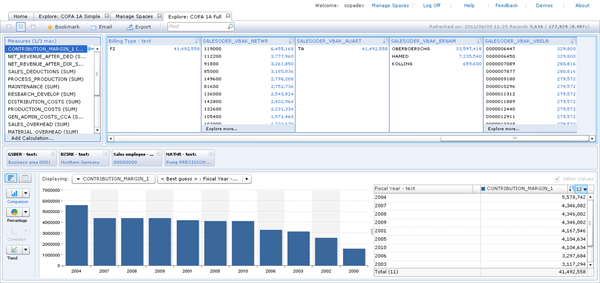
Figure 3
A flexible SAP BusinessObjects Explorer report on top of SAP HANA data
SAP HANA-based profitability data together with the SAP BusinessObjects Explorer provide a solution to the challenge of getting ad hoc access to the business user community.
Business in the Moment
Today, most of the time spent on profitability management actually is spent on profitability analysis (i.e., gathering the relevant revenue and cost data and creating management reporting compiled to understand trends, challenges, and opportunities as part of period-end management reporting processes).
With SAP HANA revenue, cost and profitability can be made available in real time. Consider the sales force needing to know if its last transactions came through, if a commission is already processed, what the eventual net profitability of a business transaction or event was, and how the actual-to-date numbers are in line with the period-end targets.
The key point is that one can move from analyzing pure after-the-fact events that happened already — and that no one can influence anymore — to managing the business still left in the reporting period.
Eventually, one can imagine a decision made in real time, in front of a customer, while negotiating with the knowledge of how much of a discount a product turns unprofitable, how the cost and therefore margin changes with different sales quantities, or which products to push price increases for based on expected increases in the underlying raw material cost.
The heart of the SAP CO-PA Accelerator implementation is business performance. The SAP CO-PA Accelerator affects the following business performance aspects:
- How business is conducted and how well it is doing (productivity)
- How much insight is gathered
- How effectively the business is managed (decision making)
- How the bottom line is impacted (profit and margin)
SAP CO-PA Accelerator: Enabler and Catalyst
The SAP CO-PA Accelerator can be considered both an enabler and a catalyst of business improvement and business transformation. Existing processes can be reevaluated. In many cases the very assumptions that led to the mandate for and setup of a process can be challenged. Workarounds put in place by IT such as early archiving of data, limitations to reporting dimensionality, or pre-processing of data (creation of data aggregation levels) to manage reporting performance are not required with the SAP CO-PA Accelerator anymore.
Existing processes can be changed to fulfill business requirements and not be just a pragmatic compromise between a business requirement and the ability to execute in an acceptable processing time. Look at cost allocations that are done at a product group level today because allocation and reporting performance does not allow you to go deeper. With the SAP CO-PA Accelerator the allocations can be driven down to the level you manage your business and make decisions at — the individual product level. However, implementing the SAP CO-PA Accelerator is as much about reversing the way you have done business in the past as it is about introducing new processes that allow for competitive differentiation.
Competitive Differentiation
Consider taking the profitability data onto SAP HANA and running a lifetime profitability pattern analysis comparing a particular month over time, looking at what was bought and when, and what other products were bought. If you give your sales force members access to this SAP HANA-based profitability data, they can make decisions on giving discounts in real time. They would know how many rebates have been given to the customer and how much rebating is still possible before the product turns unprofitable.
You can combine profitability data and enrich it in SAP HANA with other SAP data such as inventory at hand to promote only those products you can actually sell. Another example is using SAP HANA to enrich sales item details such as an attribute of a product (e.g., color or eco-friendliness) to look at profitability by those additional dimensions. Combine it with external data (e.g., location or demographics data) to broaden your set of decision parameters to include the ones that can make a difference and provide you with a competitive differentiation.
Performed formally with, or informally without, SAP support, a business transformation assessment can bring to light additional, not immediately obvious, cost benefits of SAP HANA.
Carsten Hilker
Carsten Hilker is solution manager for finance and performance management solutions at SAP. He has been working with SAP systems for more than 20 years. He is an active member and advisor to a number of think tanks and professional communities focusing on management accounting and performance management. Carsten is based in Atlanta, Georgia.
Carsten will be presenting at the upcoming Central Finance Bootcamp November 7-8 in Chicago and November 27-28 in Orlando. For information on the event, click here.
You may contact the author at carsten.hilker@sap.com.
If you have comments about this article or publication, or would like to submit an article idea, please contact the editor.

Dr. Karol Bliznak
Dr. Karol Bliznak is vice president of the Rapid Innovation Group (RIG) within the mobility division at SAP. He focuses on converging SAP’s strategic innovation categories, such as mobile solutions, SAP HANA, business analytics, and the cloud. He works at the SAP AG headquarters in Walldorf, Germany. He has more than 14 years of SAP experience in business intelligence, mobility and in-memory technologies, enterprise performance management, financial accounting, controlling, governance, risk, and compliance.
You may contact the author at karol.bliznak@sap.com.
If you have comments about this article or publication, or would like to submit an article idea, please contact the editor.



 Premium