Management
Corporate sustainability is more than a feel-good endeavor. Identifying waste and inefficiency is a key way to boost your company's bottom line. William Newman and Bill Rudiak of Newport Consulting Group have identified several ways SAP companies can leverage technology to help them meet their financial goals while improving sustainability.
Over the past several years, the concept of corporate sustainability has moved from the realm of feel-good public relations to that of serious business — with good reason. Sustainability often requires streamlining your company’s key processes, which in turn boosts the bottom line while upholding your corporate reputation, according to William Newman and Bill Rudiak of Newport Consulting Group.
“Most organizations agree that continuous sustainable performance is critical. It’s something investors and stakeholders want to see more and more. And it’s not just about stocks going up — they want to know you’ll be profitable for years,” says Newman.
SAP has drawn considerable attention and accolades for its own sustainability strategy, and many of its customers are following suit with their own initiatives. SAP companies have several options for creating sustainability programs, according to Newman and Rudiak. Choosing the right path depends greatly on your requirements; however, the need to implement an enterprise-wide sustainability program is real.
A 2009 survey by McKinsey & Company found that while maintaining corporate reputation and brand equity was the key value of a corporate sustainability initiative, a large number of executives also cited operational efficiency, growth opportunities, and improved risk management (Figure 1).
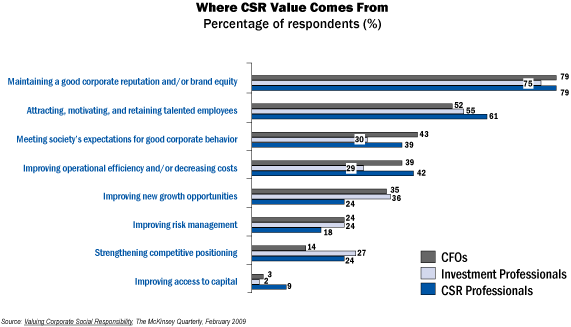
Figure 1
Where the value of corporate responsibility is derived
The results of corporate sustainability initiatives have proven their value. The Dow Jones Sustainability Index, which tracks the success of the leading sustainability-driven companies, has shown that the stock prices of those companies in Europe have outperformed their non-sustainable competitors (Figure 2).
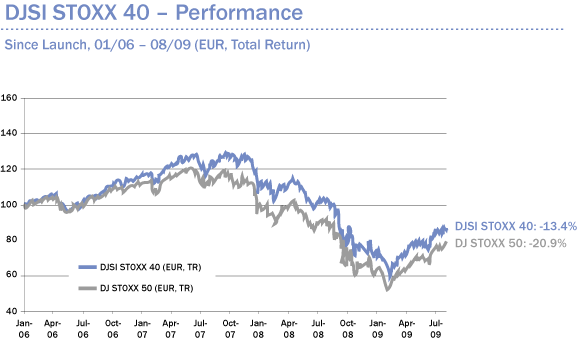
Figure 2
Sustainable companies outperform non-sustainable ones
While companies may initially focus on fixing “hygiene” problems when implementing a sustainability program, they may unearth several opportunities during the initiative to achieve strategic objectives (Figure 3).
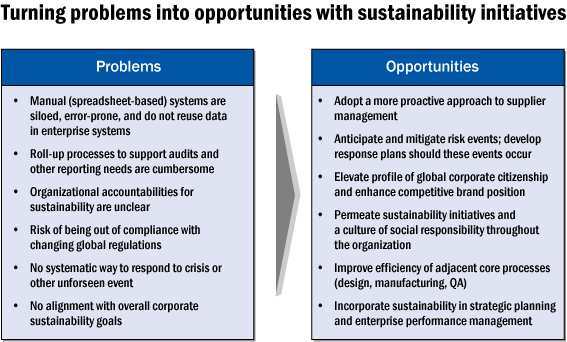
Figure 3
Sustainability and problem-solving
Sustainability initiatives have been around for decades in one form or another. Your company may have years of experience demonstrating compliance with a particular environmental or economic regulation, for example. However, pressures from the global recession and increased attention on good corporate citizenship have forced companies to align sustainability initiatives more closely with their overall mission.
“The really advanced companies are beyond the compliance tick-box. They’re thinking a lot more deeply about this,” says Rudiak.
Newman and Rudiak divide sustainability initiatives into three main pillars:
- Environmental sustainability
- Economic and financial sustainability
- Social responsibility
While many companies focus their sustainability in one of these areas, Newman points out that a sustainability reporting strategy should encompass these areas and more. Crafting a comprehensive strategy requires a framework for reporting and decision making across all three areas.
Your Options with SAP
The foundation of the modern sustainability reporting strategy is built from the Global Reporting Initiative (GRI), which in 2006 developed guidelines and audit recommendations for companies with sustainability initiatives. While the GRI guidelines serve as the standard for reporting and auditing, they are not a substitute for solving underlying business issues, according to Newman.
“You can have all of your reports and audits in order, but if you can’t ship your product to the EU because of a safety regulation, that’s still a problem. You still have to do the work required to solve the problem,” says Newman.
The GRI guidelines are also “deliberately silent” on the best approach to report on sustainability initiatives, says Newman. Instead, they offer a broad set of categories to report against. The main function of a corporate sustainability reporting program is to confirm that your company is tracking, monitoring, and reporting on program initiatives.
SAP offers three platforms that support sustainability reporting programs and offer a greater ability for strategic enablement than spreadsheet-based platforms, according to Newman and Rudiak:
The “classic” SAP landscape — Your SAP system provides the real-time ability to capture sustainability-related data, including emissions, product and materials consumption, and supplier compliance. This data is captured in the SAP ERP system or in applications such as SAP Supplier Relationship Management (SAP SRM), SAP Supply Chain Management (SAP SCM), or SAP Product Lifecycle Management (SAP PLM).
Depending on your company’s requirements, it is possible to craft a sustainability reporting strategy using only your existing SAP landscape, says Newman.
“You can make fine reports out of that data with SAP NetWeaver Business Warehouse (SAP NetWeaver BW) reports with no problem. There is a lot of flexibility there to address data and application hygiene issues,” he says.
However, SAP also offers more robust tools for aggregating key sustainability-related data and tracking, monitoring, and reporting on sustainability initiatives over time.
SAP BusinessObjects Enterprise Performance Management (SAP BusinessObjects EPM) — The SAP BusinessObjects Strategy Management component inside the SAP BusinessObjects EPM suite was designed to help companies align strategy with performance through measurable KPIs and triggers based on operational data. The component can also be integrated with other tools inside the SAP BusinessObjects portfolio to create dashboards, analytics, and reports.
SAP BusinessObjects governance, risk, and compliance (GRC) solutions — For a comprehensive and robust sustainability reporting strategy, SAP offers several tools within its SAP BusinessObjects GRC suite to enable program management and integrate with your SAP landscape. For example, the SAP Environmental Health & Safety Management (SAP EHS Management) application pulls environmental data — such as hazardous materials checks or product safety information — from your entire system landscape, including non-SAP systems. That data can then be aggregated and managed within the SAP BusinessObjects Sustainability Performance Management application for real-time decision making and repeatable reporting initiatives. And you can use the SAP BusinessObjects Risk Management application to balance the achievements of your goals and objectives against KPIs using risk indicators, says Newman.
“For example, if there’s a huge flood in an area where you operate as an agricultural conglomerate, you can build that type of risk event into the SAP BusinessObjects Risk Management application and use those risk indicators as part of your corporate sustainability initiative,” says Newman.
Because SAP BusinessObjects Risk Management, SAP BusinessObjects Strategy Management, and SAP BusinessObjects Sustainability Performance Management are built along the same architecture, Newman says, they offer capabilities that are unique.
“In that ecosystem, there are actually data stores and objects that can be used and presented across those applications,” he says. “They can be accessed at the application level without needing to do any ETL (extract, transform, and load) extended data mapping.”
The bottom line, Newman says, is that SAP offers a suite of applications that reduce the effort necessary to enable your sustainability reporting strategy — no matter what systems you rely on to run your business. See Figure 4 for a complete map of SAP BusinessObjects sustainability and reporting components.
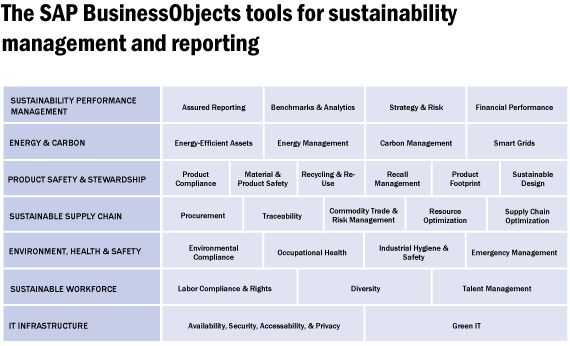
Figure 4
SAP's sustainability reporting tools
The Challenges
The ability to pull and manage data from disparate applications is a key enabler of corporate-wide sustainability programs, says Rudiak. Even as evolving standards make it easier to access data across multiple systems, data ownership issues can prevent effective information sharing.
“Most of a company’s product information may reside with the engineering group, for example. A lot of people have organizational barriers in terms of sharing and owning data. You have to be able to break down those barriers to address a corporate sustainability reporting program,” says Rudiak. “A lot of people don’t realize the difficulty of enabling that sort of program.”
Another challenge is that a sustainability reporting strategy does not offer ROI in the same way a new piece of factory equipment might. Companies limping out of the global recession may still be conserving money for projects with more immediate returns, says Newman.
However, each day that goes by only increases the risks associated with failing to implement a sustainability reporting program, he says. Your company may have hired a top scientist to help manage an environmental initiative, and the more you rely on that scientist to collect and report on data, the more risk you face when he or she takes a new job.
“What does the CIO do when the scientist wins the lottery? There’s no data stored on an enterprise level, and nothing is backed up,” says Newman.
Only by implementing a rigid program of repeatable, manageable reporting can you protect against this risk, says Newman. “The benefit of SAP solutions is that they eliminate that single point of failure.”
Base Your Plan on Three Premises
While a comprehensive corporate sustainability reporting program must include several key elements — such as appropriate considerations for access control, process control, auditing, monitoring, and reporting — Newman and Rudiak say there are three common premises on which all programs should be constructed:
1. Follow a Hypothesis-Driven Approach
While SAP technology offers a variety of functionality for reporting on sustainability initiatives, Rudiak cautions against trying to do too much too fast. Rather than crafting a plan based on massive analysis efforts, the hypothesis-driven approach calls for the project team to develop a hypothesis during initial investigation and design a reporting program around that.
“We find that companies want to get all the answers as quickly as possible. However, it’s much more effective for a reporting initiative to develop a preliminary list of the things you want to measure and walk in with those. SAP has standard taxonomies for KPIs and other sustainability measurements that are a good start,” says Rudiak. “It’s an attractive approach to come up with a focused plan and not have a huge initial investment up front.”
2. Don’t Abandon Your Methodology
While the objectives of a sustainability initiative may appear different from those of a financial or human resources technology initiative, Newman and Rudiak say your project team should adhere to the same implementation methodology.
Adhering to a common methodology for all projects reduces risk, optimizes schedule performance, and provides a common vocabulary throughout the initiative, according to Newman and Rudiak.
“There’s really no need to reinvent your methodology, whether it’s ASAP or anything else,” says Rudiak. “You don’t want to go through a huge training exercise for this.”
3. Focus on a Core Target Platform
Rather than investing in adjoining systems solely for the purpose of a sustainability initiative, Newman and Rudiak suggest working with your existing landscape as much as possible. In some cases, such initiatives can be catalysts for identifying opportunities to consolidate multiple systems.
“If you can retire unused systems or turn off pieces of the functionality to save on maintenance costs, that opens up capital for investments in the sustainability initiative,” says Rudiak.
Build Toward the Future
In the end, remember that a corporate sustainability initiative is designed to track, monitor, and report on your initiatives over the long term. You have to reflect that by creating a strategy that can be expanded or extended as needed, says Newman.
“You can’t treat this as a one-and-done project,” he says. “You need the correct framework in place so the processes can be improved with each reporting period in order to develop a history of sustainable performance. Without that, you’re not going to achieve the value of your investment.”
Other Resources
“Improve Your Corporate Sustainability Reporting with SAP BusinessObjects Sustainability Performance Management,” by William Newman.
Understanding SAP BusinessObjects Sustainability Reporting Management, by William Newman, SAP PRESS.
Davin Wilfrid
Davin Wilfrid was a writer and editor for SAPinsider and SAP Experts. He contributed case studies and research projects aimed at helping the SAP ecosystem get the most out of their existing technology investments.
If you have comments about this article or publication, or would like to submit an article idea, please contact the editor.