Management
Convincing management to invest in the latest technology has never been easy. And in today’s turbulent economy, the challenge has only grown more difficult. For companies still on older versions of SAP systems, the current recession may seem like an impediment to upgrading. However, with a little information and the right approach, you can make a compelling business case for the move to SAP ERP 6.0.
A recent survey by upgrade tool vendor Panaya found that estimating and justifying the budget required for an SAP upgrade were the top two challenges facing respondents looking to upgrade to SAP ERP 6.0 (Figure 1).
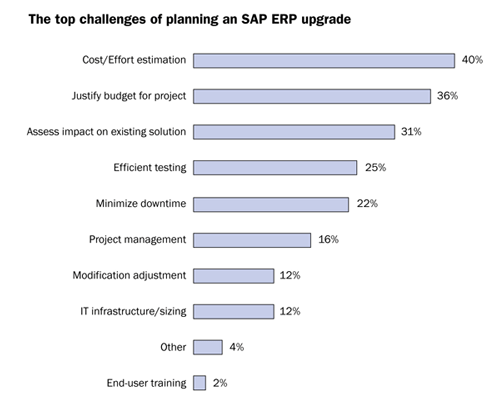
Figure 1
More than three-quarters of survey respondents cited cost estimation or budget justification as primary upgrade challenges
Panaya executive Amit Bendov estimates that between half and two-thirds of companies running SAP are on mySAP ERP 2005 (ECC 5.0) or an earlier version. To approve an upgrade, he says, company executives must be sold on real business benefits.
“If you can find two or three issues that would have a substantial impact on your business, you can combine them into a compelling business case,” says Bendov.
Whether you are a project manager, business analyst, steering committee member or functional team member, Bendov says the following 10 approaches can help you justify an upgrade to SAP ERP 6.0, even in difficult economic times:
1. Loss of Support is a Risk, Not an Inconvenience
Keeping up with standard support has long been a driver for upgrading to a newer version of SAP, but these days you need more than that to justify an upgrade. Simply pointing out that deferring an upgrade will cost maintenance dollars in the long run is not enough — you have to sell management on the risk inherent in not upgrading.
“It’s simple math that you’ll pay more for support because your support costs will go up, but that might not justify an upgrade itself,” says Bendov. “But the other side is that for most SAP users, it’s a mission-critical application — so if something happens and you’re unable to get support at the speed you need it, that’s a big risk.”
Justify it: Frame your support argument in risk-management terms that resonate with executives looking to minimize risks.
2. Time is Not on Your Side
In the long run, the dangers of delaying an upgrade can compound in several ways. For one thing, every SAP system is a pastiche of customized code built up over years of changing and tweaking. Eventually the developers and consultants who wrote those programs leave, adding several layers of complexity to the eventual upgrade.
“All those programs will have to be migrated to make them compatible with SAP ERP 6.0. If you wait too long, the people who wrote those programs might not be around or might not remember what the programs do,” says Bendov. “You then have to find the skill set necessary to make adjustments. It will cost you more if you delay the upgrade.”
Justify it: The complexity of an upgrade is always daunting. Convince management that upgrading becomes far more complicated the longer you wait.
3. Compliance Isn’t Cyclical
If death and taxes are the only certainties in life, regulatory compliance isn’t too far behind. While the economy grows and shrinks regularly, meeting governmental and organizational compliance standards remains a necessity.
“You have to do it regardless of the economy. The question is if you do it on your current version of SAP or if you upgrade,” says Bendov. “If you’re on 4.6C, you will need to develop a lot of programs that you’ll have to upgrade down the road. With SAP ERP 6.0, you get a lot of that functionality out of the box, or at least you’re in a better position to do what you need to do. If you have these requirements, the equation favors that you upgrade now.”
Justify it: Position the upgrade to SAP ERP 6.0 as a key step toward meeting the company’s compliance goals.
4. Standardization Equals Flexibility
Companies have to be flexible to survive economic turmoil, and the ERP system can be the key to maintaining flexibility. Bendov says that upgrading to SAP ERP 6.0 is the surest way to ensure that your business processes are as nimble as possible.
“When you first implemented SAP, you may have had to write custom code on top of it. Obviously that’s not good when you want to support or upgrade your system or put in an enhancement package. When moving to SAP ERP 6.0, the odds are you can remove a lot of these custom objects and use the standard functionality that is now offered in SAP,” he says.
SAP ERP 6.0 allows companies to add custom code in a designated enhancement framework, meaning those custom elements can be upgraded and managed more easily.
Justify it: Emphasize that standardized solutions are flexible solutions, and that SAP ERP 6.0 allows you to adapt business processes more quickly.
5. Stop Paying for Unused Programs
While upgrades are massive technical challenges, they do not necessarily add extra weight to the IT infrastructure. In fact, a well-planned upgrade can trim redundant code from the system, resulting in immediate cost savings.
“A lot of companies develop custom code for programs that eventually go unused. That code stays in the system, and must be tested every time you do a system change.
That redundant or unused code costs you in maintenance and support even though you’re not using it — and no one ever deletes it because they don’t even know it exists,” says Bendov.
Recent studies show that, on average, 20% to even 50% of custom development code could be redundant, according to Bendov. Keeping that code in your SAP system means money off the bottom line.
Justify it: Unused custom code drags your system down and impacts the IT team’s ability to be nimble and make changes quickly.
6. New Functionality Helps the Business Keep Pace
Management is unlikely to invest in an upgrade just to keep pace with the latest technological advancements. However, upgrading to SAP ERP 6.0 actually reduces the overall cost of adding business-critical features and functionality.
“If there is functionality that is important to your business, and you’re going to need to do it anyway, it will be cheaper to upgrade and implement it on SAP ERP 6.0 rather than to write it from scratch and upgrade it later,” says Bendov.
Justify it: New functionality can be an attractive driver for an upgrade, but only if it brings real value to the business.
7. This May be the Last Time
SAP has promised an end to major upgrades with the advent of enhancement packages in SAP ERP 6.0. The Enhancement and Switch Framework allows you to add functionality to your SAP applications without overriding any customizations.
Bendov says this functionality in particular expands the ability of the SAP system to react to needed changes. In particular, the Switch Framework allows companies to have multiple industry solutions available in one SAP system.
“If your company does business in multiple industries and is looking to standardize and simplify its landscape, it can now do that,” he says.
Justify it: Companies everywhere are struggling to do more with less. Position your SAP upgrade as a way to streamline multiple instances into one version that can be enhanced without upgrades.
8. Productivity is More Important Than Ever
Employees around the world are likely feeling the squeeze of hiring freezes, layoffs, outsourcing, and other realities. Getting more out of the remaining employees is a key mission of today’s corporate management, and SAP ERP 6.0 can be positioned to aid in that effort.
“When people talk about the new things available in SAP ERP 6.0 they talk a lot about the Switch Framework and things like that. What is less known are the improvements to the user interface. It is a lot better, and if you have a lot of users, that’s a potential area for savings,” says Bendov.
The improved user interface includes updated role-based access, increased use of Adobe forms, and several other advancements that shorten the learning curve for end users, according to Bendov.
Justify it: Management wants to know how to get more out of a reduced workforce. Show them how an SAP upgrade can deliver.
9. Consolidation Benefits Everyone
Many global companies are still running several separate SAP systems, spending far more than necessary on support and SAP-focused projects. Upgrading to SAP ERP 6.0 offers a good opportunity to consolidate multiple systems onto one central platform. Once the as-is analysis of each system is completed, that information can be used to tailor a range of business requirements from a central SAP ERP implementation.
“Now you can identify all the differences between systems and still consolidate them without losing those differences,” says Bendov. “That’s major savings.”
Justify it: If your company is running several instances of SAP, show your management exactly how an upgrade to SAP ERP 6.0 can streamline the entire global infrastructure and save real dollars.
10. Talk is Cheap — Memory is Cheaper
Depending on the age of your current SAP system, you may be overpaying for hardware in terms of ongoing utility costs.
“Your hardware options with SAP used to be limited. Now SAP supports several different hardware platforms, and hardware is cheaper and better than ever,” says Bendov. “There is an opportunity there.”
Bendov cites research from AMR Research analyst Derek Prior, who found that switching an ERP system from high-end UNIX servers to energy-saving Linux or Windows servers can reduce costs substantially.
Justify it: Saving money on new hardware is unlikely to be a key driver for upgrading to SAP ERP 6.0, but energy savings are an attractive side benefit.
Of course not every justification will work for your particular company. Bendov suggests focusing your pitch on three or four key drivers that will resonate with the management of your company.
“The key to any business case is to figure out the top priorities for your management right now and align the business case to fit,” he says. “Whether it’s opening new markets, meeting compliance or reducing costs, you have to pick the justifications that will help the cause.”
Davin Wilfrid
Davin Wilfrid was a writer and editor for SAPinsider and SAP Experts. He contributed case studies and research projects aimed at helping the SAP ecosystem get the most out of their existing technology investments.
If you have comments about this article or publication, or would like to submit an article idea, please contact the editor.


 Premium