SAP FICO
SAP FICO: An Overview and Key Considerations
What Is SAP FICO?
SAP FICO is SAP’s core functional module consisting of the tightly integrated Financial Accounting (FI) and Cost Controlling (CO) modules, designed to enable the recording of financial transactions across parent and subsidiary entities, the production of financial statements, and support both internal and external reporting, at the end of every period.
The SAP Financial Accounting (FI) module supports accurate financial accounting and financial reporting, while the SAP Cost Controlling (CO) module facilitates cost planning and cost monitoring.
Key sub-modules for SAP FICO:
- Financial Accounting (FI)
- Asset Accounting
- Accounts Payables
- Accounts Receivable
- Bank Accounting
- Fund Management
- General Ledger Accounting
- Travel Management
- Cost Controlling (CO)
- Activity-based Costing
- Cost Center Accounting
- Cost Element Accounting
- Internal Orders
- Product Costing
- Profit Center Accounting
- Profitability Analysis.
The primary objectives of SAP FICO are to provide financial transparency, improve data consistency, and enable business process integration within the organization. Organizations can leverage the inter-connected sub-modules and real-time data streaming to produce trial balances that accurately reflect most business processes from various industries. SAP FICO is an end-to-end solution that combines industry best practices with application expertise, deep-process knowledge, and technical innovation.
Key Considerations for SAPinsiders
SAP FICO: An Overview and Key Considerations
What Is SAP FICO?
SAP FICO is SAP’s core functional module consisting of the tightly integrated Financial Accounting (FI) and Cost Controlling (CO) modules, designed to enable the recording of financial transactions across parent and subsidiary entities, the production of financial statements, and support both internal and external reporting, at the end of every period.
The SAP Financial Accounting (FI) module supports accurate financial accounting and financial reporting, while the SAP Cost Controlling (CO) module facilitates cost planning and cost monitoring.
Key sub-modules for SAP FICO:
- Financial Accounting (FI)
- Asset Accounting
- Accounts Payables
- Accounts Receivable
- Bank Accounting
- Fund Management
- General Ledger Accounting
- Travel Management
- Cost Controlling (CO)
- Activity-based Costing
- Cost Center Accounting
- Cost Element Accounting
- Internal Orders
- Product Costing
- Profit Center Accounting
- Profitability Analysis.
The primary objectives of SAP FICO are to provide financial transparency, improve data consistency, and enable business process integration within the organization. Organizations can leverage the inter-connected sub-modules and real-time data streaming to produce trial balances that accurately reflect most business processes from various industries. SAP FICO is an end-to-end solution that combines industry best practices with application expertise, deep-process knowledge, and technical innovation.
Key Considerations for SAPinsiders
Leverage SAP FICO to generate timely insights within current processes. Organizations typically modernize ERP financial landscapes in phases and not all at once. As a result, finance and accounting managers must incorporate processes across multiple technologies, including legacy or manual solutions, to deliver business benefits. The flexibility of SAP FICO supports this option, as Mark Pockl, insightsoftware’s Solution Engineer, specializing in SAP and Orace EBS reporting solutions, provides best practices for leveraging SAP FICO inside Excel.
SAP FICO automation can enable the standardization of financial processes. With SAP FICO, finance teams are equipped with standard solutions capable of supporting automation across many manual processes related to financial transactions and reporting. This helps finance teams, including the finance departments at Kellogg Company and Newell Brands, effectively manage financial data within SAP ERP systems, including generating reports that different departments require for decision-making.
Economic disruptions increase the need for financial visibility across organizations. SAP FICO is designed to support multiple views of your organization in real time, providing visibility for finance managers at the most critical junctures. In addition, by accurately and quickly managing cost planning and cost monitoring requirements consistently across the business units, organizations can generate ad-hoc reporting from costing and profitability insights.
528 results
-
Live from SAPinsider Studio: Blair Wheadon on SAP Design Studio 1.6
Blair Wheadon, General Manager, Data Discovery, SAP, joins SAPinsider Studio during the 2015 SAPinsider Reporting & Analytics event in Las Vegas to discuss SAP BusinessObjects Design Studio 1.6 and SAP Cloud for Analytics. This is an edited transcript of the discussion: Ken Murphy, SAPinsider: Hi, this is Ken Murphy with SAPinsider. I am here at…
-
Live from SAPinsider Studio: Red Hat and Support for the IoT Movement
Bob Mahoney, Red Hat IoT Business Development, joins SAPinsider Studio at the 2016 SAPinsider IoT conference to discuss how Red Hat supports the growing IoT movement and community. Topics of this discussion include fundamental use cases of middleware and a joint Red Hat and SAP platform that turns data into actionable intelligence. This is an…
-
Live from SAPinsider Studio: Invoice-to-Pay with SAP S/4HANA and Ariba
Friederike Hertenstein, Director, Accounts Payable, SAP Solution Management Finance, visited with SAPinsider Studio at the 2016 SAPinsider Financials event in Las Vegas to discuss Invoice to Pay and Sourcing to Pay processes in SAP S/4HANA Finance and the importance of integrating invoicing with the Ariba Network. This is an edited transcript of the discussion: Ken…
-

Live from SAPinsider: Ivo Bauermann on the Digital Imperative
SAPinsider FIN-GRC 2016 keynote speaker Ivo Bauermann, Global Vice President and General Manager, Enterprise Performance Management, SAP, joins SAPinsider Studio at the event to discuss how SAP is helping companies make a digital transformation and run a “live” business. Topics covered include SAP S4/HANA, Central Finance, and Finance’s evolution into a strategic arm of the…
-
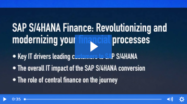
Live from SAPinsider Studio: Paul Ovigele of ERPfixers on S/4HANA and Universal Journal
Paul Ovigele, founder of ERPfixers, joins SAPinsider Studio at the SAPinsider FIN-GRC event to discuss the impact the Universal Journal in SAP S/4HANA Finance has for reconciling accounts-based vs. costing-based CO-PA tables with the general ledger. This is an edited transcript of the discussion: Ken Murphy, SAPinsider: Hi, this is Ken Murphy with SAPinsider. I…
-
Live from SAPinsider Studio: Beam Suntory’s SAP Role Redesign
Ivanka Gajecky, Manager of Application Security, Beam Suntory, joined SAPinsider Studio at the SAPinsider GRC 2016 event to discuss Beam Suntory’s SAP security role redesign project that was undertaken to align with the business becoming more centralized. This is an edited transcript of the discussion: Ken Murphy, SAPinsider: Hi, this is Ken Murphy with SAPinsider.…
-

Live from SAPinsider Studio: O.C. Tanner Rejuvenates its SAP Environment to Keep Up with Customer Needs
Ethan Kennelly, Director of Enterprise Architecture and Program Management at O.C. Tanner, joins SAPinsider Studio at the SAPinsider SCM-CRM event to discuss how O.C. Tanner’s implementations of SAP Hybris, SAP Configure Price Quote, and SAP S/4HANA helped it to keep up with rapidly changing customer needs. This is an edited transcript of the discussion: Natalie…
-
Live from SAPinsider Studio: San Diego Gas & Electric on Mitigating SoD Conflicts
Paul Malin, Financial Systems Client Support Manager at San Diego Gas & Electric, joins SAPinsider Studio at the SAP GRC 2016 event to discuss San Diego Gas & Electric’s journey to upgrade its GRC system. Ken Murphy, SAPinsider: Hi, this is Ken Murphy with SAPinsider. I’m at the SAPinsider GRC event 2016, in Las Vegas,…
Related Vendors

Your request has been successfully sent