SAP DMS
What Is SAP Document Management System?
SAP Document Management System (DMS) is a cross application component that provides document and content management capabilities.
These capabilities are offered as part of SAP’s enterprise content management application, SAP Extended Enterprise Content Management by OpenText.
Several vendors provide DMS solutions that integrate with Docusign to provide document management capabilities.
Icertis offers Icertis Contract Intelligence, a contract management solution that includes a document management component.
Why Is Document Management Important?
Businesses — especially intelligent enterprises — generate significant content during the life cycle of their products. Each phase of a product’s life — from research to supply chain to sales — requires different information to be captured, managed, stored, preserved, and shared. It is important for companies to have a robust solution that can provide efficient management of this information.
Benefits of having a solution like SAP DMS include avoiding redundancy, maintaining data consistency, having an accessible search functionality, as well as version control and automatic classification capabilities.
What Is SAP Document Management System?
SAP Document Management System (DMS) is a cross application component that provides document and content management capabilities.
These capabilities are offered as part of SAP’s enterprise content management application, SAP Extended Enterprise Content Management by OpenText.
Several vendors provide DMS solutions that integrate with Docusign to provide document management capabilities.
Icertis offers Icertis Contract Intelligence, a contract management solution that includes a document management component.
Why Is Document Management Important?
Businesses — especially intelligent enterprises — generate significant content during the life cycle of their products. Each phase of a product’s life — from research to supply chain to sales — requires different information to be captured, managed, stored, preserved, and shared. It is important for companies to have a robust solution that can provide efficient management of this information.
Benefits of having a solution like SAP DMS include avoiding redundancy, maintaining data consistency, having an accessible search functionality, as well as version control and automatic classification capabilities.
DMS Key Considerations
DMS in SAP S/4HANA Cloud. According to Anupama Chandrasekhar, the author of an SAP blog post published in 2019, SAP S/4HANA Cloud provides a repository to store content. In her blog, Chandrasekhar covers SAP DMS from the perspective of SAP S/4HANA Cloud, and provides some information from an on-premise perspective.
SAP S/4HANA Cloud provides two main DMS offerings: a “Manage Documents” application and an “Attachment Service” reuse component. Chandrasekhar explains that the “Manage Documents” is a standard Fiori application within SAP S/4HANA Cloud that supports versioning. It contains machine learning-based automation for classifying documents.
The “Attachment Service” is a UI component that allows users to attach documents to a business object at the header and item level. “All leading applications (business objects) mandatorily consume this component to enable file attachments in order to ensure similar functionality and user experience across all the Fiori applications,” writes Chandrasekhar.
Integrate DMS with SAP Enterprise Portal. Karthikeyan Meganathan explains that DMS can be integrated with SAP Enterprise Portal, which can reduce the time it takes for users to access documents. Published in 2017, Meganathan’s article provides a step-by-step tutorial involving the DMS connector for Knowledge Management. The integration requires six steps:
-
- Create Knowledge Management repositories
- Create a user group
- Assign roles to the user group
- Assign users to the user group
- Assign the required users to the DMSUser group
- Open the Document Explorer, which is an iView you can access through the portal.
549 results
-

Meeting Demand with a Constrained Supply Using Product Allocation in SAP APO Global ATP
Learn the process flow of how product allocation can be used in SAP Advanced Planning and Optimization (SAP APO) Global available-to-promise (Global ATP) to meet customer requirements by managing the supply of scarce products. The system can perform availability checks in conjunction with product allocation checks. Key Concept Availability checks, also known as available-to-promise (ATP),...…
-

ESS A to Z: How One Company Planned, Deployed, Tested, and Trained for Its ESS Implementation
You need to maintain bank routing number information in your system for all employees whose pay is directly deposited into their accounts. Many companies pay for this information, but here’s how you can use a free current bank routing number directory to update your SAP system. Key Concept You have two options for implementing Employee...…
-

Write Ad-Hoc Analysis Programs That Are Mobile Friendly with SAPUI5
SAP Professional JournalSee how to implement SAPUI5 to provide your users with interactivity and the ability to analyze data when they are on their smartphones or tablets. Key Concept SAPUI5 is a user interface (UI) technology with features and APIs that allow you to build lightweight and responsive Web and mobile applications. It is open...…
-
SAPinsider 2020 Announces Powerful and Diverse Keynote Lineup to Headline Virtual Conference Experience Aug. 18-21, 2020
BOSTON – August 5, 2020 – SAPinsider, the world’s largest and fastest-growing independent membership organization of SAP professionals, announced today the keynotes to headline their Four-Day Live Virtual Conference Experience, August 18-21. Keynote Speakers Include: Anthea Stratigos, CEO of Outsell (Panel Moderator) Alison Biggan, President Corporate Marketing, SAP Judith Williams, Head of People Sustainability and SVP,…
-

SAPinsider 2020 Virtual Conference Experience To Welcome Record Attendance August 18-21
BOSTON – August 18, 2020 – SAPinsider, the world’s largest and fastest-growing independent membership organization of SAP professionals, announced, the doors to its inaugural virtual conference will open at 10:00 AM ET today, to its largest audience ever. The Live event runs Tuesday August 18 through Friday August 21, 2020. A powerful line-up of keynote…
-
SAPinsider 2020 Virtual Conference Experience Draws Thousands, Provides New Immersive Experience
BOSTON – August 20, 2020 – SAPinsider, the world’s largest and fastest-growing independent membership organization of SAP professionals, continues to welcome members of the SAP ecosystem to its inaugural virtual conference, today and throughout the week. Live sessions started on Tuesday, August 18, and run through Friday August 21, 2020. More than 6,500 registrants have…
-
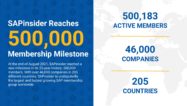
SAPinsider Reaches 500,000 Membership Milestone
BOSTON, MA – At the end of August 2021, SAPinsider reached a new milestone in its 25-year history: 500,000 members. With over 46,000 companies in 205 different countries, SAPinsider is undisputedly the largest and fastest growing SAP membership group worldwide. These record numbers amplify SAPinsider’s commitment to delivering cutting-edge content that helps the SAP user…
-

SAPinsider Announces Acquisition of MasteringSAP
Purchase Solidifies SAPinsider as the Largest Global SAP Member Community BOSTON, MA – October 22, 2021 – SAPinsider, the largest and fastest-growing SAP membership group worldwide, today announced the acquisition of Australia-based MasteringSAP. The combination brings together the two strongest brands in the SAP professional community. With more than 50,000 loyal members built over a…
-

Mastering SAP June 2023
We’re bringing the thriving Mastering SAP community together – 800+ people, 2 days, 90+ hours of brilliant content and a plethora of unrivalled networking opportunities – to celebrate the talent, innovation and ideas literally transforming the way we work. 7-8 June, Melbourne. Register today!
-

 Premium
How SAP Business AI and SAP Asset Performance Management are Closing the Loop between Maintenance Strategy and Execution
SAP Asset Performance Management (APM) helps asset owners, managers, plant managers, reliability engineers, and maintenance technicians to define, implement, execute and monitor the optimal asset maintenance. Mastering SAP Premium Access Membership Required You must be a Mastering SAP Premium Access member to access this content.Join NowAlready a member? Log in here
Related Vendors


Your request has been successfully sent