With the ongoing advancements in Internet of Things (IoT) technology and the rate of digital convergence across businesses in every industry, companies can form previously unforeseen partnerships. Ten years ago, it would seem unlikely that a lighting manufacturer might partner with an enterprise software company. Today, that idea is not far-fetched at all.
Consider Acuity Brands, a company which underwent a tri-phased transition from a lighting manufacturer into a connected building technology provider. One of the largest lighting manufacturers in North America with select global operations, Acuity has leveraged its lighting-based technology to develop IoT capabilities, both organically and via acquisition. It seeks to help its customers reimagine their buildings from a cost center to a strategic asset, delivering immediate value to building operators and business managers.
From its inception, Acuity was focused primarily on selling lighting fixtures, equipment, and hardware. Consequently, its first phase of growth included acquiring a series of lighting manufacturers, expanding its brands, and building up its distribution channel. Then, as the lighting industry underwent a technological transformation where lighting systems were evolving from analog to digital, Acuity entered the technology business and accelerated the market’s conversion to ambient light emitting diode (LED) lighting.
This marked the second phase of growth for Acuity, which involved converting its business toward LED lighting and updating the products’ physical infrastructure to include LED lights. Acuity then implemented a LEAN manufacturing model to enable rapid adoption by the North American market. The acquisition of eldoLED in 2013 further advanced the company’s transformation from a consumer of conventional lamp and ballast components to a business that designs and manufactures intelligent, LED solutions.
“Our path of digital transformation was driven by a combination of opportunity and insight. Like every business, we are trying to stay ahead of our competition,” says Greg Carter, Acuity’s Senior Vice President of Connected Buildings Software. “With the market shifting and changing faster than ever before, we have to pay close attention to technology trends to recognize ways that we can stay out in front.”
 Digital transformation is really about taking advantage of the wealth of newly available real-time data — thanks to the ubiquity of sensors, the massive processing capabilities of cloud technologies, and the proliferation of mobile devices — to better understand what’s happening in our business and translate that into changes that improve our customers’ experiences and our employees’ operational efficiencies.
— Greg Carter, Senior Vice President, Connected Buildings Software, Acuity Brands
Transforming into a Technology Company
Just as Acuity foresaw the impact that LED lighting would have on the industry, it also recognized the future for the business was beyond conventional lighting and controls; it was connected building systems. This awareness ushered in the company’s third growth phase, which was to leverage technologies — through acquisitions as well as organic development — that could complement the digital lights and provide precise location tracking services. Acuity invested in communication and beaconing technology to connect those digital lights through a digital network, access massive amounts of sensor data, and then make that data available both in mobile device software development kits (SDKs) and application programming interfaces (APIs) in the cloud. The innovation, namely Atrius, differentiates as an embedded IoT platform that collects data from the building digital sensory network covering indoor and adjacent outdoor space in a grid pattern.
“Digital transformation is really about taking advantage of the wealth of newly available real-time data — thanks to the ubiquity of sensors, the massive processing capabilities of cloud technologies, and the proliferation of mobile devices — to better understand what’s happening in our business and translate that into changes that improve our customers’ experiences and our employees’ operational efficiencies,” Carter says. “In this IoT world where low-power battery-type sensors are going to be on everything, the lighting network is well positioned to onboard that data. It’s powered; it’s got digital connections with the lighting control networks in place; and wherever there is any data generation happening — via a person, device, or process — there are undoubtedly lights overhead within 10-20 feet of the source of data.”
Today, Acuity continues its transformation strategy by leveraging the new digital infrastructure. Lighting as a platform (LaaP) facilitates IoT deployments through a dense grid, connectivity, power, and payback from energy savings alone. In short, Acuity currently has a full line of supporting products for lighting control and a software platform that sits on top of the connected lighting systems and offers navigation services, asset tracking services, and space utilization insights.
“Looking at this technology space was a real opportunity to deliver new revenue sources, create more customer intimacy, and take a different place in the market than we had been before,” says Carter, who leads the business unit that is responsible for Acuity’s two main brands of software — the Atrius platform, which leverages data coming from connected indoor lighting systems and sensors and makes that available in the cloud, and the BuildingOS platform, which offers cloud-based analytics that provide data on how to optimally run a building, cut energy costs, and reduce operational expenditures.
“Our software service is a case-in-point example of IoT technology in action. It allows us to do very precise indoor location tracking, both of people with mobile devices and asset tags,” says Carter. “But what we realized early on in development is the scope of our potential customers or businesses. Coming from our background, we couldn’t become the experts in big-box retail, specialty retail, hospitals, warehousing, manufacturing, and so on.”
Acuity knew that to find that expertise to achieve the next level, they would need help from a partner, and the business found that collaborative partnership with enterprise software provider SAP.
Acuity and SAP Partner Up
“IoT is all about connecting the physical with the virtual and the digitization of everything — and for that to happen, you have to bring the best talents of multiple partners,” Carter says. “We were looking for partners that truly understood their customers’ business and could then put that data into context. Then the data could be consumed for improving an experience for a client’s customer — for example, the consumers and employees in a retail space. That’s where we saw a perfect partnership with SAP because that’s its business.”
Acuity was not a stranger to SAP software. One key aspect of the company’s digital transformation involved updating its internal systems’ landscape to migrate from a mix of homegrown and third-party legacy applications into the cloud. Acuity rolled out SAP SuccessFactors Performance Management and SAP Concur solutions to provide more efficiency in human resources (HR). The business is currently rolling out the complete SAP SuccessFactors suite.
The SAP account manager, who had established a relationship with Acuity’s HR organization and learned what the company was doing in the digital product space, suggested that Carter’s team meet with the SAP Leonardo team at Acuity’s headquarters in Atlanta, Georgia. This would allow each side to better glimpse into each other’s business, sharing details about the new Atrius lighting-based intelligent sensory networks and SAP’s recent investments in SAP Leonardo.
“We all felt there was an opportunity for us to work together,” Carter says. “We agreed to complete a Design Thinking workshop to turn our high-level concept of joint value into a concrete solution that we could test in the market together with joint customers.”
Success with Design Thinking
Carter and several business and technology colleagues traveled to Palo Alto, California, mid-May in 2018 to participate in a day-long Design Thinking workshop with members of the SAP Leonardo team. Carter describes the Design Thinking process as a classic consultative solution development approach, which involves asking business-first questions; determining interesting, challenging problems to address; and then determining what technology could help solve the problem. However, this particular Design Thinking engagement was unique in that instead of the parties involved discussing Acuity’s own digital transformation or a customer’s business problem, the group was thinking about what a potential partnership could look like.
“Both sides came in with different expectations of what problems we could solve,” Carter says. “We had preconceived notions of SAP software being traditional transactional systems, and SAP came in with ideas focused on industrial use cases. But we spent the time digging into customers’ needs across several different verticals, fleshing out potential value, and identifying the lowest hanging fruit.”
While workshopping technology fit with potential joint customers, SAP offered compelling use cases of several retail customers and their digital journeys, according to Carter. “That happened to be a place where we had good, broad coverage and a large install base of digital lights and connected systems,” he says. “The Design Thinking process got us to start big and conceive an idea for a solution we could build together. Then we were able to create a real, actionable, and executable plan that could garner executive support from both sides to set the team moving.”
Benefits of the Co-Developed Offering
What came out of the Design Thinking co-development was not a physical product that either SAP or Acuity launched, but rather a proof of concept (PoC) for SAP systems integrators and partners. That PoC offers a vision, a response to customers’ ongoing market challenges today. “This is where we see the power of the Acuity and SAP partnership,” says Carter. “We provide a platform with significant location-based data services. SAP provides an application platform that can consume those services and put the data in context of the problems their customers are trying to solve. Then our partners can build the mobile apps leveraging all that data.”
Customers who can benefit from this joint solution are companies that have invested in both SAP’s and Atrius’s complementary platforms. “Our target audience is customers who already use SAP transactional data systems, have deployed smart, digitally connected lighting, and are using Atrius software services to expose that lighting data,” says Carter. “We sifted through hundreds of possible use cases and chose to build this proof of concept with SAP Customer Activity Repository. This is just one example of how an SAP partner can build a software solution for their customer leveraging back-end SAP systems.”
The software service extracts data from an SAP system — in this case, the SAP Customer Activity Repository. It simultaneously pulls real-time data from the Atrius platform. “By combining different types of data, we can solve a diverse set of use cases for either a store manager or a store designer,” Carter says. “Given the homogenous and consistent nature of retail lighting, retail was a good place for us to enter that market and test a software platform. And, there were a lot of compelling business use cases for taking advantage of sensor and location data in the stores.”
Use Cases for Retail
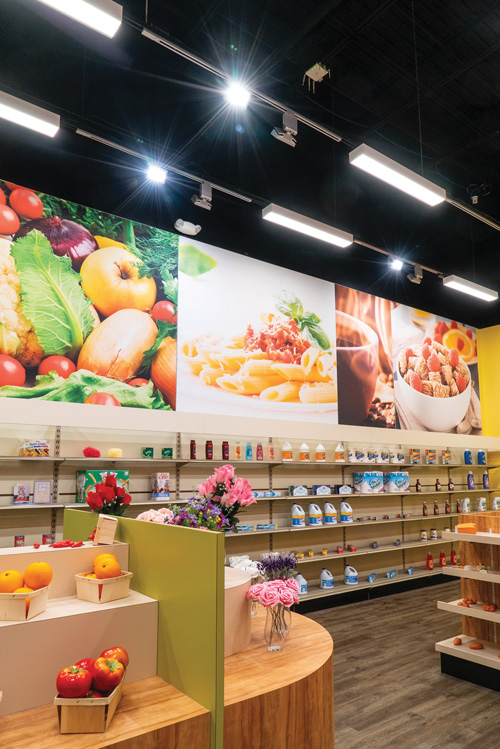
Bringing together the intelligence enabled by Acuity’s IoT platform with SAP Leonardo can provide powerful and immediate results for the retail sector, according to Carter. “By combining in-store operational data with location and path information, retailers can now gain valuable insights about shopper traffic, behavior, and engagement throughout the physical store. This includes knowing the path customers walk through the store and understanding ‘dwell time,’ which is how long they spend in each area,” he says. “With this kind of intelligence, stores can improve targeted promotions. They can help in-store associates with shopper assistance efficiency. And, they can do all of this in real time.”
With this real-time data at their fingertips, store managers have better intelligence about what products to restock and when and where to maximize revenue; store operations can optimize product assortments and store layouts; and customers can experience personalized service, such as turn-by-turn directions to products they want.
“With this joint solution, data from SAP Customer Activity Repository will not just provide store managers availability data of when a product is out of stock, but also data about the profitability and turnover of that item,” says Carter. “The Atrius system can provide location data on the number of visitors that passed by a stocked-out item within a specific hour, calculate an impact score based on the risk of lost profits, and display it on an intuitive dashboard. The subsequent checklist makes it easy for store managers to prioritize restocking so managers can achieve their own key performance indicators.”
Another example use case for retail is applicable to store designers or marketers for tracking where customers spend their time. “We can track the number of people passing by a particular marketing display or product and then the dwell time of how long people spend in front of them, which is useful if you’re trying to drive certain user flow,” says Carter. “SAP Customer Activity Repository provides a lot of detail and demographics on customers whose in-store activities can be tracked with Atrius location services. For example, marketers could segment out the data for certain customer sets — such as heads of households — and store designers could innovate store configurations to achieve the desired customer flow and dwell time for specific products. Stores could also do A/B testing of a marketing display or product promotion to determine how each influence the amount of time customers physically spend near those areas.”
While the focus for the initial use case of the co-developed offering was the retail space, Acuity plans to expand into other verticals historically served by the lighting side by presenting future use cases. “As we expand to other verticals, there are many other untapped SAP applications and joint customers for both companies. These could produce use-case-driven software solutions that leverage data from both platforms.”
Expanding to Other Verticals
According to Carter, there are endless opportunities for monetizing the PoC, from verticals to industries where indoor lighting can be turned into a strategic asset — even adjacent outdoor spaces and outdoor lighting. “Because we have a very large percentage of the market share for street lighting, we’ve started investigating ways to leverage it,” he says. “There are opportunities to collect data from those lights as well.”
In the shorter term, the next step is for both companies to do a pilot deployment with one of their joint customers. They are actively working on that today. After a project success, they will begin to scale the solution in retail, eventually moving beyond into other verticals. “So far, we have proven out the initial ideas, and our customers can see how it works and envision use cases,” says Carter. “With every deployment, we will learn new things. In the end, it will be up to the SAP partners, who are the application developers on top of these two platforms, that will consume and produce the data in ways that will be most valuable to customers.”




 Premium