Management
Lisette Bellissimo answers questions about SAP NetWeaver BI 7.0 certification and her new book, "SAP Certified Application Associate - Business Intelligence with SAP NetWeaver 7.0," published by SAP PRESS.
Lisette Bellissimo, a Senior Professionally Certified BI Consultant at SAP, has written a guide for exam C_TBW45_75, the certification for SAP NetWeaver 7.0. Her book, SAP Certified Application Associate - Business Intelligence with SAP NetWeaver 7.0, gives an overview of the exam’s structure and content and breaks down the exam by topic area. Each chapter provides objectives, key concepts, and practice questions for exam topics such as SAP BEx Analyzer, Performance Tuning, Dataflow, and 17 others. We asked Bellissimo some questions to give you a clearer picture of the exam.
What is the aim of the book?
A recent International Data Corporation (IDC) study showed that projects using certified resources deliver on time and on budget more often than projects without certified resources. In addition, a Burlington Consultants survey showed that organizations with more than 25 percent of their staff certified enjoy a 17 percent decrease in spending on ad-hoc external IT support, and a 28 percent increase in overall productivity.
SAP feels so strongly that certification can materially impact business objectives right now that our entire SAP Consulting organization is working toward 100% certification.
In the book I have focused on the topics, terminology, and definitions that you can expect on the exam. I also discuss the different types of exam questions and each chapter has practice questions and answers. In short, I’ve written the book to help others improve their odds of doing well in each section of the exam.
What’s new in the certification process?
A major change in the certification process at SAP is the introduction of multiple certification track levels with “fast track” options and a variety of entry points. The three levels of certification are:
Associate Level: This certification covers the foundational level knowledge in an SAP solution. At this level, the exam is based mainly on training but hands-on experience reinforces the knowledge gained from training.
Professional certification: This advanced certification requires proven project experience, business process knowledge, and a more detailed understanding of SAP solutions.
Master certification (under development): This certification, under development, involves demonstrating an expert-level understanding of a specific area of SAP software and the ability to drive innovation and solution optimization through in-depth knowledge and vision. Certification at this level requires broad project experience, comprehensive SAP product knowledge, and the ability to create a future IT vision within complex project environments.
In addition to the tiered certification exam, SAP Education made other changes to the certification process. A partnership with Pearson VUE testing centers was formed. This partnership makes the certification exam more readily available around the world. The process for developing the certification exams was improved. Prior certification exams were primarily based on SAP training materials. The new process includes the participation of SAP Education, SAP Consulting, and SAP Partners and adds real-world experience to the certification exam. Unlike previous certifications, SAP is actively promoting and branding SAP Certification and SAP Certification logos have been developed to draw attention to SAP certification.
How long is the certification good for?
SAP retires exams as soon as they are two releases behind the current release of the software for which a certification exam is available. With the new certification program, SAP will be able to monitor the level of certifications within the certification community, and contact professionals with outdated certifications for a reminder that there is a need to re-certify.
What should candidates expect from the course?
Each level (Associate, Professional, and Master) of the certification exam is comprised of 2 or more of the following competency levels.
- Level “A” – Articulate, explain, describe, and outline solutions and processes.
- Level “B” – Build, implement, configure, model, and troubleshoot solutions and processes.
- Level “C” – Conceptualize, blueprint, modify, and optimize integrated solutions and processes.
Each question on the exam will belong to one of these competency levels. The associate exam will have 60% of its questions designed for competency level A, 40% of its questions designed for competency level B, and no questions for competency level C.
The topics for the associate exam are broken down by competency level in Table 1.
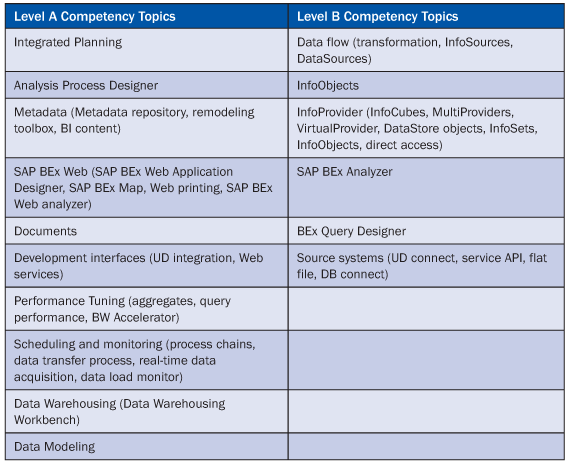
Figure 1
Associate exam topics by competency
What is the exam structure?
You have three hours to take the exam. The exam will have 80 questions. These questions have a structure just as the exam has a structure. In general, a question will have a question stimulus, the question, and a question hint (Figure 1).
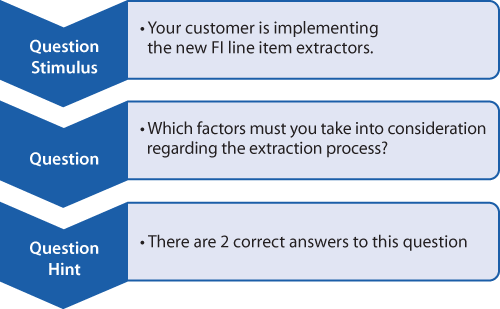
Figure 1
An example exam question
Answers to questions can be in five forms:
- Multiple Response: More than one answer will be correct. If you are presented with this type of answer, you must identify all correct responses in order to get credit for a correct answer. There is no partial credit given.
- Multiple Choice: Multiple choices (usually 4) are provided and only one answer will be correct.
- True/False: Only one answer will be correct.
- Fill in the Blank: The test is online so you won’t actually be filling in the blank. This answer type will have you fill in the blank in the form of a multiple choice answer. Only one answer will be correct.
- Sequence/Ranking: Not utilized on the actual exam but could be on future exams. This answer type will have you rank or sequence answers in the correct order.
Laura Casasanto
Laura Casasanto is a technical editor who served as the managing editor of SCM Expert and Project Expert.
You may contact the author at lauracasasanto@gmail.com.
If you have comments about this article or publication, or would like to submit an article idea, please contact the editor.


 Premium