Management
Boosting end user performance is key to getting the most out of your SAP system. To ensure your employees are performing at their peak, you need a comprehensive learning sustainment strategy that addresses your current needs and is flexible enough to adapt to future changes. Joel Spenner of RWD Technologies shares ideas for analyzing your end user performance and building a lasting strategy to help them improve.
Implementing or upgrading an SAP system requires a significant amount of time, effort, and funding. Because of this, it’s easy to view go-live as the finish line — the final milestone and the end of the project. “In essence, however, it’s like the starting gate at a horse race,” says Joel Spenner, a project manager at RWD Technologies. “Go-live means the start of my new world, it does not mean the end of my old world.”
“For many organizations, the goal is to get people proficient with the tool to do what they need to do. Unfortunately, proficiency will differ from one person to another. You want to be able to address where people are struggling, identify what’s causing them to struggle, and address their specific needs while taking the organization or department past transactional proficiency,” says Spenner.
Instead of merely installing a new system and letting employees figure things out on their own, Spenner advises creating a learning sustainment strategy. He suggests using a Performance Optimization Analysis (POA) to guide users through the new processes.
Keys to the Performance Optimization Analysis
A POA assesses where your organization is currently and where your gaps in learning are, with the aim of ensuring that your organization has the highest competency possible.
Key performance indicators (KPIs) established by the POA monitor the progress of your learning sustainment strategy. An effective POA must address the four key components of an ongoing learning strategy:
People
- Ongoing learning and performance support
- Key power users
- Ongoing communication
- Organization capabilities and alignment
Business
- Governance strategy and structure
- Business goals
- Enabling managers to manage ERP
- Program management
Processes
- Process ownership and management
- Organization design and change management
- Continuous improvement
Enabling Technology
- IT organization alignment
- Master data maintenance
- Help desk process and structure
The deliverables of a POA, which Spenner suggests can take five weeks to complete, can be broken down into three main areas: determining your learning strategy needs, performing a gap analysis, and building a strategy to support an ongoing strategy.
Determining Your Learning Strategy Needs
“If you want to find out where you need to go, you need to find out where you are first,” says Spenner. A learning strategy should be based on what works for your business needs and processes. To do this, Spenner suggests deploying a three-step process to gather detailed information on where your organization is before deciding how to bring it to where it needs to be.
Step 1: Surveys
The first step of the data collection process is to create and distribute surveys to gather information directly from the users. Surveys can uncover strengths and weaknesses in system education, which allows you to develop training in the areas most in need.
A recent client survey demonstrated how varied user proficiency can be, says Spenner. “Some survey responses revealed that they were mostly confident in the processes. Some really felt they didn’t even know what the concept was. We needed to find out where our starting point was.”
Spenner recently worked with one client to create a survey to assess competence in 15 business component categories (Figure 1). Spenner and his team built an online survey of 57 questions and distributed it to a diverse list of users who were regularly involved in the areas of interest. The questions consisted of a statement and accompanying levels of agreement from strongly disagree to strongly agree, with five stages in between. Users were asked to rate themselves, their departments, and the organization as a whole in relation to each statement.
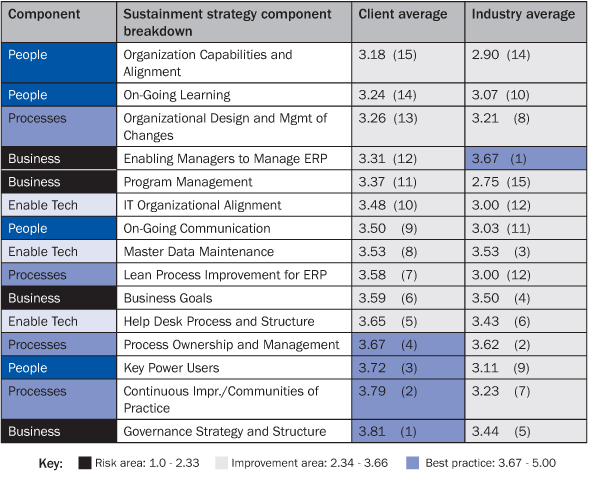
Figure 1
An example of a survey results chart
Once the survey was closed, Spenner and his team executed an analysis of the responses to see where the organization stood (Figure 2).

Figure 2
An example survey analysis
Step 2: Interviews
In addition to surveys, Spenner suggests conducting interviews to assess the organization’s learning processes and how employees interpret them. “If they said that they didn’t really feel that there was a clear learning path to take, we ask them to provide examples of something that they need to be able to do to grow within the organization that they’re currently not able to do,” says Spenner.
Spenner suggests creating two sets of interview questions: one for the leadership group and one for non-management, each with questions tailored toward their business functions. Once the interviews are completed, you can compare the results with the survey results to identify similarities and differences. “We begin to put the pieces of the puzzle together to see what kind of picture we see,” he says. “We then come up with some preliminary findings to determine what trends, if any, we see from the data collected.”
Step 3: Documentation Review
Reviewing current documentation is the final step in the data collection process. Reviewing an organization’s guidelines, processes, and business rules, Spenner says, shows you how available, clear, well-documented, and up-to-date the organization’s training processes are today.
After reviewing the documentation, you can compare the information available to users to the results of the surveys and interviews. “Then we can say, ‘This is where the organization is. Here is where your gaps are, and here is where your points of strength are,’” Spenner says. Once you compare the information from these three methods, you can clearly see what areas of the learning process need to be improved upon or are in good standing.
Perform a Gap Analysis
After you have collected information from surveys, interviews, and document reviews, it is time to perform a gap analysis to see where your current learning program falls short. “The goal of a gap analysis is to prioritize these gaps into either short-, medium-, or long-term initiatives based upon what needs to be done, the number of resources, the amount of effort within the org, and so on,” he says. “The gap analysis will show what you need to do as far as training and development, and putting a strategy together.”
Short-term initiatives are especially important as they can give your learning strategy crucial “quick wins” that boost buy-in from end users, says Spenner. “People need to see what’s in it for them, how this is going to benefit them,” he says.
Industry best practices are often a guideline for identifying gaps during this phase. Spenner also suggests creating a list of potential risks that could stand in the way of closing the gaps, and identifying ways to mitigate those risk factors.
Building Your Ongoing Strategy
The final step of the POA is to present the findings of your gap analysis and recommend an ongoing strategy to address learning and performance. Spenner suggests building your strategy around six key elements:
- Mission
- Vision
- Values
- Framework
- Objectives
- Strategies
Spenner recommends a performance-based approach to measuring and tracking the progress of your learning strategy (Figure 3). Too many companies, he says, track progress based on industry standards or established performance levels from unrelated parts of the business. Sometimes targets are set at the plant of division levels, which tells you little about how each employee is performing. “Are the targets getting met because we have a couple of star performers that are generating 70% of the deliverables,” Spenner asks, “or do each of the people within that group meet the performance expectations?”

Figure 3
A performance-based approach may be the best route to a sustainable learning strategy
The key to a successful learning strategy, he says, is to map the strategy to your particular business needs. To do this, you’re going to need well-designed and strictly-measured KPIs. Performance targets pegged to the most productive people in the organization will help the organization focus on bringing others up to that standard.
“If you’re looking for ways to improve, you have to make sure that all people are on target to produce what the highest producers do. That really ties into what we expect people to do when they’re hired,” says Spenner. “Show them what needs to get done, and have leadership in place to support a mix of learning, performance support, and collaboration. That’s where you really begin to guide accurate performance.”
When your strategy is in place, tracking performance over time enables you to make necessary changes to the strategy as your business needs adjust, says Spenner. “Verify people know what they need to be able to do, test to make sure they can do it, and then track their progress,” says Spenner.
Tracking individual progress not only confirms that your employees are adopting the new skills and processes, says Spenner, but also monitors “if they’re actually taking this skill development and producing higher levels of performance that go beyond transactional functionality and into value creation.”
Laura Casasanto
Laura Casasanto is a technical editor who served as the managing editor of SCM Expert and Project Expert.
You may contact the author at lauracasasanto@gmail.com.
If you have comments about this article or publication, or would like to submit an article idea, please contact the editor.





 Premium