Our thoughts on SAP for 2026
Key Takeaways
⇨ 2026 is crucial for organizations still using SAP ECC, as they need to secure budget approval and establish a clear migration roadmap to S/4HANA Cloud before ECC support ends in late 2027.
⇨ A practical and phased approach is recommended for migration, including the adoption of standard processes, data cleansing, and effective change management to mitigate risk and realize benefits.
⇨ Organizations should leverage SAP S/4HANA Cloud’s AI capabilities progressively while ensuring data governance and integration planning are priority actions in their transition strategy.
Our thoughts on SAP for 2026: Your Last Budget Cycle Before ECC’s 2027 Deadline.
As trusted advisors working closely with SAP customers, we believe 2026 is the year to act. With SAP ECC support ending in late 2027, if you have not already got plans in place, it’s time to move from planning to doing. Most organisations will need project and budget approval in 2026 to achieve a go-live in 2027, so this next budget cycle is critical.
Where SAP delivery meets pragmatism
Explore related questions
Rather than simply saying “migrate now,” we advocate a practical, planned strategy. Take clear action, manage risks, and ensure real benefits with strong SAP governance. Make your 2026 roadmap simple and flexible, allowing confident commitment and smooth execution.
Still on ECC? Make a board-ready business case that quantifies risk (support, compliance, talent availability, rising TCO) and captures opportunity (automation, AI, continuous innovation, process standardisation). Build a staged roadmap with realistic timelines and clearly articulated business benefits for your organisation.
Three pillars we recommend for ECC customers:
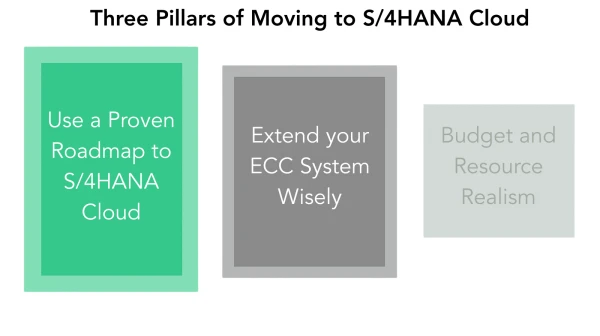
- Use a proven roadmap to SAP S/4HANA Cloud
- Fit-to-standard processes: Focus on adopting standard processes instead of copying old ones. Cut down on custom code when you can, and use clean extensions for what makes your business unique.
- Data strategy: Archive what you don’t need, cleanse what you do, and define migration waves tied to business outcomes.
- Integration and security: Use event-driven architectures and make sure identities are secure from start to finish.
- Change management: Begin early. Getting process owners and super-users involved is key to successful adoption.
- Value tracking: Connect major project targets to clear, measurable benefits like faster processes, more automation, or better margins and cash flow.
- If you’re not ready, extend ECC wisely.
- Prepare: Prepare your ECC system for extended maintenance by applying patches regularly, staying compliant, improving performance, and cutting technical debt.
- Stabilise: Stabilise your key processes and cleanse your master data now. Every improvement you make, lowers your future risk.
- Transition: Set up a bridge plan: use an 18 to 24-month support model to keep ECC stable and running while you get ready for S/4HANA Cloud.
- Budget and resource realism
- Budget now for the future: Complete your 2026 approvals without delay. Secure partners, internal experts, and governance immediately, as available resources will dry up quickly as the deadline approaches.
- Roadmap: Think about rolling out changes in phases by region, business unit, or process group. This helps lower the risk during cutover and keeps your project moving forward.
Why S/4HANA Cloud ERP: proven, modern, and ready
SAP S/4HANA Cloud is proven globally, and SAP continues to make great improvements to its AI-driven solution. Organisations that are already using S/4HANA Cloud ERP are seeing significant business process improvements and automation efficiencies through the adoption of the latest SAP AI capabilities, giving them cost savings and a competitive edge.
Two main editions are available:
The Public Edition gives you standard processes, frequent automatic updates and fast deployment. It has the lowest total cost of ownership and the fastest access to embedded AI and automation. It’s now the top choice for full-suite ERP in many industries. Pick this option if your organisation wants a greenfield clean slate standardise processes, faster time-to-value without extensive customisation.
For most, Public Edition is now standard. It delivers full ERP industry coverage, faster innovation with regular updates, rapid time-to-value, fewer upgrade projects, and quicker access to SAP’s latest AI and automation.
The Private Edition is better suited to complex setups that require more control or specialised customisations. It supports older processes while using cloud infrastructure and modern operations.
If your business can use standard processes, Public Edition provides a simpler system, faster improvements, and more reliable operations. If you need more agility during the transition, Private Edition can help, but we don’t recommend moving the old ECC complexity to your new SAP solution.
AI in 2026: start now, start simple, and scale with purpose
AI is now central part of SAP. Once on S/4HANA Cloud, embedded AI introduces efficiencies with little extra effort. Joule, SAP’s AI assistant in Public Edition, provides free tools for tasks and analysis, letting teams use AI daily without a separate budget.
Where we see quick wins:
- Finance: Automated matching, anomaly detection, and faster period close support
- Procurement: Intelligent recommendations, supplier risk indicators, and contract assistance
- Supply chain: Predictive inventory and demand insights, exception monitoring
- Sales and service: Next-best actions, guided quoting, and customer case triage
- HR and shared services: Process automation, guided self-service, and document generation
Adopt a “learn-by-doing” approach:
- Identify two or three use cases tied to clear KPIs (e.g., reduce order processing time by X%, cut manual reconciliations by Y%).
- Use embedded AI first: leverage Joule and native features alongside fit-to-standard processes.
- Establish governance early: data access framework, responsible AI policies, and human-in-the-loop checkpoints.
Once you see real value, expand your AI use and create custom scenarios that set your business apart.
2026 priorities checklist
- Confirm your ECC position: mainstream vs extended maintenance, patch posture, and support model
- Approve your 2026 budget early and lock in your partners and internal experts before demand increases.
- Decide on your S/4HANA Cloud path: Public Edition as default, where fit-to-standard applies; Private Edition if warranted by complexity or industry requirements.
- Cleanse your data: accelerate archiving, quality, and master data ownership
- Prepare integrations: take stock of existing integration points, validate future usefulness, map critical interfaces and plan for event-driven patterns
- Start using AI safely. Test embedded SAP AI tools in day-to-day application use and in finance, supply chain, or procurement first. Then expand with strong oversight.
If you need a partner to support ECC now and help you move to S/4HANA Cloud, we’re here for you. We offer a proven roadmap, reliable SAP delivery, and hands-on experience in support, migration, AI, and custom solutions.
Contact Realtech now to secure your 2026 budget, confirm your migration, and unlock the value of SAP Cloud. Get expert support for both ECC and S/4HANA Cloud to accelerate your journey to SAP S/4HANA Cloud.