How the World’s Biggest Biscuit Brand Modernised ERP: Inside Parle’s Shift to SAP Cloud ERP Private
Key Takeaways
⇨ Parle shifts to SAP Cloud ERP Private to standardise operations.
⇨ Transformation delivers ~30% reduction in total cost of ownership.
⇨ Clean core architecture enables AI, analytics, and scalable growth.
Parle Biscuits, the world’s largest-selling biscuits brand, has moved to SAP Cloud ERP Private (formerly RISE with SAP) as part of a multi-year transformation to standardise processes and data across its operations. Built on a clean core architecture, the shift is already delivering measurable gains, including an approximately 30% reduction in total cost of ownership, according to SAP.
Parle-G, identified by Nielsen as the world’s top-selling biscuit brand by volume with billions of packs sold annually, has outpaced brands such as Kraft’s Oreo, Walmart’s private labels, and Mexico’s Gamesa in category volume sales – equivalent to cookies in U.S. terms.
First launched as Parle Gluco in 1939 as an affordable, Indian‑made alternative to British biscuits, Parle‑G has stayed popular for its low price, wide availability, and ‘everyday’ appeal across generations of Indian consumers.
Explore related questions
As the popular biscuit was rebranded as Parle‑G in the early 1980s and its reach expanded from local shelves to a truly national staple, the operational engine required to support that growth became significantly more complex.
For decades, Parle’s growth came from a largely traditional operating model: large‑scale manufacturing, a vast distributor network, and margins that left little room for error. As product volumes surged and channels diversified, this legacy setup began to show its limits.
When Scale Became an Operational Constraint
Coordinating multiple partners and parallel initiatives became increasingly complex, with overlapping timelines and dependencies slowing execution and making accountability harder to track across the programme.
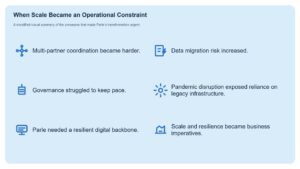
At the same time, large-scale data migration and validation introduced risk and delay. High data volumes and tightly coupled integrations strained system performance. Governance frameworks struggled to keep pace, creating challenges in maintaining accountability, managing risk, and ensuring consistent decision-making across teams.
The pandemic amplified these pain points: remote collaboration, sudden supply shocks, and shifting consumer buying patterns revealed how dependent Parle still was on on‑premise infrastructure and point solutions. The company needed a more resilient, scalable digital backbone that could keep pace with its ambitions.
Parle’s Journey to a Clean Core Architecture
Parle began its SAP journey in the early–to–mid 2010s. It implemented SAP ECC as its core ERP to standardise finance, supply chain, and HR processes.
Around 2021, the company’s hybrid cloud phase with IBM formally took shape when it started migrating mission‑critical SAP, ERP, supply chain, and analytics workloads onto IBM’s hybrid cloud platform.
Core ERP modernisation was supported by SAP BTP and SAP Integration Suite, while analytics and reporting were handled through SAP Datasphere, SAP Analytics Cloud, and SAP Group Reporting, alongside embedded AI and GenAI capabilities.
The current intensive phase focuses on migrating from SAP ECC to SAP Cloud ERP Private and establishing a clean core architecture. This phase has been underway since roughly 2019–2020 and is now culminating in a large SAP Cloud ERP Private go-live recognised in 2025–2026.
The transformation also integrated tools including SAP Signavio, SAP Cloud ALM, and LeanIX to support process optimisation, governance, and lifecycle management.
With this, Parle is modernising the core platforms running its business to scale infrastructure more flexibly as demand shifts across regions and seasons.
It is standardising processes and data so KPIs are consistent across plants and markets, while embedding AI and advanced analytics to improve forecasting, optimise sourcing, and reduce cost-to-serve.
The transformation ultimately aims to create a more agile, data-driven operating model that supports faster decisions and sustainable growth.
Measurable Outcomes: Lower TCO and Faster Upgrades
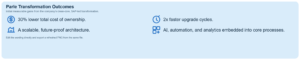
The initial measurable outcomes from the transformation show:
- About a 30 percent reduction in total cost of ownership.
- Two-times faster upgrade cycles.
- Establishment of a scalable, future-proof architecture.
- Integration of AI, automation, and advanced analytics into core processes.
SAP planning capabilities are combined with IBM’s cloud and AI stack. This approach strengthens forecast accuracy and reduces stockouts and logistics cost to serve, laying the groundwork for more advanced scenario planning around demand surges or supply constraints.
These improvements were supported by embedding intelligence into business workflows and strengthening the company’s digital foundation for long-term efficiency.
Sanjay Joshi, CTO, Parle Biscuits said, “A strong partnership across SAP leadership, delivery teams, and Parle Biscuits stakeholders ensured our S/4HANA transformation was strategic—not merely technical. Enterprise Architect played a pivotal role in navigating the complexity of the transformation, enabling roadmap clarity, accelerating solution adoption, and delivering enterprise-wide value.”
Strengthening Compliance and Future Readiness
As part of its transformation, Parle is prioritising security and regulatory readiness, including alignment with India’s Digital Personal Data Protection Act (DPDPA 2023). The modernisation effort also includes strengthening integration architecture and ensuring data readiness, positioning the company to support continuous innovation and evolving compliance requirements.
“Once again, Parle Biscuits and SAP have demonstrated what strong, trusted collaboration can achieve. Together, we have crossed multiple major milestones, reinforcing the power of partnership and a shared vision. As we look ahead, the next chapter is even more exciting, building a compelling AI and Automation collaboration story that drives innovation, efficiency, and measurable business impact at scale,” Joshi said in a LinkedIn post.
This approach is designed to ensure that this combination, IBM’s hybrid cloud and services wrapped around a clean SAP core, will let Parle keep its biscuits affordable and available at massive scale, while giving leadership the data confidence to grow into new channels and markets.
What This Means for Mastering SAP Insiders
Clean core enables continuous transformation at scale. Standardising processes inside SAP while pushing innovation to BTP allows enterprises to upgrade faster and adapt without disrupting operations. This model reduces technical debt while preserving flexibility for future innovation.
Data consistency becomes a competitive advantage. A unified data model across finance, supply chain, and operations enables faster, more confident decision-making. Organisations can move from reactive reporting to predictive and scenario-based planning at enterprise scale.
Hybrid cloud supports resilience without losing control. Combining SAP as the system of record with hybrid cloud infrastructure allows organisations to scale performance and innovation layers independently. This approach balances agility, cost efficiency, and governance in complex environments.
More Resources
See All Related Content-

-
-

-

 Premium
Climbing the FP&A maturity curve