Agentic ambition outpaces AI foundations – SAP NOW AI Tour ANZ
Key Takeaways
-
SAP named three foundations for reliable agents. It supplies one. Australia trails the world on the other two
-
Deployment has outrun governance: 43% have no human-in-the-loop, and 49% report agents already taking incorrect actions.
-
Australia matches the world on generative AI maturity at 53%, but trails on agentic AI, 19% against 24%
Foundations, not budgets, will decide which organisations win the AI value race.
That was the message from Angela Colantuono, President and Managing Director, SAP Australia and New Zealand, opening the SAP NOW AI Tour Australia and New Zealand event at Sydney’s Hordern Pavilion on Wednesday.
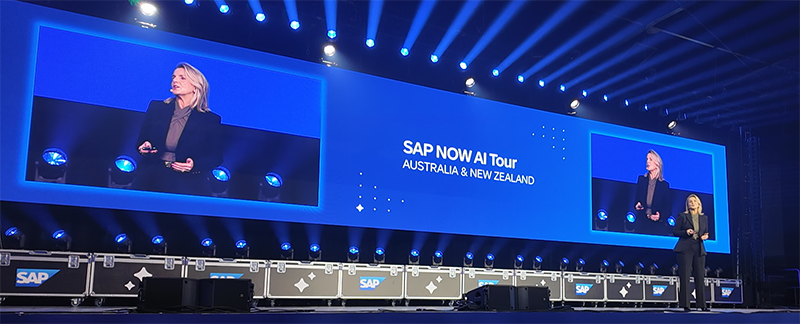
“The organisations that are making real progress aren’t the ones with the biggest budgets. They’re the ones taking the time to simplify their businesses and their processes, automating intelligently, and freeing people up to focus on what matters most. And they’re building the right foundations today instead of waiting for perfect conditions to come.”
Explore related questions
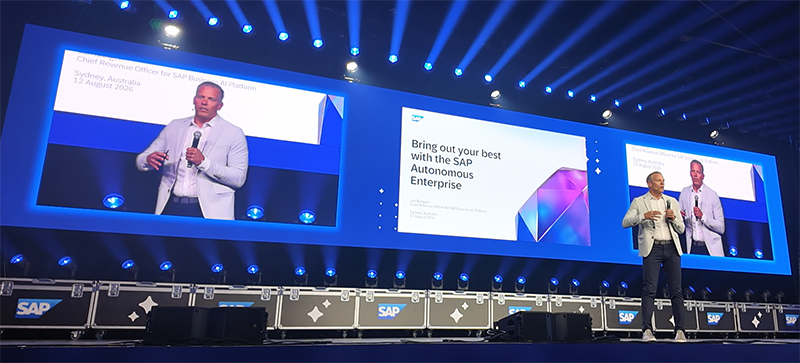
Foundations was the common thread through the day, across more than 20 customer presentations and the Autonomous Enterprise keynote from Jan Bungert, Chief Revenue Officer, Data and AI, SAP.
Bungert set out three conditions he described as fundamental to making agentic processes work reliably. The first is deep process and industry knowledge, held in domain-trained models and a knowledge graph rather than in the heads of developers. The second is semantically rich business data, connected in real time from business processes into that knowledge graph. The third is enterprise-grade governance.
SAP supplies the first through the product. The second and third are the customer’s to build, and on both, SAP’s own research places Australia behind the rest of the world.
The Value of AI Report 2026, conducted by Oxford Economics across more than 2,600 business leaders in 13 countries, found 22% of Australian businesses consider themselves mostly or fully ready on AI governance skills and expertise, against 33% globally. Nearly three-quarters (73%) report challenges with poor data quality.
Governance is the step from a proof of concept to production
Governance is the condition Bungert tied directly to production.
“If the agent doesn’t understand what type of data it is allowed to access and to process, if you cannot set, for example, a flag to make it SOX compliant, you will never have an enterprise-ready system,” he said. “You will never make the step from a proof of concept to a real-life environment.”
Governance also decides where a person stays in the process. Agents carry the information assembly work and the human makes the judgment call at the points an organisation’s own guardrails specify. Agents are managed through an agent hub covering SAP and non-SAP agents, with guardrails and access structures defined per agent, including risk classification, validation and behavioural review pre go live.
Many Australian organisations are working without that governance framework, and deployment has run ahead of it. Some 42% say they are rolling out agents faster than they can standardise and govern them, reaching 68% once those who are unsure are counted. More fundamentally, 43% have no human-in-the-loop process for agentic workflows, so nothing formally defines which decisions require a person.
The cost is already evident, with 49% reporting agents have taken incorrect actions during pilots or deployment and 54% saying employees increasingly accept AI outputs without sufficient scrutiny.
SAP allows little margin for either. Introducing the Autonomous Enterprise at SAP Sapphire earlier this year, CEO Christian Klein said that for the mission-critical processes of SAP’s customers, “‘almost right’ just isn’t good enough.”
Meeting that standard requires ownership, which is also thin on the ground. Fewer than half of Australian companies have a dedicated AI leader responsible for adoption (46%), a third have leadership KPIs for AI (33%), and 41% provide training on AI capabilities and risks.
Grounding, and what it is grounded in
SAP’s accuracy argument rests less on the model than on what the agent is connected to. Bungert described a knowledge graph of 7.3 billion connected data points, domain models trained on data from 40,000 customers, and tabular models including TabPFN, from SAP’s Prior Labs acquisition, which return predictions on structured data without further training or fine-tuning.
“All the agents running in your company are grounded in this type of knowledge graph,” he said, arguing that this is what keeps the data correct and routes the right information through agentic work.
The grounding works only if customers have the data to ground it in, which returns the argument to a point SAP made in Melbourne a year ago. At the 2025 SAP NOW AI Tour, Stephan de Barse, President, Business Suite Organisation, told the audience there is no good AI without fixing the data first. Today, the Value of AI Report 2026 shows Australian leaders rank integrated data systems (64%) and data quality (51%) as the biggest enablers of AI readiness, but the share describing themselves as data-ready has fallen over the last year.
And it is compounding. The knowledge graph draws on data products, and building those requires a governed foundation few organisations have reached. SAPinsider’s SAP Business Data Cloud benchmark research puts 3% of organisations at a unified, governed data layer and 12% at the automated governance level required to support AI-driven workloads. Agents grounded in an incomplete foundation inherit its gaps.
Model choice narrows the picture further. Bungert said SAP is partnering with more or less everybody on the market for standard large language models, with sovereign options built into the offer. Australian organisations are less able to exercise that breadth than the roster suggests: 99% now operate under some form of sovereign AI framework or requirement, and 76% cite data residency constraints that limit model choice. The practical decision here is less which model performs best on a given workload than which models local obligations leave available.
Where the installed base actually is
SAP’s analysis of its most widely deployed AI use cases across the ANZ customer base for the twelve months to mid-2026 demonstrates the gap to be closed. Nearly all of the top 10 are ring-fenced task solutions, solving distinct challenges around manual, error-prone work or improving the speed and outcome of CX interactions. The exception sits at seventh, the foundational platform for building, deploying and running AI applications at scale, which is foundation work rather than a task. The top ten are a far cry from an autonomous enterprise, and again shows the foundations are being set but there is still a long way to go.
Rachel Hunter, appointed Head of AI for Australia and New Zealand in an announcement made at the event, framed those deployments as the point rather than the shortfall.
“AI has already found its place in Australian and New Zealand business; not in the strategy deck, but in the day-to-day,” said Hunter. “The most widely used applications are helping finance teams process invoices faster, helping marketers personalise connections with customers and helping operations teams catch problems before they escalate. This is not experimental AI. It is already working.”
Australia sits close to the global average on generative AI maturity, with 53% scaling or leading against 54% globally. On agentic AI, 19% are scaling or leading against 24% globally. In SAPinsider’s benchmark research, only 16% of technology leaders report using AI within their SAP systems in more than a limited way.
Closing the gap by domain
SAP’s answer to that gap is structural. Rather than shipping a flat catalogue of agents, Autonomous Suite is organised into domains such as finance, spend and supply chain, with assistants mapped to specific roles. A category manager works with a category management assistant handling spend analysis and market insights, which Bungert put at efficiency gains of 30% to 40%. At Sapphire, SAP set out more than 50 domain-specific Joule Assistants orchestrating over 200 specialised agents.
Industry AI runs the other way, taking a process end to end across seven industries in the first wave. Bungert used asset maintenance as the Australian example, citing the local weight of mining, oil, gas and energy, and said the first end-to-end agentic version improved the process by 25% to 30% against a baseline involving seven to eight people and applications.
According to Bungert, for customers still on legacy ERP, transformation agents covering system analysis, data management, custom code analysis, configuration, test management and rollout improve transformation speed by 35%. A connector allows on-premise systems to feed agentic workflows during migration, so customers can pull data and trigger ERP workflows before reaching clean core or RISE.
Both target the same problem. SAPinsider’s ERP Migration and Transformation 2026 research found the proportion of respondents intending to complete their move to SAP S/4HANA before the end of 2026 has more than doubled year on year, and describes that figure as more of an intention than a reality. For organisations whose timelines are slipping, SAP is offering two answers: compress the migration, or stop treating its completion as the point at which agents start delivering.
Commercially, Joule Agents design time is free and runtime carries no additional charge until year end, with customers able to activate assistants themselves through SAP For Me. Pricing for AI runtime tokens in 2027 has yet to be announced.
What this means to Mastering SAP insiders
- Of the three conditions Bungert named, SAP supplies the process and industry knowledge through the product. Semantically rich business data and enterprise-grade governance are internal work that no product activation resolves, and the free runtime window closes in roughly four months.
- Governance sequences first on SAP’s own framing. The question is not whether a human reviews everything, but whether the organisation has defined where a human decision is mandatory and can enforce it through guardrails. For the 43% with no human-in-the-loop process, that definition does not yet exist, and the 49% reporting incorrect agent actions suggests the cost of the gap is already being paid.
- For data teams, the order of work follows from the grounding claim. Agent output is bounded by the quality of the data products feeding the knowledge graph, which puts that work ahead of agent deployment rather than alongside it. The message from Melbourne last year has not changed. For teams still on legacy ERP, the connector allows agentic workflows during migration rather than after it, though the 35% acceleration figure is SAP’s own and will want testing against a comparable local programme before it enters a business case.