How an AI Tool Reduced Our Hybris to Spartacus Migration Time by up to 70%
We took a real enterprise SAP Commerce storefront, including JSP templates, Spring MVC controllers, and LESS stylesheets, and migrated it to Spartacus Angular using the AI tool as a co-engineer. This article covers exactly what happened, what the AI got right, and where human expertise still matters.
Explore related questions
The Problem
Hybris Challenges: High Costs and Complex Upgrades
If you’re running a storefront on SAP Commerce Cloud (Accelerator), JSP-based storefronts are no longer the focus. The recommended direction is Spartacus, a modern, API-driven storefront built with Angular.
For many organizational teams, this raises a big concern. You may have hundreds of JSP pages, many custom controllers, and years of business logic built into addons. Traditionally, the approach has been to hire specialized developers, spend 18–30 months rewriting everything, and invest heavily in the process. While this works, it is slow, costly, and depends on rare skill sets.
A more practical approach is to rethink the problem.
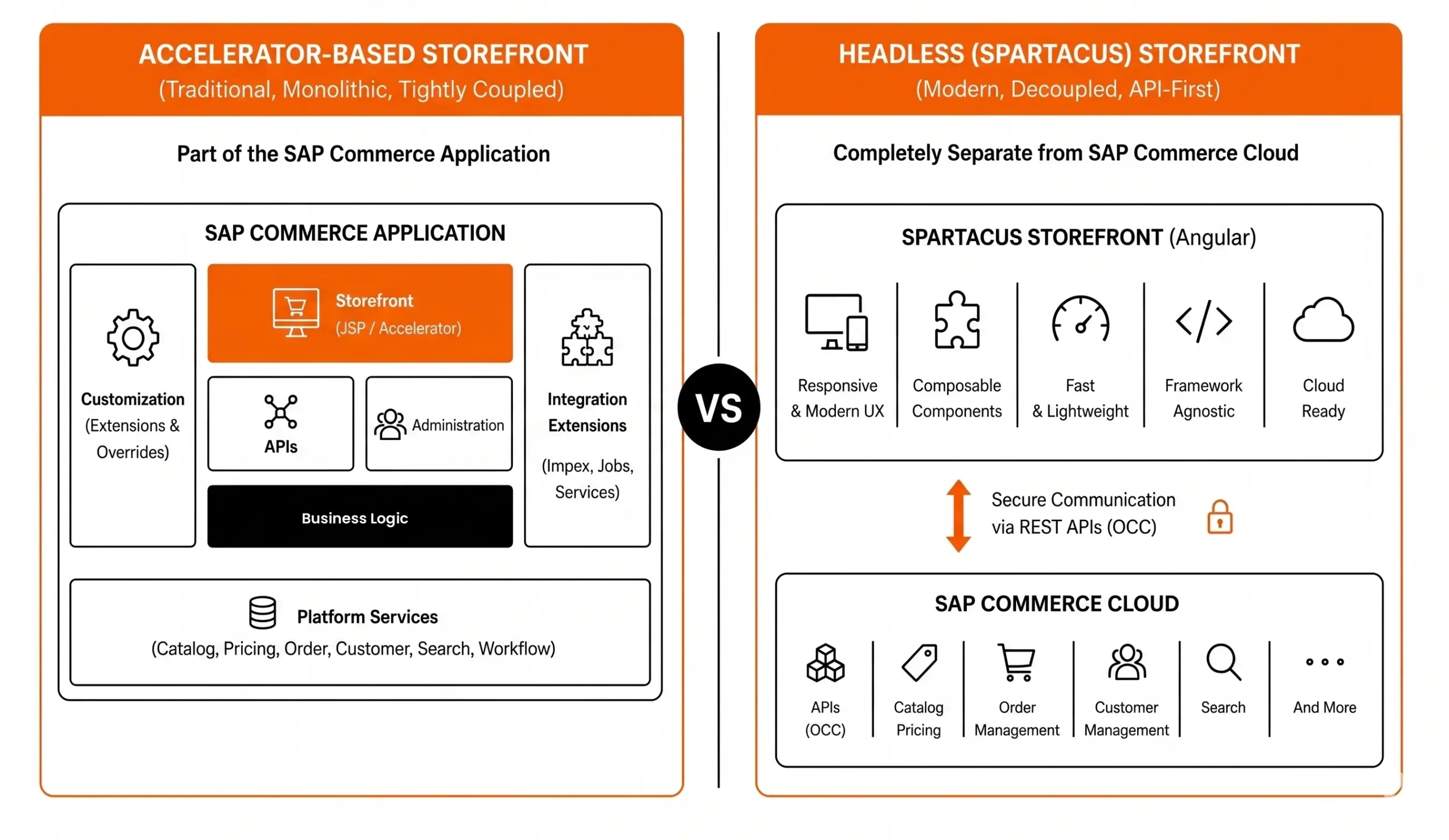
By adopting an AI-assisted, phased approach, using automation for code analysis and API mapping organizations can significantly reduce timelines and effort, delivering results faster with more efficient use of resources.
The Experiment
We Migrated a Real Homepage
Rather than theorise, we ran the experiment on a real Hybris implementation. Our subject: a fully custom homepage comprising five source files that represent every migration challenge in miniature.
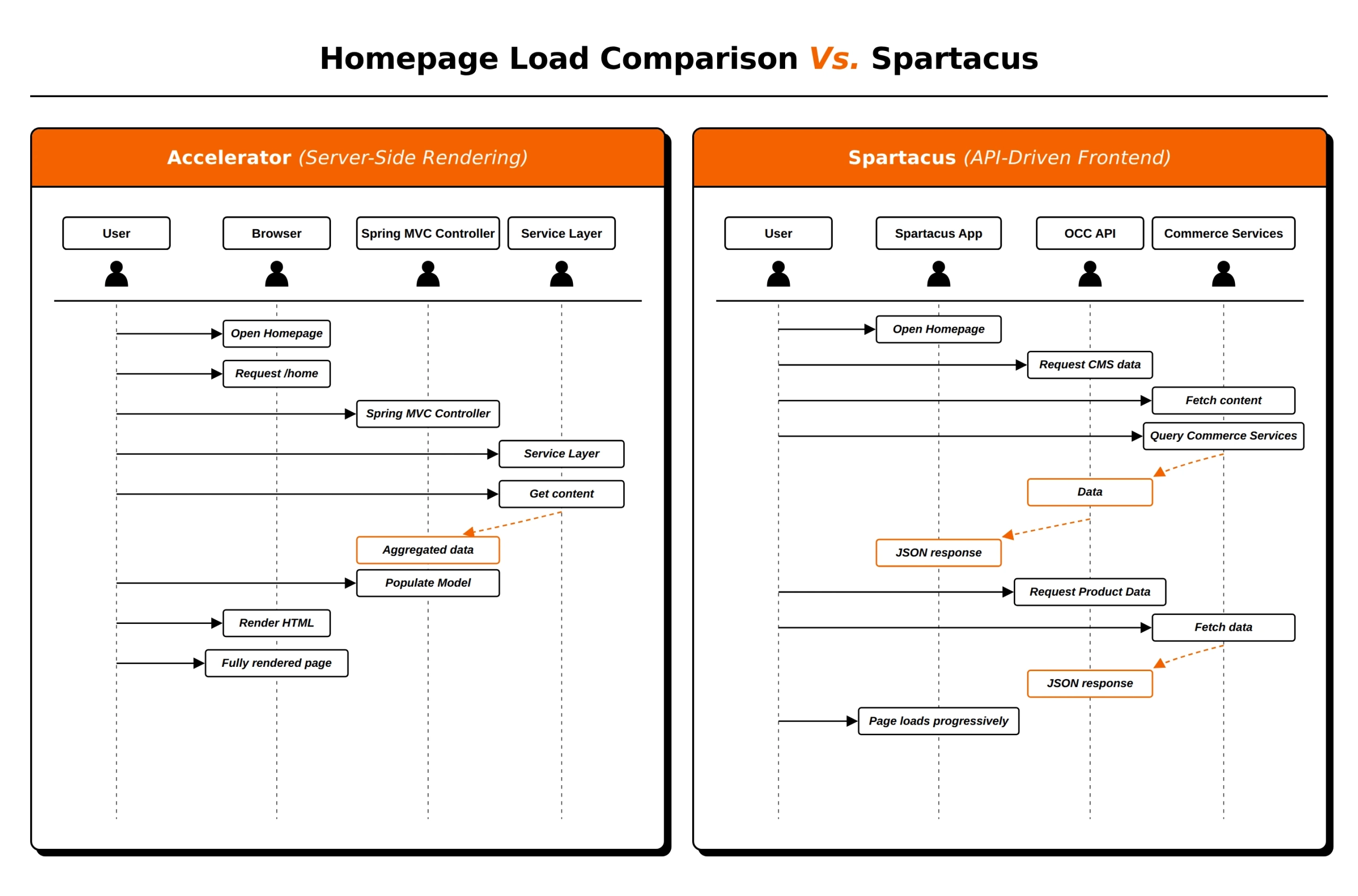
Migrating the homepage from SAP Commerce Cloud Accelerator to Spartacus uses AI-assisted analysis to extract UI intent from JSPs and map it to API-driven Angular components.
What the AI did
AI-Powered Code and Logic Optimization
The first thing that surprised us was the depth of semantic analysis. The AI didn’t just convert JSP syntax to Angular syntax. It understood the intent of each construct and mapped it to the idiomatic Spartacus equivalent.
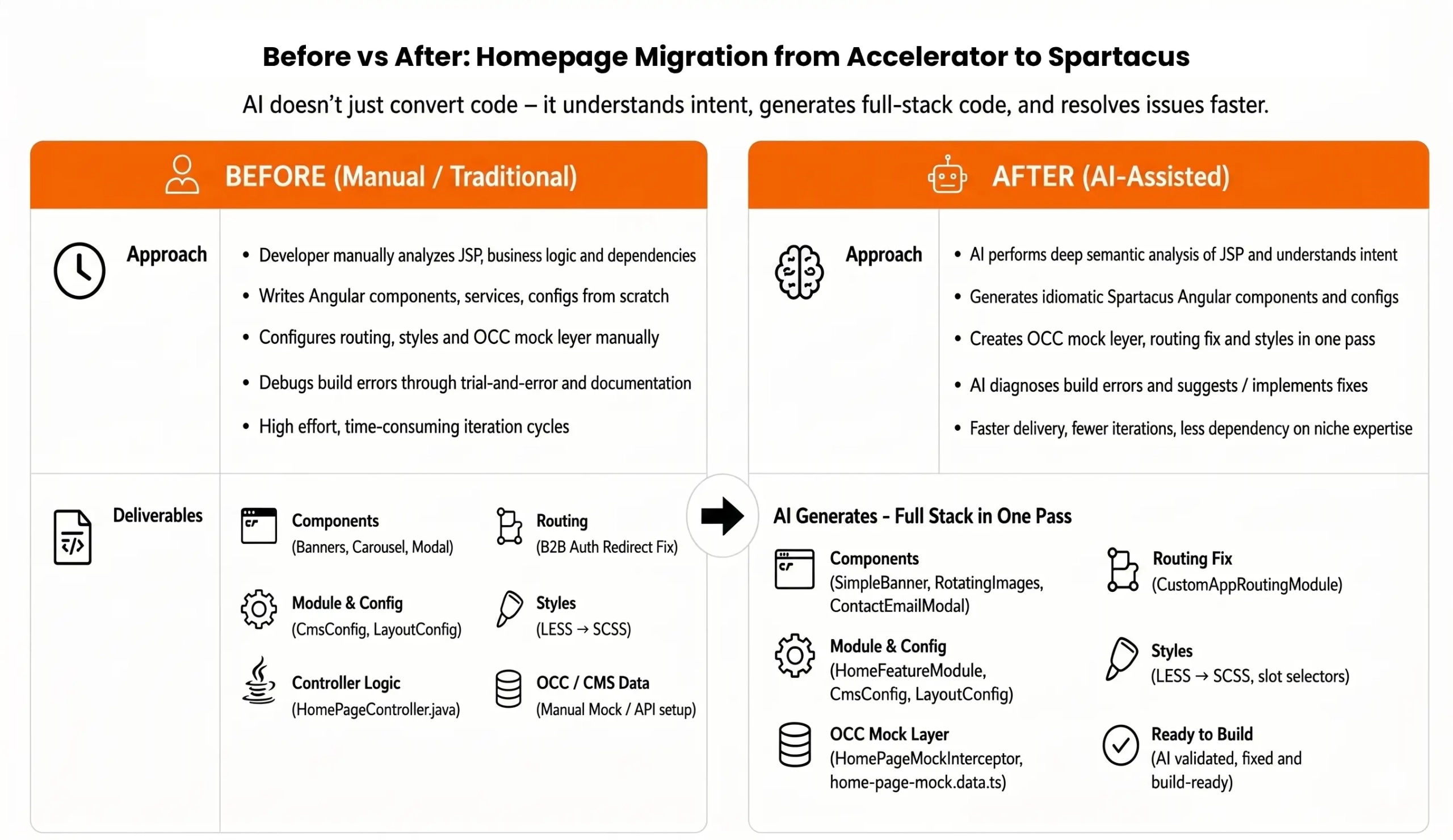
But what genuinely impressed us was the iterative debugging. When ng build threw errors, we fed them back to the AI and it diagnosed root causes that would have taken a senior developer hours to find.
| Error | Manual Diagnosis | AI Tool Diagnosis |
|---|---|---|
| NG6008: Component declared by 2 NgModules | Hunt through module tree manually | Identified stale home-wrapper.module.ts from previous iteration |
| Identified stale home-wrapper.module.ts from previous iteration | Know Angular 19 changed the default | Added standalone: false to all 3 decorators immediately |
| SCSS mixin undefined at build time | Trace angular.json styles array | Identified double-import of @spartacus/styles/index |
| Homepage redirecting to /login (B2B mode) | Senior architect, 1–2 days investigation | Read channel: B2B from network tab, traced to defaultB2bOccConfig NgRx effect, generated CustomAppRoutingModule fix |
| SyntaxError: Unexpected token ‘<‘ at module import | Vite chunk resolution debugging | Identified featureModules dynamic import() returning HTML 404; switched to eager declarations |
The AI didn’t just translate the code, it understood this business rule and rebuilt it in the new Spartacus setup so the user experience remained exactly the same.
The Numbers
How AI Accelerates Storefront Migration
The homepage migration is a single data point, but it is a highly representative one that contained every category of challenge present in a full migration. Extrapolated to a 300-file enterprise implementation:
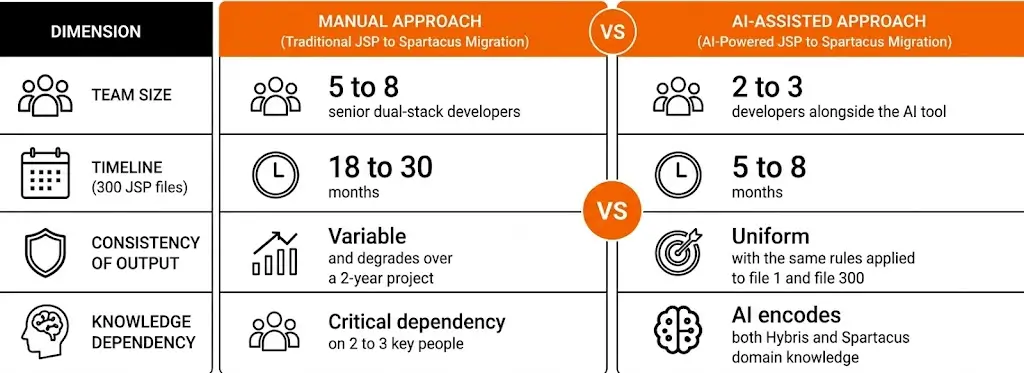
The AI tool does not just write code faster. It makes the knowledge portable. You no longer need a rare individual who knows both Hybris internals and modern Angular.
Honest Assessment
What AI Doesn’t Replace
We want to be precise about this, because the hype cycle does nobody any favours. AI-assisted migration is not autonomous migration. It is a powerful accelerator that still requires qualified engineers at the wheel.
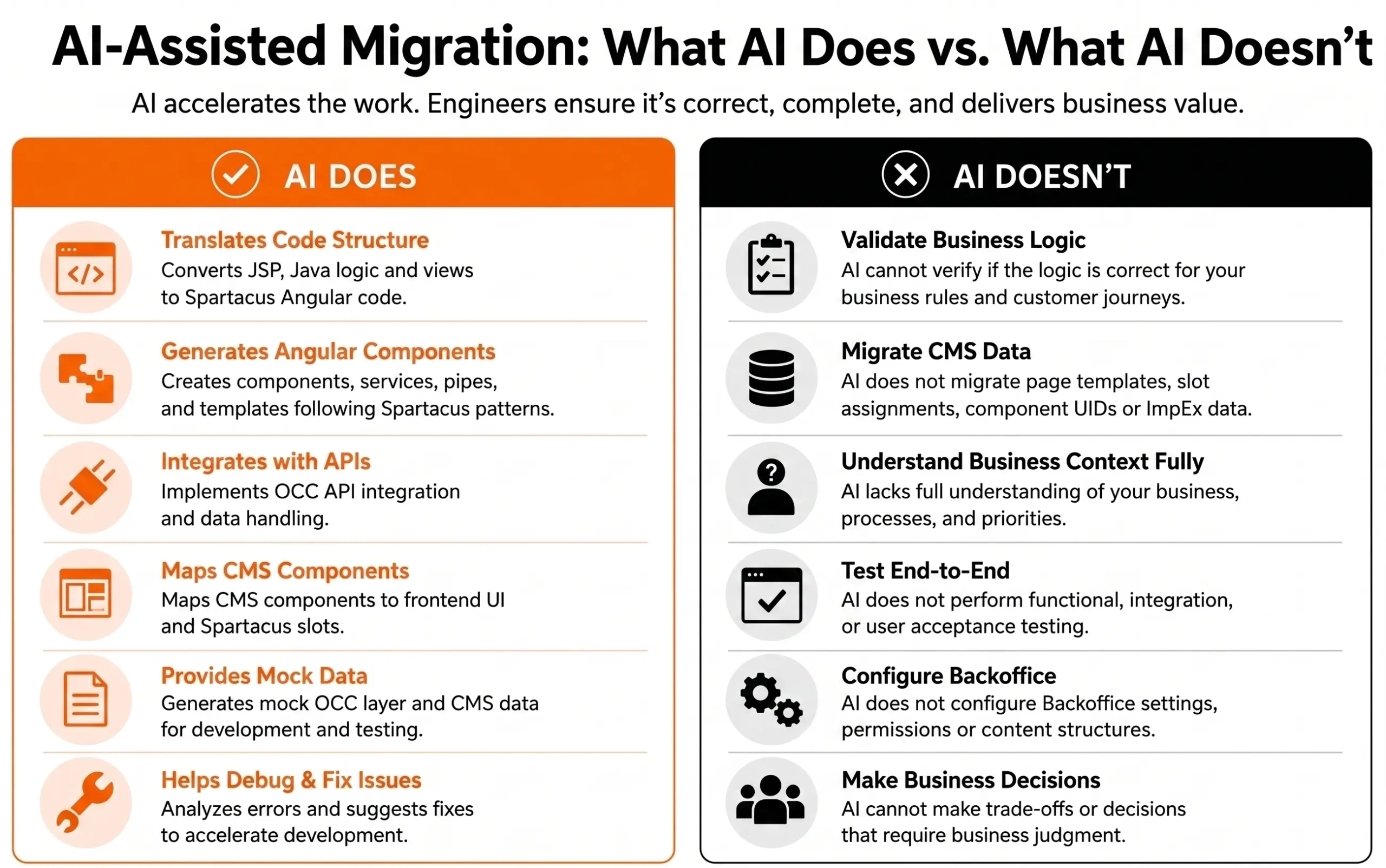
Instead of spending time coding each component, teams focus on assurance and alignment with business needs. The result is a 4–5x improvement in developer productivity, delivering faster outcomes while maintaining control and quality.
How to Do It
Our Recommended Four-Phase Approach
Discovery & Inventory
AI-powered JSP parser generates a migration manifest JSON across all source files. Classify by page type and complexity. Export CMS metadata from Backoffice. Prioritise in the following order: Content pages, Category pages, Product Detail Pages, Cart, Checkout, and finally Account pages.
AI Component Generation
Feed JSP files and CMS metadata to AI in page-type batches. AI generates Angular components, NgModules, CmsConfig, LayoutConfig, and mock interceptors. Developer reviews, runs ng build, feeds errors back for correction. Repeat until green.
Integration & Testing
Replace mock interceptors with live OCC. Regression test against JSP output. Lighthouse profiling. Accessibility audit. Parallel-run JSP and Spartacus for A/B comparison before cutover.
Go-Live & Decommission
Traffic cutover. Monitor Core Web Vitals and conversion metrics. Decommission JSP infrastructure after stability period. Archive AI session logs as migration audit trail.
This approach streamlines migration by using AI to handle repetitive development tasks while teams focus on validation and business alignment. It delivers faster time-to-market, improved efficiency, and a controlled transition to a modern, scalable storefront.
Bottom Line
AI Strategic Accelerator for Migration
Every SAP Commerce Cloud customer will eventually move to Spartacus. The shift away from JSP storefronts is a clear product direction from SAP, so the real decision is not if you migrate, but how efficiently you do it in terms of time, cost, and engineering effort.
Our experiment shows that AI-assisted migration is already practical. A real homepage consisting of five source files was converted into a fully working Spartacus feature module in a single session, compared to the two to three weeks typically required with a manual approach.
At enterprise scale, across hundreds of files, this impact becomes significant: reduced timelines by months, substantial cost savings, and the ability for smaller teams to deliver what previously required large, specialized groups.
Book your free strategy call today and let us show you what your migration could look like with AI working alongside your team. Reach us at info@gowide.com and we will get back to you within one business day.
 Premium