Serialization and track and trace are hot topics in the supply chain landscape today, but few industries are affected as deeply or as imminently as the pharmaceutical industry. See what serialization and trace and trace are, how to apply them in pharmaceutical operations, and what solutions SAP offers in support of serialization and track and trace.
Key Concept
Serialization is a process used to identify a particular unit or example of a material, whether it is a single bottle of a prescription pharmaceutical or a case of bottles. It usually refers to the smallest saleable unit of a material. Track and trace refers to the ability to track the physical movement and location of a specific material, using that serialization of material to provide visibility at a granular level.
Serialization of materials has long been a part of many industries. It is used to identify components, finished goods, returnable containers, and repair parts. While serialization is not required for track and trace functionality, it enables a significant benefit in terms of accuracy and ability to identify a specific item. This is critical in drug safety and also adds efficiency in the returns process.
Although I focus on serialization in the pharmaceutical industry, which is the subject of new regulation and compliance directives in the global marketplace, other industries also rely on serialization. They include the medical device industry, which is closely related, aerospace and defense, automotive, and high tech, all of which benefit from the ability to track a single component, whether it is a fan blade in a jet engine or a prosthetic hip replacement.
Serialization or the lack of it can have a significant effect on drug safety. Consider the case of a drug theft from a Connecticut warehouse. Thieves managed to steal an estimated $75 million dollars worth of prescription drugs. The thieves were caught, and the drugs were found before they entered the market, but the threat is plain.
The drug trade is not focused only on currently illegal drugs. In fact, the illicit drug trade is by a significant margin more involved in legally produced and distributed drugs.
In another example, 129,000 vials of insulin were stolen comprised of three separate lots. These lots entered the legal market. Only 2 percent was recovered, and as a result, the U.S. Food and Drug Administration recommended all three lots be recalled and notices were sent to consumers to return them. Since the lots were not serialized at the unit or vial level, pharmacists, health care providers, and consumers had no way to determine whether the vial they had was one of the stolen vials, and subjected to improper storage and handling.
If serialization had been in place, the physical location and disposition of every vial of the lot could be compared to the stolen vials, and the stolen vials could be readily identified. This would have been a significant cost savings to the manufacturer, as only those vials identified as stolen would be recalled. That would have increased customer confidence in the product.
Track and trace functionality can be applied to record the timeline and chain of custody of a product, just as you see when you order products from most online retailers. You receive an electronic notification of when a product ships, where it is in the delivery chain, expected delivery time, and confirmation of delivery. If any part of the expected chain of events fails to occur or takes longer than expected, a flag is raised and an immediate investigation can begin.
Returning to the focus of this article, many countries and regulatory bodies have embarked on a drug safety initiative that is based on serialization of products. Pharma companies are under the gun for compliance from many regulating bodies.
Much is yet to be confirmed about the regulatory environment, and changes are accelerating. However, a clear common denominator is the need to track an individual saleable unit from manufacturing to use. SAP provides solutions to address this need. I explain their practical application in the following sections.
The SAP Solution
A significant amount of information is available from SAP on the details of serialization, so I only hit the high points of the solution set in order to focus on how it is applied rather than how it works.
SAP provides a set of SAP solutions called Auto-ID Enterprise, which includes SAP Auto-ID Infrastructure (AII) and SAP Object Event Repository (OER). These applications are not part of the SCM suite of products, but rather are delivered on a separate server instance.
AII is the basic level of communication with devices that read, encode, and print radio frequency ID (RFID) and bar code labels. SAP AII can then report events in the process to SAP OER, from commissioning a serial number and associating it with a unit level product code and a specific unit of that product, as well as the aggregation of that unit into cases and pallets.
SAP AII is also used to deconstruct that aggregation, which is to remove a case from a pallet, or a unit from a case if needed, and then add it to a new case or pallet. SAP Auto-ID Enterprise uses the Process Interchange (PI) functionality of SAP by routing connections to SAP ERP Central Component (ECC), SAP AII, and SAP OER through this communications hub.
Some configuration is required, but it consists mostly of maintaining number ranges and configuring the rules around what to do with the events that are registered by AII/OER – for example, configuring the flow of information between AII and OER, and how the master data is applied from ECC.
Figure 1 is a diagram of the architecture. PI can be used in SAP and non-SAP environments, connecting to third-party applications, including production systems, ePedigree document generation, warehouse management systems, and Web portals.
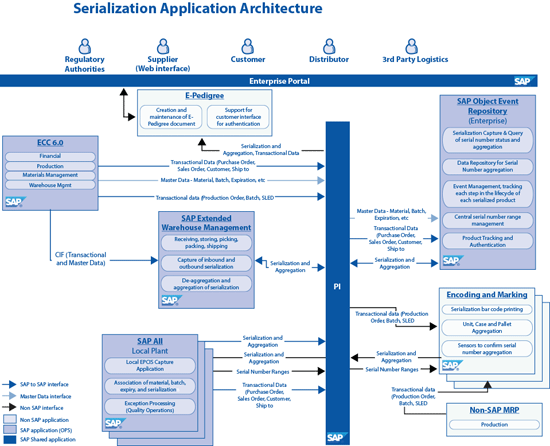
Figure 1
Serialization architecture
ePedigree is important to pharmaceutical organizations because it is the document that establishes the history of ownership of a serialized material, from manufacturing to use. The history begins with the data provided by AII, and subsequent events are stored in OER, from which you can create an ePedigree document.
The SAP system uses master data from ECC for product data, batch (lot) tracking, expiration date, and order management to ensure a secure system of record and limit duplication of stored information. This reduces complexity, eliminates synchronization issues, and increases visibility.
As serialization is introduced as a required functionality, more detailed master data is needed. More information about the product needs to be stored, including additional methods of identifying the stock keeping unit (SKU) by the Global Trade Identification Number (GTIN), country of origin, manufacturing plant, saleable unit, units per case, cases per pallet, and other important master data information.
Starting the Process
Serialization becomes a reality when an item is physically marked with a bar code or an encoded RFID tag is attached, or even the serial number in human readable form is attached. In the manufacturing process, this necessarily takes place at high speed and at a critical point in the production cycle. Once the saleable unit is determined, serialization occurs by one of the above methods. The two media types (bar code and RFID) for marking the saleable unit represent significant differences in functionality and resulting process. Figure 2 illustrates a common RFID chip, with the lines around the center as the antenna and the miniaturized radio in the center.
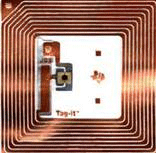
Figure 2
RFID chip example
RFID has long been the darling of the track and trace discussion, but adoption rates have fallen far short of the forecasts in most industries. For serialization and track and trace purposes, RFID is an effective method until the aggregation process takes place. The intent of the aggregation is to provide a method of linking the saleable units to a serialized case, and then linking the serialized case to a pallet. That’s where the challenge lies. RFID read rates vary significantly at the pallet level depending on the material and type of RFID media.
Passive tag read rates do vary, and less than 100 percent is not acceptable in a pharmaceutical track and trace scenario. You must know exactly what is on that pallet, down to each saleable unit. The read rates can be improved with active and semi-active tags, but the cost goes up exponentially, and reading a single pallet and only that pallet must be dealt with, as the read distance is also increased.
Note
Passive tags have a radio and an antenna, but the tag only becomes operational when it is inside the electrical field from a reader. The reader must be fairly close to the tag, usually in terms of one meter or less, but that is affected by the material. Liquids, metals and dense materials have a significant impact on the read distance, so this is why the read rates for passive tags at the pallet level are not 100 percent, and vary by materials. Active tags have an onboard battery, and have the power to push their signal through the materials to provide greater distances to read the tag. Semi-active tags are similar, but the power to the tag is only turned on when the reader field is sensed, extending the tag battery life.
Collisions from a large group of RFID tags responding to a radio signal must also be handled, and multiple interrogations must be used to ensure all tags are read. That technology exists today.
If you then consider the global impact, not all countries and regulatory bodies have ratified frequency and tag media regulations. That adds another layer of complexity that is currently handled by embedding an RFID tag into a self-adhesive label that is printed with the human readable information or a bar code to represent the data encoded on to the RFID chip.
Lower densities of items on a pallet, for example some medical devices, can be accommodated with accurate reads. However, if you are trying to read vials of pharmaceutical solutions, where the item count on a pallet can exceed 10,000, RFID is a complex solution. The alternative? Bar code printing, in the form of 2D bar codes (Figure 3).
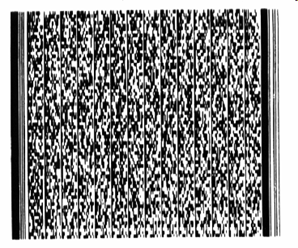
Figure 3
2D Bar code example
The benefits of bar code printing in a 2D format include the ability to store large quantities of information in a small footprint, which is often a significant consideration at the saleable unit level. The technology is proven and inexpensive to deploy. However, you can’t read a barcode on an item that is packed in a case and the case is stacked onto a pallet. Enter a process called serialized inference.
When applied to a pharmaceutical or medical device supply chain, inference is used to aggregate items, cases, and pallets. As each item is labeled, it is read to confirm and “commission” the serialization of the item. Then as each item is packed into a case, it is aggregated, or linked to that case, which is also serialized, forming a hierarchy of specific serial numbers linked to a specific case identified by a another serial number. Then palletization is created by confirming the serial numbers packed onto a pallet, resulting in the third-level packaging hierarchy. Inference is then applied in the supply chain to infer that the items and cases have been scanned, and the aggregation data is provided to demonstrate the linkage.
Regulation in the pharmaceutical supply chain is pending with regard to inference, but conservative views hold that inference will be supported, at least for the first two levels of item and case, and potentially for pallets, but perhaps only for homogeneous products, not for pallets of mixed SKUs.
So with that background, it seems that serialization in the form of 2D bar code marking is a reasonable and cost effective alternative to RFID. Now, let’s get to the system side of making this process a reality.
Production Process
Serialization of the saleable unit can come at different points in the production process. If RFID is the choice, the RFID tag can be applied to a container before it contains the product, and encoded with the SKU, lot, expiry date, and other information as it becomes available. With a 2D bar code, as it is a WORM (write once read many) medium, the information must be known at time of printing. This pushes the process further out in the product cycle. If the saleable unit of a material is composed of 10 vials of a material, the marking occurs after the packaging of the 10 vials is concluded.
The application and encoding, or printing in the case of bar codes, is performed by a system in the production or packaging process. A number of vendors provide this functionality, which is not detailed in this article.
The system needs the data for serialization and track and trace operations in order to encode or print the serialization media. In the early days of serialization, “slap and ship” methods were employed, which involved redundant data stores and manual operations to accomplish the task. As the serialization process becomes more widespread, a more automated approach is needed.
The encoding or marking system requests a range of serial numbers from SAP AII for the particular GTIN on which it is operating. An item has a different GTIN at the saleable unit level than at the case level. This request for serial numbers can be based on the expected quantity of a production run, or as a stock of serial numbers that is replenished by AII at specific minimum levels.
At a predefined point in the process, the encoding or marking system returns to SAP AII the numbers used, or commissioned, along with the GTIN, lot, expiry date, plant, line number, and other pertinent information to start the first level of aggregation information. Then as the process continues, the case serialization is performed and the saleable units packed into the case are linked, or aggregated, into that case and the case is sealed. Again, this information can be passed to SAP AII if needed with the hierarchy, or delayed until palletization is complete, which is the next logical point to communicate the aggregation data to SAP AII.
As the case is completed, the encoding or marking system can also be provided master data from ECC that indicates the standard case quantity of an SKU or GTIN. This is to ensure that a single point of reference for SKUs and master data is available, eliminating multiple databases to update and increasing the opportunities for inaccuracies. If the verification scans indicate that the correct number of commissioned serial numbers is observed being packed into the case, the case can then be sealed and serialized, providing the basis for inference discussed earlier. Encoding and marking systems should provide functionality to reject incorrect case counts.
As the pallet is completed, again compared with verification of the number of cases stacked on the pallet by scanning the serialized case against the master data from SAP ECC, the production cycle is then complete. The pallet is ready to transition into finished goods.
In the pharmaceutical industry, there are some important factors to consider at this point. Throughout the production process, the quality process is performed to ensure product quality in terms of material efficacy, packaging, and correct marking. In many cases, the determination of whether the lot is available for sale may not be available until some time after the product is moved to a finished goods warehouse.
In SAP, the batch is restricted until Quality releases it for sale. Even if the pallet is physically moved to the warehouse, it is not available for picking against a customer order until that release is provided.
Warehouse Operations
So let’s recap where I am in the process. The production and packaging is complete to the pallet level. Each saleable item has a serial number identifying the specific unit, and each case has a serial number identifying the case. SAP AII has the hierarchy of what item serial numbers are packed into which cases, and can also have the linkage or hierarchy of cases on a specific pallet, identified by pallet serialized identification, or in SAP terms, a handling unit.
The handling unit is then physically moved to the finished goods warehouse. Now you have a new set of challenges to meet. There are two approaches to storing serialized material in a warehouse.
In the first approach, the serialized material is confirmed into the warehouse management system by receiving the handling unit or pallet and reading the RFID tags to confirm the serialized materials at the unit, case and pallet level, or by referencing the aggregation data linked to the pallet ID, or handling unit, and stored in SAP AII. The pallet is put away, and the serialization is not considered again until the material is picked for shipment. The picking unit of measure, whether unit, case, or pallet, is scanned by RFID or bar code scanning.
SAP AII is updated with delivery and shipment information related to that serialized material, whether at the item, case, or pallet level of aggregation. The serialized material is not tracked to the bin level. This accommodates the multiple putaway strategies employed by many warehouses, breaking pallets into cases and each pick location without updating the warehouse management system.
The second approach is similar, except that the serialized material is tracked all the way to the bin level so that you can query a bin to see what serial numbers reside there, or query a serial number and see its exact location in the warehouse. SAP Warehouse Management (WM) does not provide a standard method of tracking serialized materials at the bin level except at the handling unit, or pallet level. SAP extended Warehouse Management (EWM) does provide this level of tracking in standard form.
At this point of the serialization process, a new application called Object Event Repository (OER) comes into play. The physical and systematic movement of a pallet of material from the production area to the finished goods warehouse triggers an event. The system then transmits the handling unit number, aggregation data to the item level, batch, expiry date, and other data recorded in SAP AII during the production and packaging process. It adds to it the new physical and systematic location of the material in the finished goods warehouse. SAP OER is a key component in the track and trace functionality for serialized material, and is Global Standards One (GS1) Certified as a repository for ePedigree information. (GS1 is an international non-profit association dedicated to the development and implementation of global specifications to management of supply and demand chains.)
As material is packed and prepared for shipment, the serialization of the materials must be captured and sent to SAP OER, adding the detailed delivery information and date and time, and even who performed the packing function.
Once the post goods issue process is complete, signifying the departure of the material both physically and systematically from the warehouse, SAP OER is once more updated with the status.
You may now be wondering what happens if a pallet is broken down in the warehouse. Since you are not tracking serialization at the bin level, how does SAP AII know that the aggregation has changed? The correct answer is, it won’t know unless you tell it. You can wait to update SAP AII at the pack and ship process, or you can update SAP AII as cases are removed from the pallet. The same is true for material that becomes damaged while in the finished goods warehouse. This is part of the same exception processing needed to support aggregation changes.
SAP AII provides RF- and SAP GUI-enabled transactions to remove serialized cases from the pallet, and serialized items from the cases, and re-aggregate them as required. These can also be used to identify damaged materials, and the associated serial numbers can be changed to a decommissioned or destroyed status, ensuring that damaged material is correctly dispositioned. This capability also provides functionality for non-SAP warehouse management systems.
The result of these transactions in SAP AII is sent to SAP OER, providing accurate information about the serialized materials at a central point.
The SAP OER contains all the necessary information about the serialized material to create the ePedigree document. The FDA defines a pedigree as “A drug pedigree is a statement of origin that identifies each prior sale, purchase, or trade of a drug, including the date of those transactions and the names and addresses of all parties to them”. An ePedigree is simply an electronic representation of that statement, with the idea that it is stored in a central database where updates are possible. However, the ePedigree premise is that the chain of custody and ownership is detailed enough to identify any gaps that could indicate counterfeit or theft opportunities. In addition, cold chain operations can also benefit by adding temperature monitoring to the sensors.
Sensors can take many forms, including bar code readers, RFID readers, and temperature and impact monitors. Another form of sensor is reporting from the supply chain partners outside the plant. SAP OER, PI, and the SAP NetWeaver Portal provide the foundation to allow carriers to update shipment progress and customers to indicate goods receipt, including quantities and shipment condition. The expectation is that there will be a method for each owner to update the ePedigree when ownership changes, with the burden of the change falling to the current owner to update the document.
The SAP Portal also can provide a Web-based query capability for customers and partners that allows authentication and status of serialized materials.
Figure 4 illustrates the increasing levels of functionality in the serialization processes that are enabled by SAP applications.
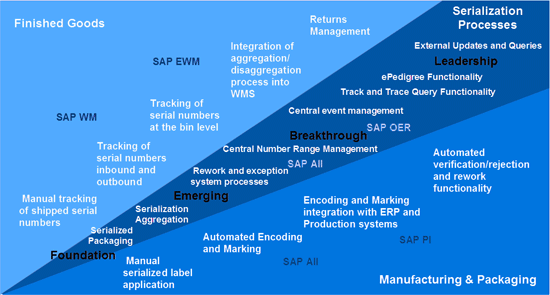
Figure 4
Levels of maturity in serialization
The Human Resource Factors
In addition to the technological challenges companies face when implementing serialization and track and trace functionality, there is a need to link the manufacturing process with the supply chain, since the manufacturing process exposes the individual unit at a point when serialization should be applied at the unit level. After the manufacturing and packaging process is complete, complex unpacking and repacking would be required to add the serialization at the unit level. It is important that business and IT work closely together to create a solution that works for both organizations. It avoids costly architecture and functionality mistakes.
Production teams are often comfortable with engaging vendors and building systems, and receive funding based on the production demand for a product or server. The IT department is often viewed as overhead, and the procurement cycle can be significantly longer than the “mission driven process” that for production is measured in days and weeks, and for IT can be measured in months and years. Table 1 shows the internal organizations that need to be involved with a serialization implementation effort.
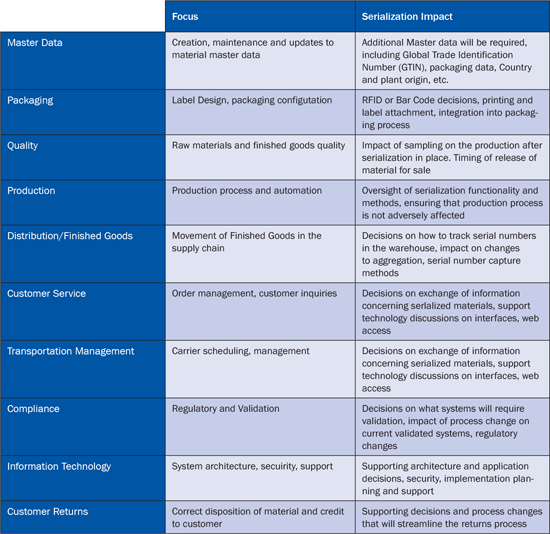
Table 1
Team responsibilities with serialization
Excluding any of the teams’ results is a less-than-comprehensive solution that likely requires more rework and duplication of effort in the future. If the teams cannot be assembled to address serialization in the required time frame, I recommend you limit the reach of serialization until the collaboration is possible.
Serialization cannot operate as a silo initiative or application. In order to benefit the enterprise beyond simple compliance and add business value to the organization, the implementation of serialization must touch and consider almost every point in the supply chain.
The key is to use business benefits beyond simple compliance. Track and trace is focused on supply chain visibility, and most organizations would benefit from this. There is more opportunity to respond to issues that affect customers, and even eliminate potential issues.
Compliance is not negotiable, so look for ways to use the serialization functionality and increase supply chain visibility.
Tim Craigmyle
Tim Craigmyle has been involved in supply chain systems for more than 15 years. He is serving as a senior managing consultant for IBM Global Business Services, an externally focused role assisting clients that are initiating supply chain improvements primarily in distribution and warehousing solutions to help solve their business challenges, focusing on the SAP Eco-system.
You may contact the author at tim.craigmyle@us.ibm.com.
If you have comments about this article or publication, or would like to submit an article idea, please contact the editor.