10 points illustrate the complexity and nature of German payroll and help you prepare for a successful rollout.
Key Concept
Unlike some US organizations, companies in Germany and many other European countries see payroll as a part of the HR module rather than the accounting department. This usually leads to a high level of integration between payroll and the rest of HR in processes and systems, which is why German companies consider running payroll on a separate third-party system a hassle. SAP standard offers payroll solutions for more than 35 countries, which you can customize with add-ons from SAP or third-party suppliers. Germany, often high on the list for an international SAP HR rollout, has one of the most mature country versions.
Payroll is often the most challenging part of any international rollout. This is particularly true for Germany with its well-structured, but very complex tax and social security legislation. Many people make false assumptions and run into brick walls. I’m going to take you through the fun parts of German payroll and help you avoid the most common mistakes that are likely to happen if you approach German payroll with little or no special expertise. To be fair, even people who know German payroll walk into some of these traps occasionally.
False Assumption 1: It’s just another payroll schema — it can’t be a big deal.
If this is the first international rollout you do, you’ll certainly be surprised at the myriad details you have to consider. I will not go into the details of global templates and local customization in this article, but my experience shows that workload and possible problems are usually underestimated (as are the potential benefits when it’s done properly, by the way).
However, even if this isn’t your first rollout, you may be surprised by the complexity of German payroll. Germany has more than 2,000 technical wage types, which is about double the number for the US. Most countries have between 300 and 600. Fully expanded, the German standard payroll schema D000 is more than 50,000 lines long, dwarfing all other schemas, such as Austria (6,000 lines), Canada (3,000 lines), and US (2,000 lines).
Although this may be due in part to the maturity of the German payroll solution in SAP, much of this complex solution can be attributed to the complexity of the matter itself. It is said that more than half of all the tax literature in the world is written in the German language and I am afraid that this might be the truth.
False Assumption 2: Well, surely our HR staff in Germany will know about all the specifics …
My experience from many projects in this regard was quite mixed. Some organizations have very well-trained payroll professionals with up-to-date knowledge. However, the downsizing of HR departments and the breathtaking speed of changes in legislation in recent years produced a situation in which many payroll teams, particularly in medium-sized subsidiaries of overseas companies, have significant gaps in their knowledge. So, be prepared to gather some of your information from the authorities, literature, and particularly the legacy system. In any case, it is a good idea for users who implement payroll to have some understanding of the statutory regulations in this field.
False Assumption 3: You must replicate the legacy system status quo in your SAP system.
Payroll processes in most German companies are much more complicated and diverse than they have to be. Use the opportunity to harmonize and streamline them as much as possible. All too often, complicated procedures are only maintained for individuals or very small groups. In these cases, it may be worth it to buy off some acquired rights to get a more efficient process. For example, if you have a legacy of many individual allowances and supplemental payments, perhaps it would be worthwhile to institute one basic salary even if it means that some individuals will be paid a little more than before. In other cases, a complicated process may have purely historical reasons such as obsolete regulations. However, start this process early enough and make sure that all the people affected are involved in the decision-making process.
False Assumption 4: Public sector? Not relevant to us!
Some industries such as construction and publishing have particularly difficult payroll regulations. The most important exemption in Germany from the normal regulations is the public sector, where you have to use a different schema (D100).
You may think that this doesn’t affect you because your German subsidiary does not belong to the public sector. However, public sector regulations often apply to employees from formerly government-owned organizations that have been privatized. Even if only some employees have transferred from a public sector employer to your subsidiary — because you perform certain tasks in a public-private partnership (PPP) or outsourcing agreement — public sector regulations may apply. So, just be aware that even though your organization belongs to the private sector you may still be affected by some public sector rules.
False Assumption 5: We don’t need workers’ representatives involvement — after all, the number on the bottom line of the payslip won’t change.
Works councils have very extensive rights in Germany. Even if the compensation doesn’t change there are plenty of issues that you have to discuss with them. They are particularly critical regarding reports, and you often depend on their approval. For example, the works council scrutinizes any report that could be perceived as monitoring of performance and behavior, such as looking for patterns in sickness-related absences. Many SAP HR projects are expected to deliver huge improvements in the area of reporting but fail to deliver the goals because the works council wasn’t properly involved.
It is always a good idea to check with your labor law experts about what rights the works council has regarding your project and to establish a trusting relationship through open communication and very early involvement. Then, they can help the progress of the project significantly — particularly when it comes to gaining the acceptance of the workforce for, say, an Employee Self-Service (ESS) system. Unlike unions, which are less important in Germany than in some other countries, works councils know the organization and are more interested in the well-being of the workforce than in some remote union policy.
False Assumption 6: There are no special infotypes for Germany or differences in fields and features.
Actually Germany does have several unique infotypes. Most country-specific infotypes are related to payroll, such as tax, social security, and garnishment. However, in addition to whole infotypes, internationally-used infotypes often have special fields or features. In these cases, SAP HR uses different dynpros for each country. A dynpro is the piece of software that determines the fields and layout of the screen as well as the functionality behind it. One example is infotype 0002 (personal data).
Figures 1 and 2 show several differences, such as the social security number (US only) and religion (German only). Less obvious differences are hidden in the program logic. For instance, the German version of infotype 0002 performs a check to make sure that the spelling of the name complies with the regulation of the DEUV (the automated data transfer to the social security authorities — a kind of e-filing).
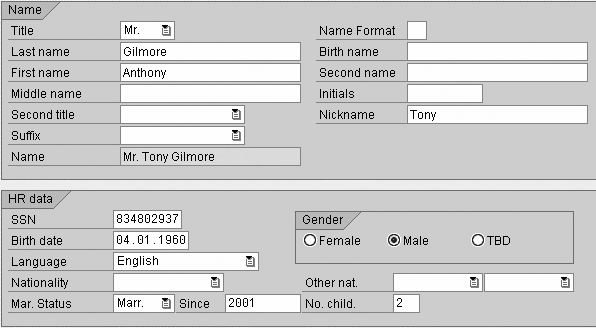
Figure 1
US version of infotype 0002

Figure 2
German version of infotype 0002
For your German rollout project, you should be familiar with specific infotypes (especially for the authorization concept) as well as infotypes that exist in all countries, but have different functionality or fields.
False Assumption 7: You should always implement the German pension module.
SAP HR supports German company pension schemes with a special module, integrated into payroll. This is a very sophisticated solution with a “pension database” and several infotypes:
- 0323 (entitlement group type)
- 0201 (basic pension payments)
- 0202 (entitlements)
- 0203 (pension/valuation status)
- 0263 (salary conversion [deferred compensation])
The system maintains the core data in infotype 0323, which also includes references to one or more entries of infotype 0202 (Figure 3).

Figure 3
Data required for external transfers
The major functions of the German pension solution are:
- Calculation and transfer of contributions
- Deferred compensation (option for self-service scenario)
- Administration of employer’s and employee’s contributions
- Posting into accounting
- Calculation of pension entitlements, including interest
- Information for employees (reports and ESS)
- Monitoring of waiting periods and forfeitability
- Reimbursement of forfeited entitlements
- Actuary interface
- Adjustment of pensions
- Statutory certificates
- Payments to pensioners or their surviving dependants
However, you may not need all this functionality and might be better off using infotype 0699 (pension provision act), which is much easier to use and customize. When talking about pension schemes, first check whether infotype 0699 fulfills your requirements and only turn to the pension schemes module if it doesn’t. This will save you a lot of effort.
In some cases, it may even be easier than that, because you only need some calculation in core payroll and a simple transfer of the resulting amount to a certain account. In this case, international infotype 0011 (external transfers) would do the trick. Infotype 0011 is fairly simple (Figure 4) and primarily includes a wage type, an amount, and the payee data. You probably use it in your country already.

Figure 4
Data required for external transfers
You may also be tempted to use infotype 0026 (company insurance) for a particular German concept called “Direktversicherung” (direct insurance), which you can use for pensions or other kinds of insurance. Don’t do it! This infotype may calculate tax-free contributions incorrectly and should be replaced by infotype 0699.
So, the important message here is to check requirements in detail before embarking on a potentially costly journey through the pension scheme module. An implementation of this module usually takes at least 10 workdays, but can easily take 100 or more. Before deciding to implement the pension scheme module, be sure to consider the alternatives mentioned above.
Note
In Germany, the term “versicherung” (insurance) encompasses all types of insurance, including car, health, and pension plan insurance.
False Assumption 8: Data conversion: We don’t need payroll results from the legacy system because we start on January 1.
In many countries, payroll results from previous years are not relevant as long as no wages based on averages have to be paid. However, German social security law includes a March clause, for which wage types from the previous year may be necessary to calculate contributions for bonus payments in January, February, or March.
Apart from this, you must track time accounts that originate from semi-retirement or include more then 275 hours until full retirement. This allows you to calculate contributions in case they are paid off early.
Both requirements mean that you have to transfer last year’s amounts for some wage types from the legacy system. Make sure you include this in your data conversion strategy.
False Assumption 9: We don’t have to worry about an interface from the Travel Management module because we don’t pay taxable travel expenses.
Of course, you must transfer reimbursements of travel expenses above the tax-free threshold to the payroll module to calculate taxes. However, as of 2005, German law also requires that you disclose all tax-free food allowances on the income tax card. This makes some kind of interface necessary between travel expenses and payroll. However, this process is not too complicated if you use SAP HR for payroll and travel expenses
False Assumption 10: Semi-retirement cannot differ much from normal part-time work.
Semi-retirement is arguably one of the most complicated parts of German payroll. To begin with, in most cases it doesn’t look like semi-retirement at all. The original idea was to work half-time for a certain period (say four years) before retirement, while receiving more than 50% of your salary due to federal subsidies (80% of the original net salary is quite common). However, most people choose the block model, in which they work two years full time and then stay at home for another two years while receiving the same level of subsidized salary.
What’s the point? Well, for the government it is a way to reduce unemployment, particularly because federal subsidies are paid only if the employer can prove that someone else has been hired as a result of the semi- retirement. For the employer, it is a way to cut down the workforce on a voluntary basis without severance payments (in this case, they may lose the government subsidies, but large organizations usually can make some connection between any new hire and the semi-retirement anyway).
While this may seem strange, it isn’t very complicated. What makes semi-retirement a confusing concept is that the calculation of gross pay isn’t simply a percentage of the original full-time payment. What is guaranteed to the employee is a percentage of the original net pay. You can only calculate this through a fictitious payroll run included in the normal payroll run. You calculate “top-ups” in this fictitious run:
- One to get to the legally guaranteed net pay level
- One to get to a net pay level guaranteed by the employer, if that goes beyond the legally guaranteed level
- One to top up the employer’s contributions to the public pension insurance
There are always discussions about how to account for special wage types, particularly for non-recurring payments and items such as company cars. Allow yourself enough time to define the requirements and to perform testing. Don’t feel safe just because there are only a few cases in your company — they still have to work properly. More often than not, these few cases include high-ranking managers with individual agreements beyond the normal scheme of your organization.
A real nuisance is the special treatment of social security contributions in case the employee leaves the company during semi-retirement in a block model. In this case (a “Stoerfall” or disturbance), the employee has worked for some time at a reduced salary without getting the full payoff and the employer has to reimburse those earnings. The way social security contributions in Germany work (they are capped at a certain amount per year), make it likely that this means fewer contributions are paid than would be with an evenly spread salary. Therefore, the system has to perform a calculation to ensure that contributions are paid as if the salary had been spread out evenly.
Any More Complications?
Certainly there are some other interesting points. Most notable are other cases using the concept of fictitious payroll runs inside the normal payroll run — for example, an employer’s allowance to top up government maternity pay.
After reading this article, you may lose confidence in a payroll rollout to your German subsidiary. However, two particular points will help you to achieve a successful rollout:
- German payroll is one of the most mature components in SAP HR. Thousands of customers and a long history guarantee a very broad coverage of statutory and even industry-specific requirements.
- Being the motherland of SAP software, there is a strong skill base of experts in large and small consultancies as well as in organizations. Although you can find very experienced SAP HR consultants in many countries, you probably won’t find them on such a broad basis as you do in Germany.
So, if you consider the recommendations of this article and approach the project systematically, you should be able to implement payroll in your German subsidiary successfully and at a reasonable cost. To celebrate your success after the project, I recommend a couple of good German beers in a traditional “Biergarten” (beer garden).
Sven Ringling
Sven Ringling is executive director at iProCon (www.iprocon.de) and iProCon Human Capital Management (www.iproconhcm.co.uk). He started working as an SAP HCM consultant in 1996 and also works in strategic HR and change management. He is one of the authors of the books Mastering HR Management with SAP and HR Personnel Planning and Development Using SAP.
You may contact the author at s.ringling@iproconhcm.co.uk.
If you have comments about this article or publication, or would like to submit an article idea, please contact the editor.